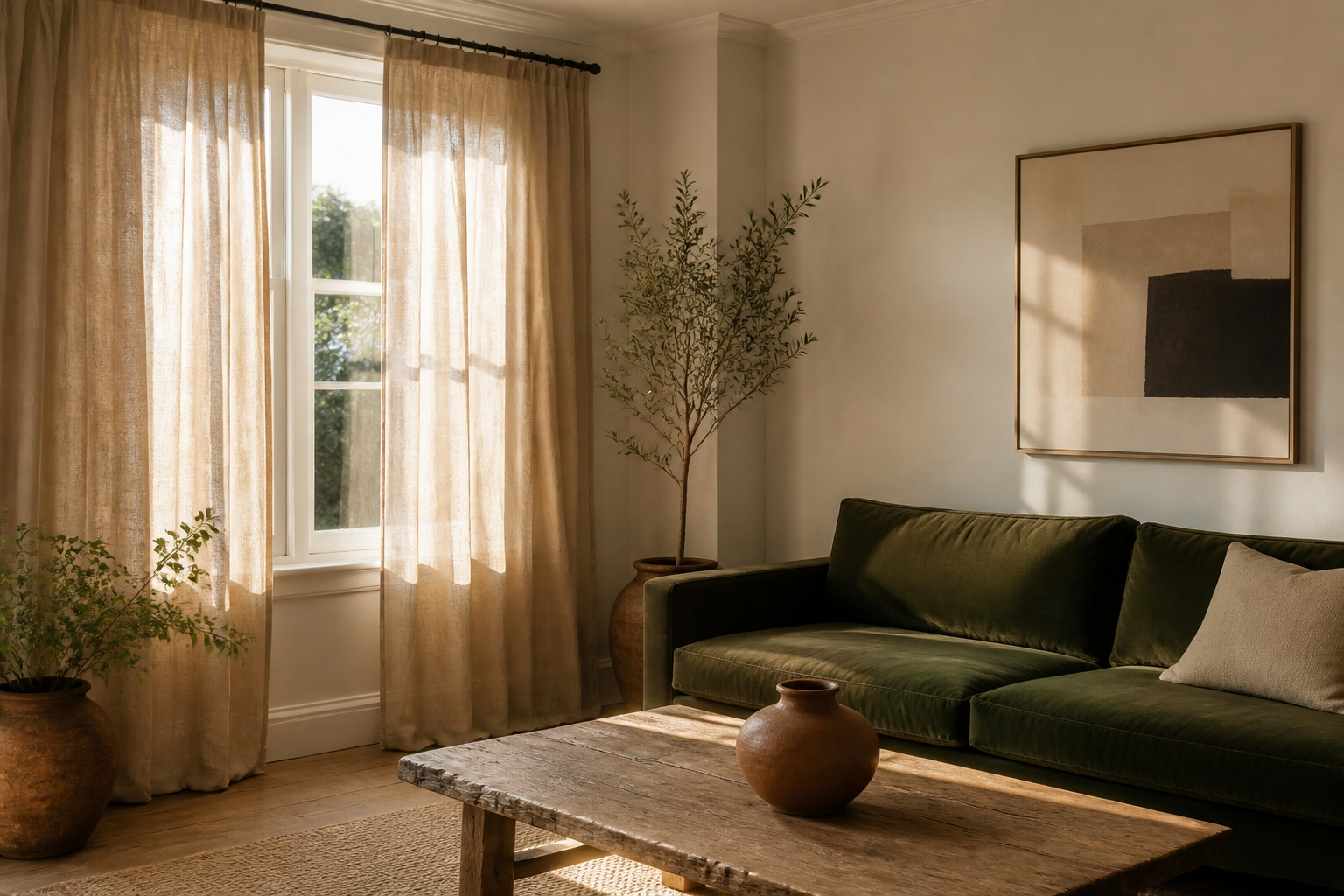
The right living room window treatment depends on whether you need insulation, blackout darkness, or just something to stop the afternoon glare from killing your television.
Most people pick drapery for softness and end up with lightweight linen that looks romantic at noon and useless by six, when every neighbor’s porch light lands on the couch.
A medium-weight cotton or lined weave fixes that, and the pleat style you choose changes the whole posture of the room before a single guest sits down.
1. Drapery
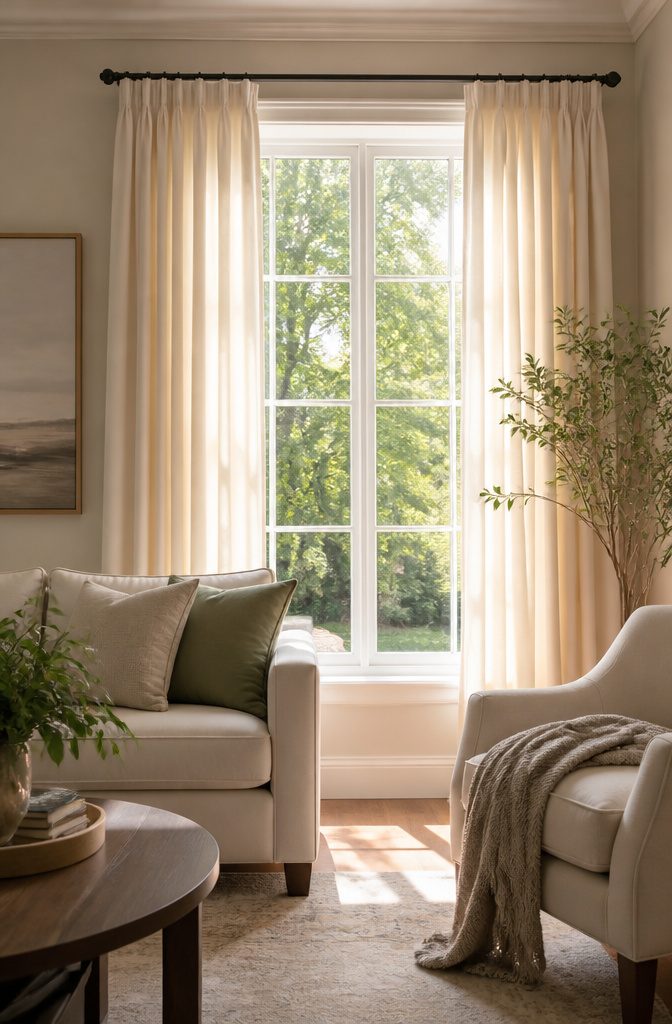
Drapery still does what nothing else in this section quite manages: it brings actual softness into a room full of hard edges.
The fabric catches light differently than any shade, and when you stand panels at either side of a large window or a sliding door, they frame the glass like a finished edge on a photograph.
Weight matters more than most people expect. A lightweight linen looks romantic at noon and useless by six, when every neighbor’s porch light lands on your couch.
Medium-weight cotton or a lined weave gives you the dimming you actually need for a living room you use after work.
For anyone sleeping in the same open plan, a blackout lining is the difference between drapery that decorates and drapery that works.
Pleat style changes the whole posture of the room.
A pinch pleat reads tailored; a ripple fold reads relaxed. I spent an afternoon in a friend’s place where she had chosen inverted box pleats for a 12-foot span, and the panels looked upholstered even when drawn.
The hardware carried weight she hadn’t anticipated, though, and opening them required two hands every time. If you open and close daily, a simpler header and a smooth rod beat the dramatic stack.
The most important factors are function, fabric, and fit. Once you determine what a window needs, that naturally guides you toward the most suitable fabric options.
That order, function first, saves you from the common mistake of falling for a pattern and discovering it performs wrong for your wall.
Off-the-shelf panels can work if you bring them to a tailor for length and width; custom is the gold standard, but the price difference is steep enough that most renters I know mix the two, saving the splurge for the one window that faces the street.

STANDARD MADE: Curtains are sold per pair. Each pack contains 2 blackout functional curtain panels. Each panel measures 52" W x 84" L | Pair measures 104"W x 84"L. Thread trimmed and wrinkle free, each piece is constructed with 8 anti rust grommets which fit well up to 1 1/2 inches curtain rods for effortlessly installation and sliding

MULTIPLE HANGING: Sold per pair, including 2 window panels - Panel measures: 52 x 84 - inches | Set measures: 104 x 84 - inches, with 3 curtain top hanging options (Back tab & Rod pocket & Pleated) for your personalized style. Each panel sewn with 4" rod pocket (7 back loops), 2" bottom hem and 0.8" side hem, specialized fitting the curtain rods up to 3

100% Blackout & Privacy: With a dual-layer, heavy-duty design, these curtains block 100% of sunlight and UV rays, providing complete darkness and privacy. Ideal for bedrooms, nurseries, and home offices that need a peaceful, undisturbed environment
2. Woven Wood Shades
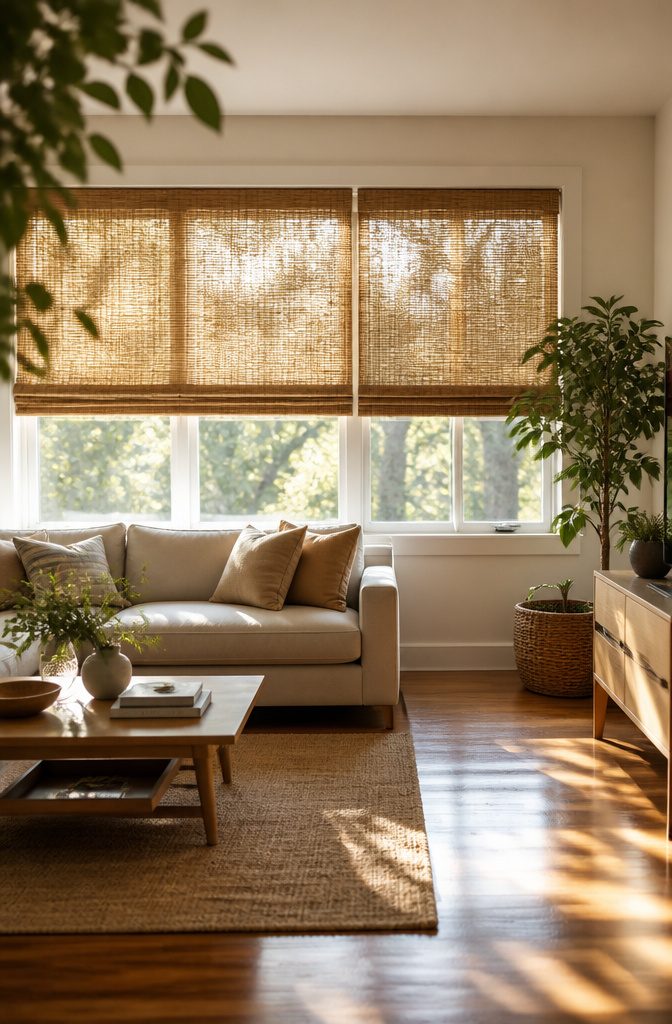
Woven wood shades bring a warmth that painted finishes struggle to fake. The natural grain and slight color variation from slat to slat make a living room feel grounded without trying too hard for "organic" style.
Light filters through in a way that depends entirely on the weave you pick.
A loose bamboo or grass weave throws soft stripes across the floor and keeps some connection to whatever is outside. Tighter weaves, like matchstick or certain reeds, trade that openness for real privacy after dark.
I spent an afternoon holding samples up to a west-facing window before I understood the difference; the loosest one looked beautiful at noon and let the neighbor’s porch light straight in at eight.
The material itself is the selling point and the maintenance reality. Dust settles into the texture more than it would on a flat surface, so a vacuum with a brush attachment is non-negotiable every few weeks.
Spills are worse. A damp cloth can leave water stains on unfinished fibers, so spot-cleaning with as little moisture as possible is the safer call.
Durability is solid for normal use, but cats who treat window coverings as climbing gyms will fray the edges faster than vinyl would allow.
For renters, the inside-mount versions install with two brackets and leave no more trace than a mini-blind would. The natural tone works with most wall colors, which matters when you are not painting.

Material & Comfort: Made with 60% cotton and 40% polyester, this zip up sweatshirt is soft and cozy. Its fleece lining adds warmth without extra bulk for all-day wear

How To Hang: Our header allows you to hang 3 ways. Curtain panels can be sheered on a rod using the pocket, Hang with back tabs Or attached to rings using the belt and drapery pins. Pole Pocket will accommodate a pole up to 1.5 inches, Hooks Not Included.

100% COTTON OUTER COMFORT – Crafted from breathable 100% cotton shell and 100% polyester lining, this womens maxi skirt feels soft against the skin while providing lightweight comfort throughout the day. The natural fabric promotes airflow and keeps you feeling fresh during warm weather, making it a must-have for summer wardrobes
3. Cellular Shades
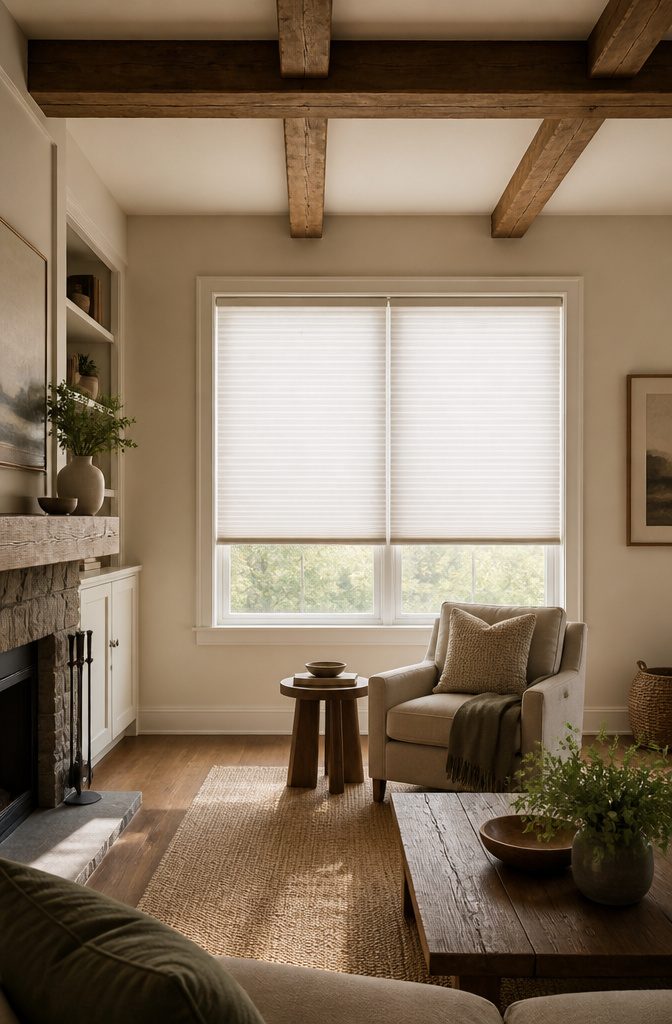
Cellular shades earned their place in my living room after a winter of watching heat leak past the glass.
The honeycomb construction traps air in distinct pockets, and that trapped air works as insulation you can actually feel when you stand near the window.
Blackout fabric or sheer, the cells still do that job, so the light control choice becomes a separate question of whether you want to block a streetlamp at night or soften afternoon sun without losing the view.
Privacy after dark is where these outperform anything with slats or gaps. The fabric runs edge to edge, and when the shade is down, the room stays yours alone.
The pleated cells collapse into a slim stack at the top of the frame, which keeps the look clean enough for modern spaces but not so stark that it fights transitional furniture.
Cordless operation is the version that makes sense for a living room you actually use. Cords tangle in throws and vacuum attachments; cordless lifts tuck the mechanism into the headrail and leave nothing to snag.
The insulation value varies with cell size and how many layers you choose, but even a single-cell shade changes how that wall behaves in July and January.

🛒【Custom Design Fabric】To reduce budget while keeping the linen/cotton organic characteristics,Designer makes this stone-washed ultra soft yet linen look blended fabric - 20% cotton,20 linen,60% polyester.It drapes well,medium thick,airy and breathable in hot summer.Each package includes 2 panels of pinch pleated curtain with 18 hooks,measuring 40"Wx84"L each panel.

PINCH PLEATED DESIGN: Curtains top features 1.5 times length fabric design for an elegant pleated effect. Perfectly presenting a sense of stereoscopic and layering. Whether in living room, bedroom, dining room or sliding door etc, it fit perfectly into a variety of room decor style

Thick Linen Blend: These natural linen blend curtains are woven from premium linen, cotton and polyester, retaining linen’s organic charm while boasting polyester's durability. This unique fabric composition delivers rich linen texture, excellent airiness and soft light filtering, bringing a cozy, comfortable vibe to rooms in modern, classic, coastal, farmhouse, neutral or traditional decor
4. Roman Shades
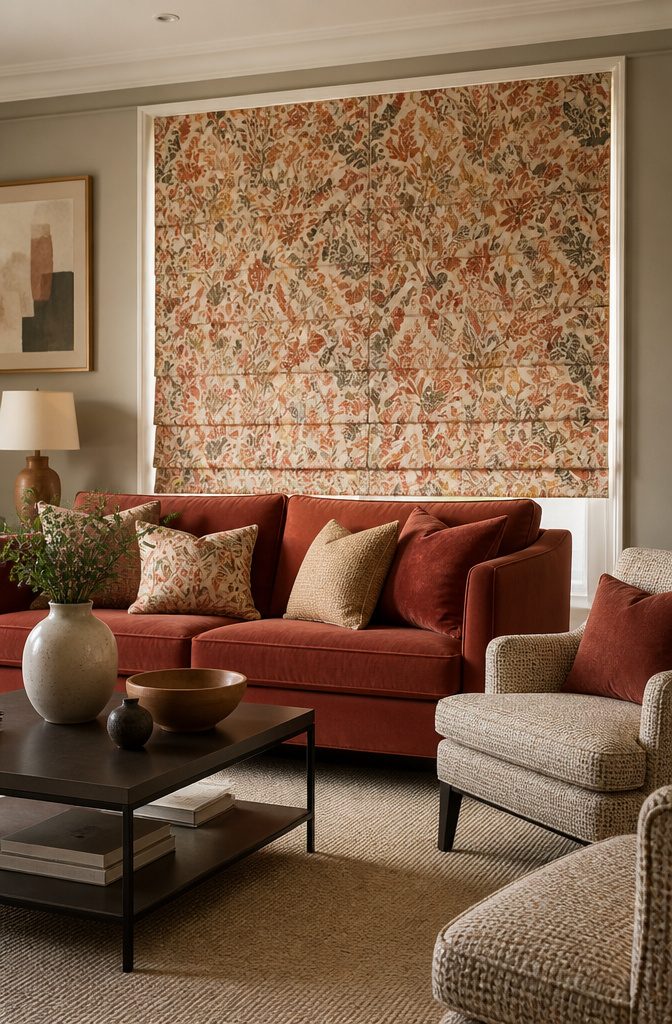
Roman shades give a living room the tailored finish that makes a window feel intentional, not like an afterthought.
The fabric options run wide enough to match a sofa or pull in a pattern from elsewhere in the room, and the structured folds stack neatly rather than pooling on the floor.
Light control comes down to the lining. A standard lining diffuses glare and protects furniture from UV fading; a blackout lining blocks light entirely when the shade is fully lowered.
Privacy works the same way. Because roman shades are one continuous piece of fabric with no gaps, they seal off the view completely when down.
The fold style changes the look more than people expect.
A flat fold stays sleek and modern, almost architectural. A relaxed fold, with its slight curve at the bottom, reads more traditional and softens the lines of a large window.
What convinced me, reading through a dozen of these projects, is how much the stack height matters when the shade is raised.
A thick fabric with a relaxed fold eats six to eight inches of window glass at the top; plan for that when you have trim or a view you want to keep visible.
Operation smoothness varies by hardware.
A cord lock or continuous cord loop feels precise; motorized options remove the cords entirely. The tradeoff is cost and whether you want one more remote to keep track of.

REAL WOVEN BAMBOO CONSTRUCTION: Authentic natural bamboo fibers create a warm, textured roman shade with genuine tonal variation in every panel. Adds organic texture to modern organic, boho, coastal, farmhouse, and rustic rooms at an everyday price.

PLEASE REFRESH YOUR PAGE if all fabric swatch options are not showing. We've recently updated our listing to offer all sizes in one convenient place! Simply select from our most popular materials and click the yellow "Customize Now" button to customize your shades from 20"–72" wide and 24"–72" high. PLEASE NOTE: Extended handling times are currently in effect due to backorders on shades measuring 31"–36" and 61"–72" wide. All other widths have normal production time.
REAL WOVEN BAMBOO CONSTRUCTION: Authentic natural bamboo fibers create a warm, textured roman shade with genuine tonal variation in every panel. Adds organic texture to modern organic, boho, coastal, farmhouse, and rustic rooms at an everyday price.
5. Roller Shades
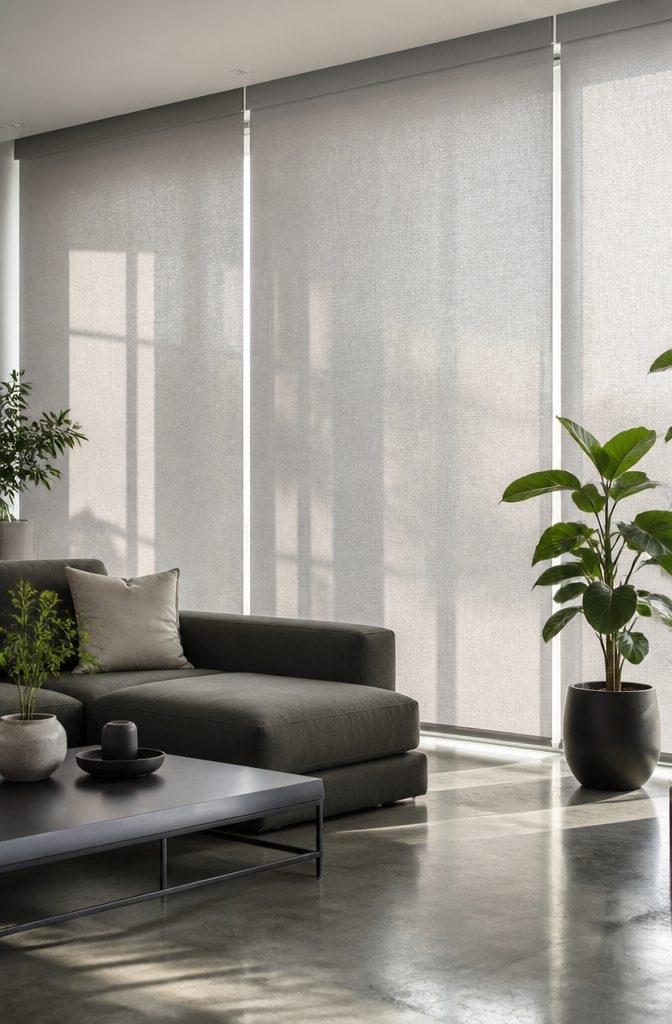
Roller shades bring the most options to a living room without adding visual weight.
Fabric choices run from barely-there sheers to full blackout, so the same hardware can handle a south-facing TV wall or a street-level window where privacy matters more than light.
The clean, flat profile works especially well in contemporary spaces where curtains would feel like an afterthought.
No folds, no stack, no hardware showing above the casing. Just a straight line at the sill or the floor.
Motorization fits natively here, too.
Roller mechanisms were built for it from the start, unlike retrofitting motors onto older shade types. If you’re already running smart home routines, this is the treatment that plays nicest with automation.
Color and pattern range is where roller shades really distance themselves from basic blinds. Sources carry solids, textures, and prints that read as intentional design, not mere coverage.
A textured roller fabric adds warmth without the softness tipping into traditional territory, which is the sweet spot for renters who want personality they can take with them.
The tradeoff is adjustability.
Most roller shades offer up or down, maybe a stop in between if you manually set it. You don’t get the incremental light control of slatted blinds unless you layer, and half-open leaves the bottom third exposed.
For rooms where you want full sunlight at 3 PM and full privacy by 6 PM, pair them with a secondary treatment or accept the two-position compromise.
REAL WOVEN BAMBOO CONSTRUCTION: Authentic natural bamboo fibers create a warm, textured roman shade with genuine tonal variation in every panel. Adds organic texture to modern organic, boho, coastal, farmhouse, and rustic rooms at an everyday price.

Vintage Bamboo Look: These bamboo blinds for windows use natural woven bamboo to create a warm decorative accent for indoor rooms and covered outdoor spaces

Important Inside Mount Measuring Instructions: This bamboo shade is the exact size you order - no deductions are made. Measure the width across the top, middle, and bottom of window. Ensure your window measures 34.25" - 35" wide for a 34" wide bamboo shade. This allows proper fit with minimal light gaps.See our images for a simple guide to measuring to get the ideal fit and coverage for your windows.
6. Vertical Blinds
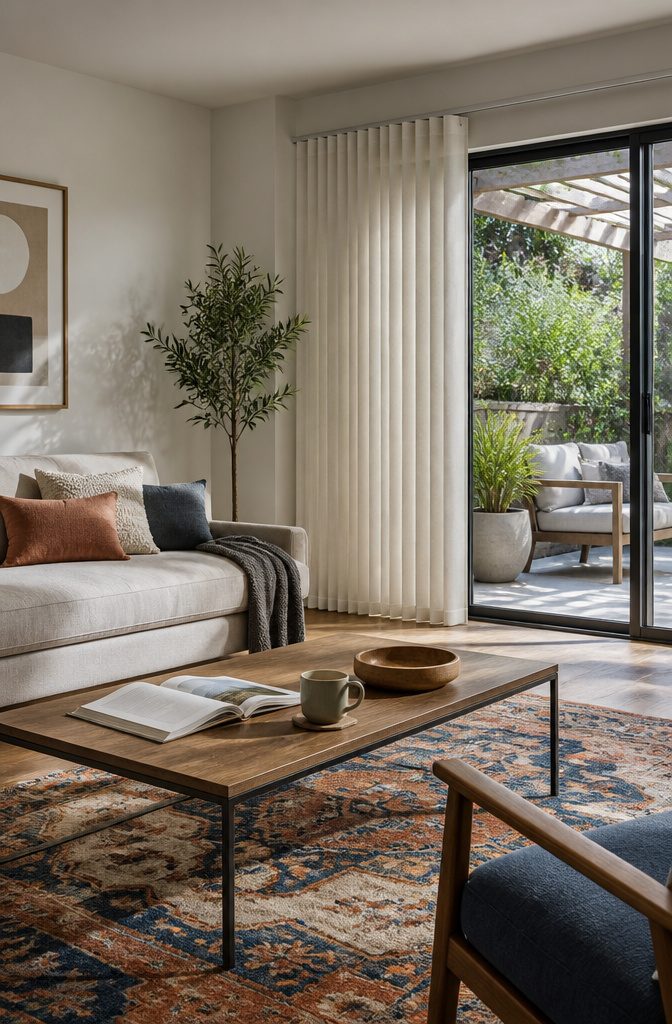
Vertical blinds are built for the oversized openings that make living rooms feel generous but hard to dress.
A wall of glass over a sofa, a slider that opens to a patio: standard shades top out, and curtains swallow too much wall.
Vertical blinds cover that span without custom fabrication, and the vanes rotate on their axis to let you set the exact angle between full sun and closed privacy, not just open or shut.
The stack direction matters more than people notice. Slide them all to the left, all to the right, or split and meet in the middle depending on where your traffic moves and what furniture sits beneath.
Individual vanes clip in and out, so a cracked slat from the dog or a bent one from the kid’s ball means replacing a single piece, not the whole treatment.
Style has been the honest weakness.
Older generations read office park or dated rental. Newer options in faux wood or fabric-softened vanes close that gap, and brands like Norman have pushed toward softer architectural lines with products such as SmartDrape.
Still, if your living room leans traditional or layered, vertical blinds may fight the mood even in their updated forms. For modern or transitional spaces with sliders, they earn their place on function alone.

Ready-Made Full Blackout Curtain Set:This package includes two pinch pleated blackout curtain panels (40"W x 102"L each) and 18 hooks. Each panel features 7 permanent pinch pleats and a weighted bottom hem for a polished, full-bodied drape. Independently tested—"No Detected Formaldehyde" in both the natural linen-blend fabric and blackout lining, safe for your home.

STANDARD MADE: Curtains are sold per pair. Each pack contains 2 blackout functional curtain panels. Each panel measures 42" W x 84" L | Pair measures 84"W x 84"L. Thread trimmed and wrinkle free, each piece is constructed with 6 anti rust grommets which fit well up to 1 1/2 inches curtain rods for effortlessly installation and sliding

Double Layer 100% Blackout Curtains: Our 100% blackout curtains feature a thick linen textured fabric and a 100% blackout liner. Fully blocks sunlight and UV rays. 450GSM thick material adds a premium texture, not only creates a private space for undisturbed sleep or relaxation but also provides thermal insulation - keeping the room cool in summer and warm in winter
7. Solar Shades
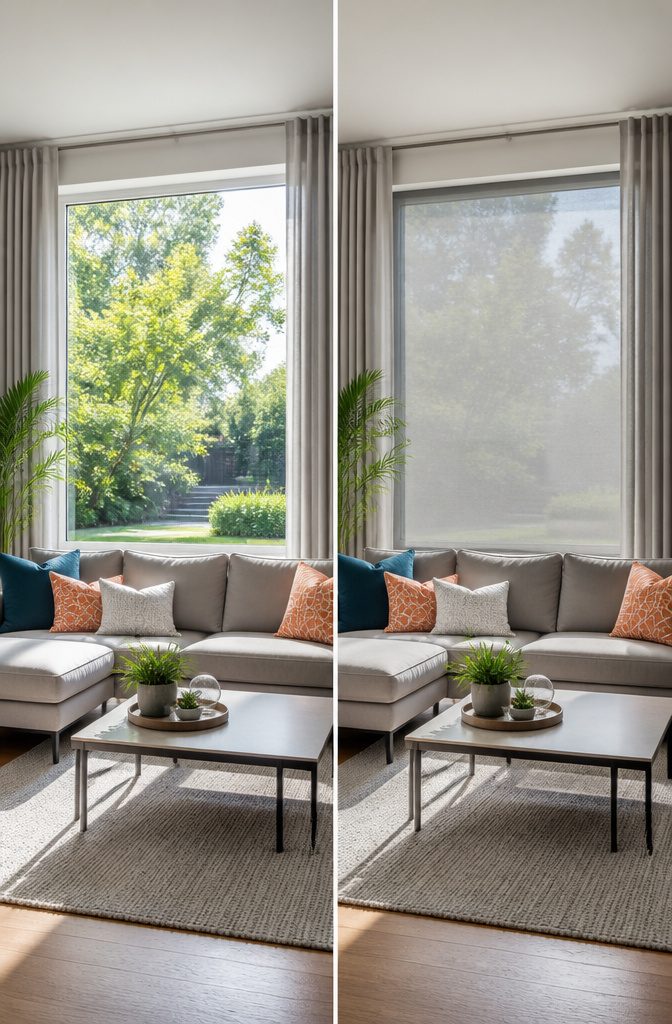
Solar shades let you keep the view while cutting the UV that fades sofas and floors. The fabric comes in openness percentages, usually 1% to 10%, and that number matters more than the color.
A 5% openness still shows plenty of the backyard but blocks enough glare to stop the television from turning into a mirror by mid-afternoon. Drop to 1% and you lose some of that view for heavier heat control.
Daytime privacy is almost automatic with any option; the weave faces the street but keeps the interior dim enough to prevent clear sight in.
After dark the effect reverses, so plan on a secondary layer if your living room faces a sidewalk and you want to move around with the lights on.
Stylistically this is the treatment that reads as nothing at all. The hardware hides inside the frame, the fabric rolls tight to the header, and the whole thing disappears when you want it to.
For renters who cannot replace dated vertical blinds, a tension-mounted solar shade slips in without drilling the casing and leaves no trace at move-out.
Glare reduction is where my own research got interesting.
One installer pointed out that south-facing rooms in older buildings often need the shade mounted outside the recess to catch the sun before it hits the glass, which changes the clean look entirely.
That tradeoff, between minimalism and actual function, is worth deciding before you order.

【NO DRILLING & INSTALLATION】 NICEEC magnetic wooden ball curtain ties for drapes use a simple and elegant Bohemian creative design.You only need to open the magnetic curtain holder and buckle the curtains to achieve the function of fixing the curtains. You do not need to use tools or drill holes on the wall, so magnetic curtain tiebacks for drapes will not damage the wall, and you don’t need to worry about the extra curtain hooks hurting the child

[SMOOTH FLEECE] Upgrade your outerwear with this chic plus size zip up hoodie for women. Crafted from a high-density, lightly fleece-lined fabric, it offers a premium, structured feel that naturally smooths your silhouette. Experience cozy warmth and a luxurious drape without the bulky or clingy look of basic hoodies

Soft Lightweight Fabric: Made of 65% Polyester, 30% Cotton, and 5% Elastane, this women's oversized sweatshirt features a soft, breathable feel with gentle stretch for comfortable everyday movement. Lightweight and not fleece-lined, it is perfect for easy fall layering
8. Sheer Shades
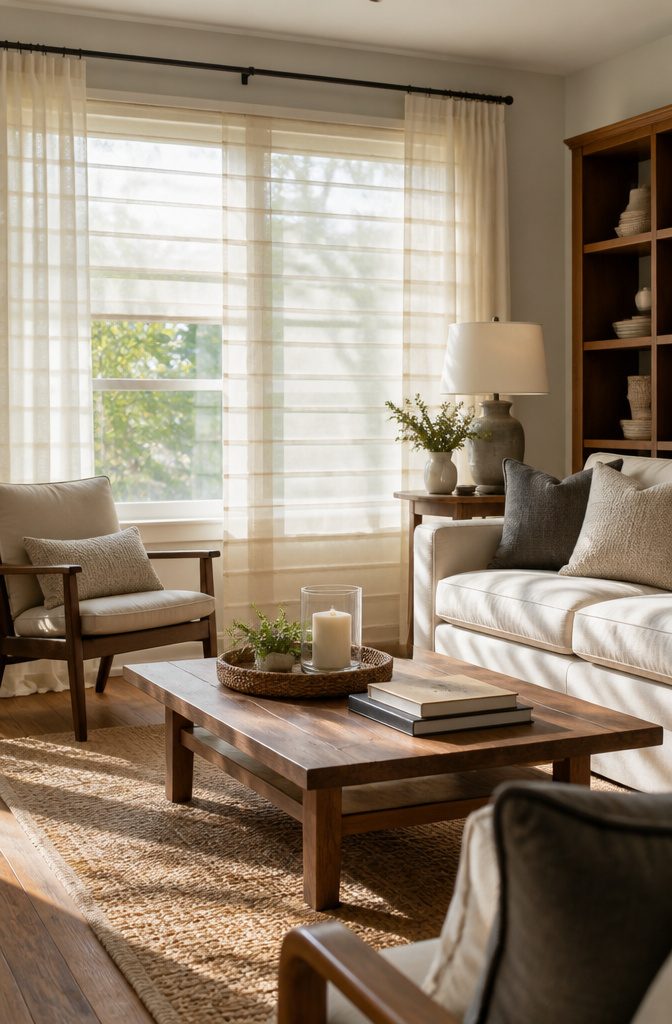
Sheer shades were the first upgrade I made in my own living room after realizing the west-facing windows turned the space into a fishbowl by four o’clock.
The layered construction, fabric vanes suspended between two sheer panels, diffuses sunlight into something usable rather than blinding, and during daylight hours you get privacy without the cave effect of drawn curtains.
For traditional or transitional rooms, the softness reads as elegance rather than minimalism. The fabric vanes tilt closed when you want to block the view, open to let light wash through, or settle somewhere between.
Unlike blackout options, sheer shades keep the room connected to the time of day, which matters more than I expected for how a space actually feels to live in.
The tradeoff comes after sunset. Once interior lights go on, the sheers become translucent from outside and the vanes need to close fully for privacy.
In a room used mostly during the day, this is rarely an issue. For evening-heavy spaces, they pair cleanly with side drapes on a double rod, though that adds the cost and hardware the shade alone avoids.
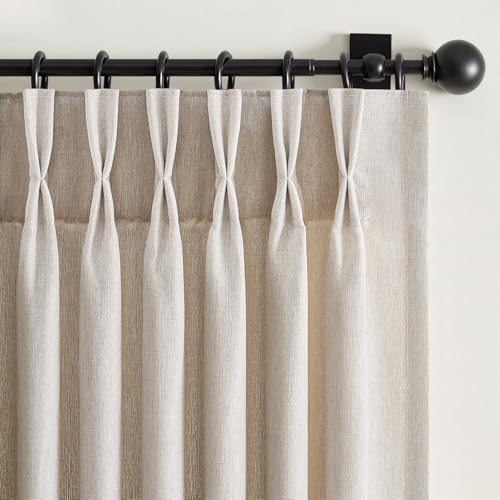
Pinch Pleat Design:Each curtain panel features 7 pinch pleats,creating a vintage and elegant ambiance.The pleats are not easy to deform,and have both softness and natural beauty.We provide a variety of different colors and sizes.The criss-cross linen texture also adds a touch of sophistication.

Upgraded Triple Pleat Design: Featuring a structured triple pleat construction for a fuller, more dimensional look. Compared with double pleat curtains, triple pleats use more fabric and feature an additional fold at each pleat, creating richer texture and a more defined silhouette. The enhanced structure delivers a tailored drape with a refined, luxurious, designer-inspired finish
9. Motorized Drapery
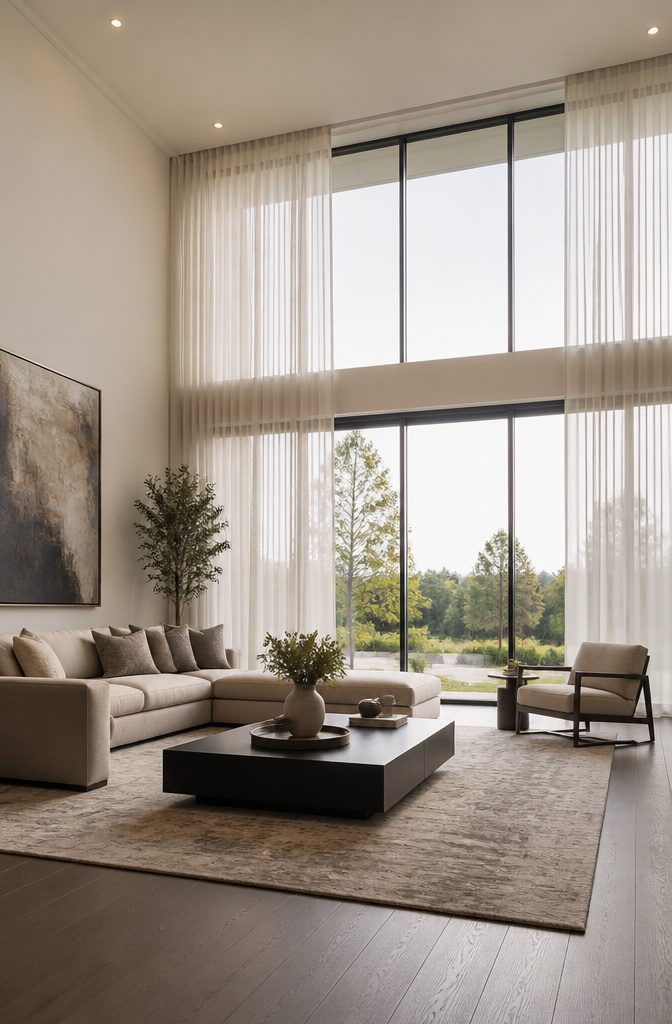
Motorized drapery solves the one problem traditional curtains never could: windows you cannot physically reach.
In my last apartment, the living room had a double-height wall of glass that looked dramatic until 6 p.m., when climbing a step stool to close curtains became a nightly ritual I abandoned within a week.
Battery-powered tracks changed that entirely, and the hardware itself hides inside the header so the technology disappears into the room.
Programmability matters more than the motor itself. Setting the drapes to close at sunset and reopen at your alarm time means privacy and light control happen without your thumb on a remote.
The sources split on power: Norman’s PerfectTilt system runs wired with a Smart Dial remote, while battery options suit rentals where you cannot open walls.
Smart home integration lets phone scheduling replace both, though I would not pay extra for voice control you will use twice and forget.
The mistake is treating motorized drapery as a luxury add-on rather than a functional solution.
For standard eight-foot windows, manual hardware wins on price and reliability. For anything over ten feet or behind furniture, motorization stops being indulgent and starts being the only practical choice.

100% Natural Bamboo: Our bamboo blinds are made of 100% premium bamboo material with a simple and elegant appearance. Effectively block harmful UV rays and offer semi private light control. Bamboo shades are suitable for a variety of decorative styles, bringing freshness and vitality to your room
REAL WOVEN BAMBOO CONSTRUCTION: Authentic natural bamboo fibers create a warm, textured roman shade with genuine tonal variation in every panel. Adds organic texture to modern organic, boho, coastal, farmhouse, and rustic rooms at an everyday price.

REAL WOVEN BAMBOO CONSTRUCTION: Authentic natural bamboo fibers create a warm, textured roman shade with genuine tonal variation in every panel. Adds organic texture to modern organic, boho, coastal, farmhouse, and rustic rooms at an everyday price.
Layering Treatments
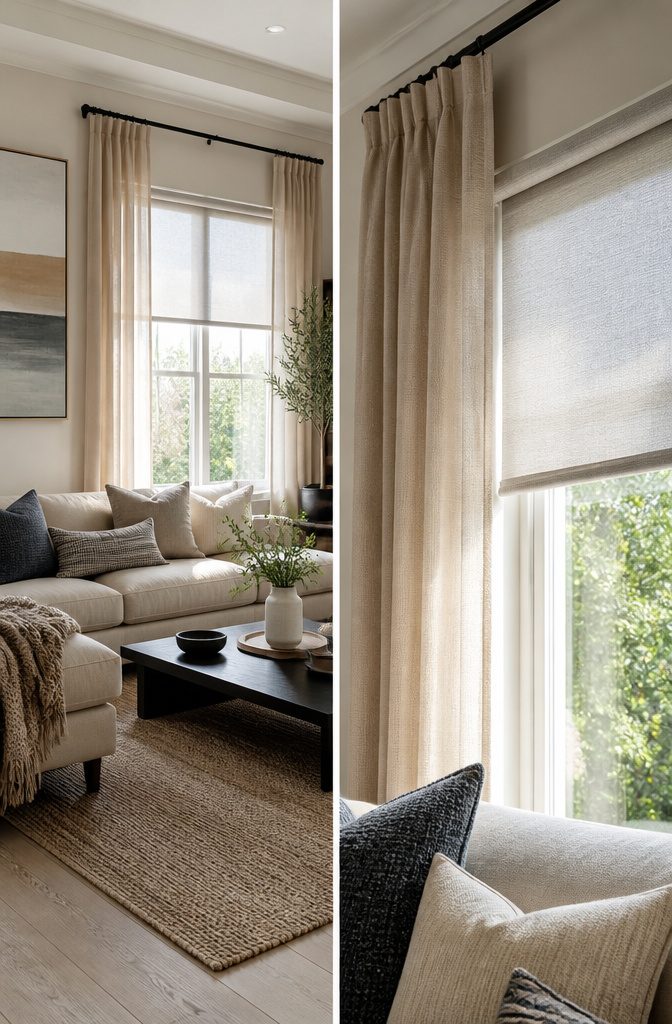
Layering window treatments is where a living room stops looking like you picked one thing off a shelf and starts looking like someone lives there.
The practical reason to do it is that no single layer handles both light and privacy well enough for a room you actually use.
A blind or shade can block the view at night, but raise it for morning sun and you are fully exposed.
Sheers soften glare but do not block sightlines. Pair them, and the sheers stay fixed while the blind moves.
The combinations that work are straightforward. Roman shades or roller shades behind drapery give you blackout when you need it and softness when you do not.
Blinds with sheer curtains let you tilt slats for daylight privacy without closing the room off entirely. Cellular shades layered with heavier panels add insulation through the fabric stack at the sides.
What separates a layered look from a cluttered one is the hardware: a single rod system that holds both layers, or at least rods mounted at the same height so the eye reads one header, not two competing lines.
Cost runs higher than a single treatment, but not double. You are buying two sets of fabric or material for the same window count, so budget for the nicer hardware rather than cutting corners on both layers.
The mistake I see most is mounting the drapery rod too low, which visually shortens the wall and traps the shade awkwardly inside the frame.
Mount high, let the drapery clear the shade entirely when open, and the window reads larger than it is.
REAL WOVEN BAMBOO CONSTRUCTION: Authentic natural bamboo fibers create a warm, textured roman shade with genuine tonal variation in every panel. Adds organic texture to modern organic, boho, coastal, farmhouse, and rustic rooms at an everyday price.
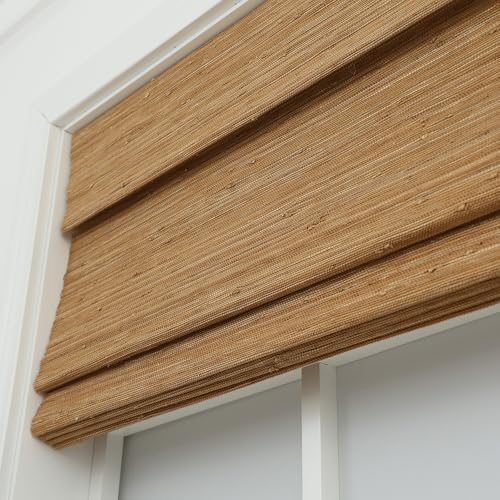
① Organic Beauty: Crafted meticulously by hand from 100% natural jute, our window blind features a soothing ‘Serene Sand’ hue. This elegant earthy color simplifies your space, cutting through visual noise to introduce a sense of peaceful, organic modernity. Transform your room into a calming retreat with this perfectly neutral shade.
Important Inside Mount Measuring Instructions: This bamboo shade is the exact size you order - no deductions are made. Measure the width across the top, middle, and bottom of window. Ensure your window measures 30.25" - 31" wide for a 30" wide bamboo shade. This allows proper fit with minimal light gaps.See our images for a simple guide to measuring to get the ideal fit and coverage for your windows.
Specialty Windows
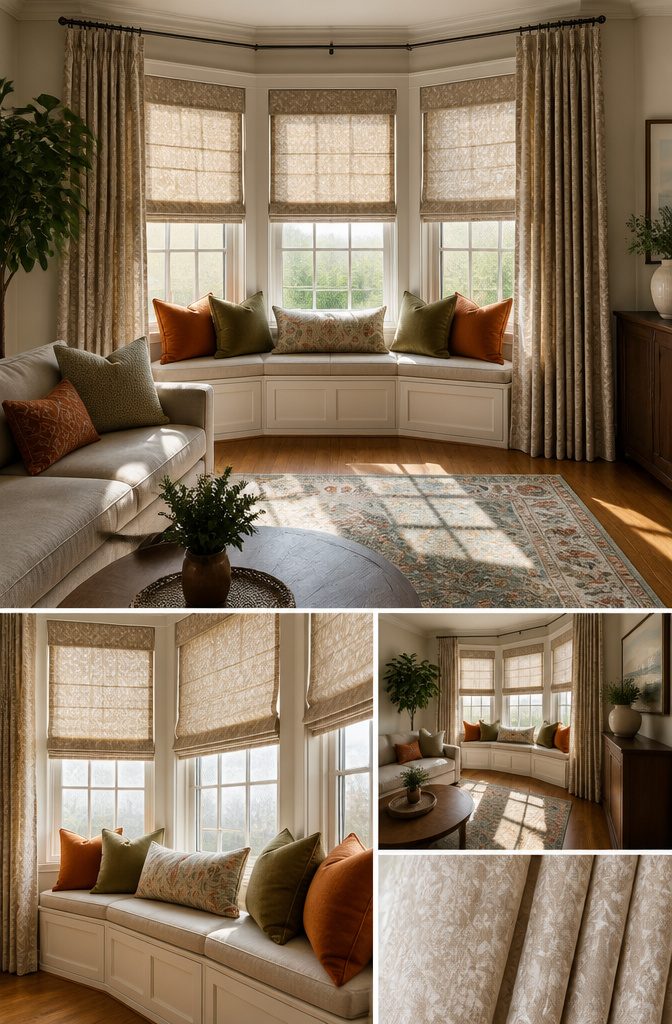
Standard treatments fail on bay and arched windows because the geometry never cooperates.
A straight rod across a bay window leaves triangular gaps at the angles, and an arched top with an off-the-shelf rectangle either covers the curve or floats below it.
Custom shutters solve the bay problem by fitting each panel to its own angle, while honeycomb shades contour to arched or tall openings without looking like an afterthought.
Light control gets tricky in these shapes because the sun enters from multiple angles through the day. Bay windows collect glare from three directions, and arched tops throw afternoon light onto the ceiling in ways a standard shade cannot block.
Privacy matters too; the angled panes of a bay can expose seating areas to the street from directions a single curtain panel does not cover.
Measurement is where most DIY attempts on specialty windows fall apart.
The angles in a bay need to be taken wall-to-wall at each joint, not guessed from the center point. Arches require a template of the curve itself, and the tolerance for error is slim.
Professional measurement becomes necessary when the window shape is anything other than flat and rectangular, because the cost of a mis-cut custom piece is the same whether the fit is close or completely wrong.
Blinds or Curtains
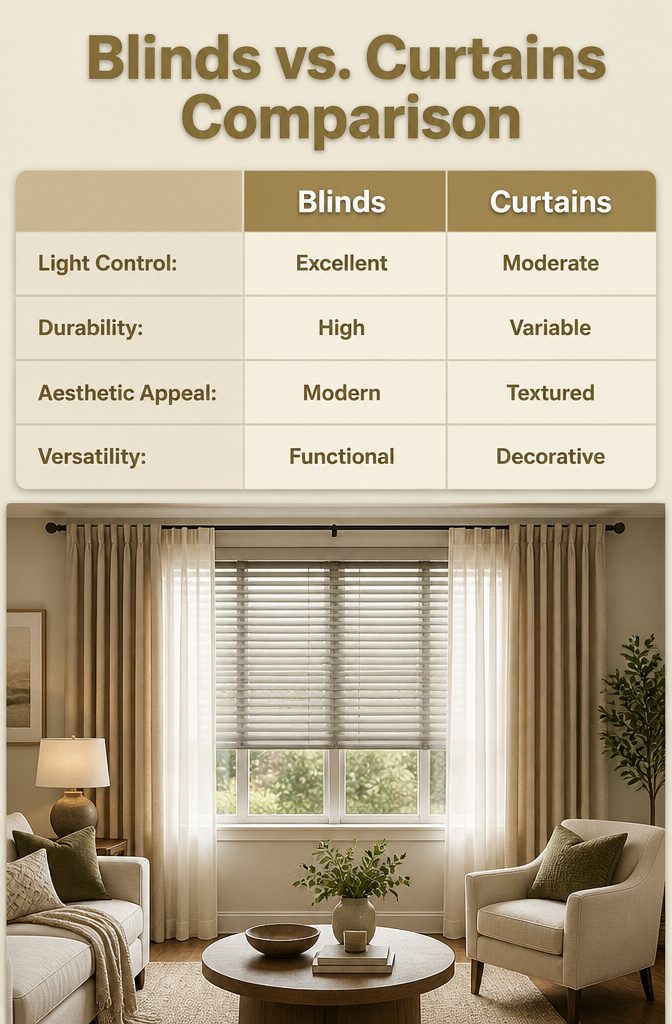
Blinds give you the kind of light control curtains simply cannot match.
Horizontal or vertical slats rotate open, closed, and everywhere between, so you dial in exactly how much afternoon sun hits your screen or how much of the street view your neighbor gets at dusk.
Aluminum or wood blinds handle that wear-and-tear well in a high-traffic living room.
Curtains, though, add what blinds never will: softness, texture, and the visual height that makes a modest ceiling feel intentional.
A sheer layer filters glare without turning the room into a cave, and heavier fabrics frame a large window or slider with something blinds alone would leave looking utilitarian.
The move that usually wins is both together: blinds or shades behind for daily privacy and light management, curtains in front for the finished look.
You get the flexibility of tilting slats at 3 p.m. and the softness of drawn panels by evening. Renters especially benefit, since the curtain rod holes are easier to patch than a full blind mount when the lease ends.
Small Living Room Treatments
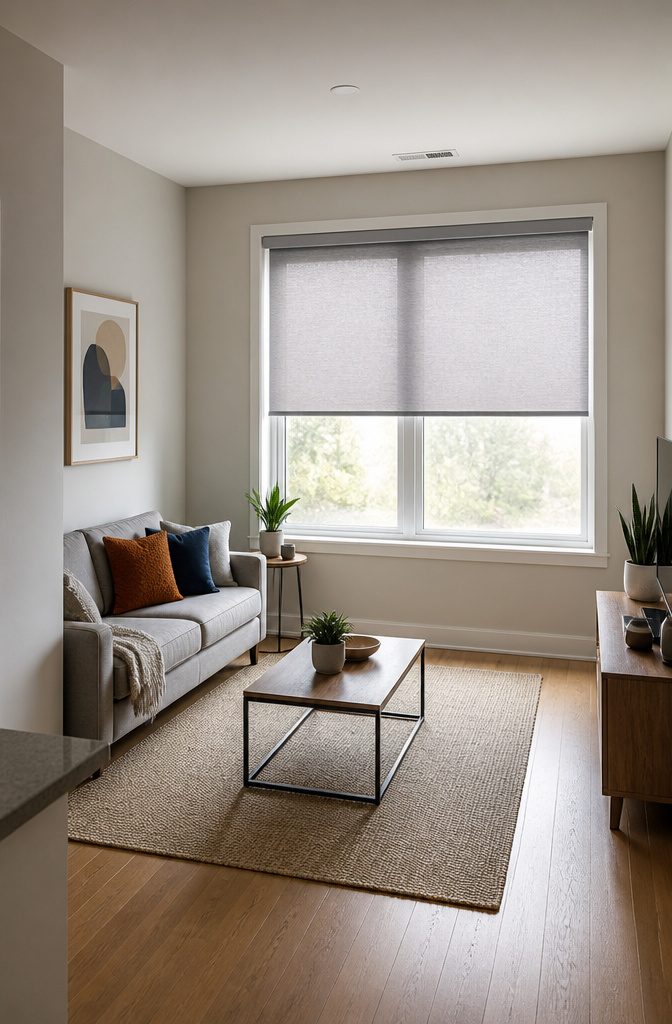
A small living room can shrink fast under the wrong window covering. Heavy drapes pooling on the floor or ornate valances eat visual space that already runs short.
Streamlined window shades or simple blinds keep the lines clean and the room feeling open, which matters more than any pattern or texture you could add.
Color works harder than structure in tight quarters.
Neutral or light-colored curtains, hung high and wide, draw the eye upward and make ceilings read taller than they are. The trick is letting them frame the window without swallowing it; fabric should recede, not announce itself.
Layering still has a place here, but only where function demands it. A shade plus a curtain gives you light control through the day and privacy at night, yet in a small room that combination needs discipline.
Skip the extra panels, the tiebacks, the decorative hardware. Each element you add back should earn its keep by solving a problem the first layer could not.
Function wins over bulk every time. A cordless roller shade disappears almost entirely when raised, and the savings in visual clutter translate directly to square footage the room seems to gain.
That tradeoff, lean coverage over full drama, is usually the right call until the space itself grows.
Frequently Asked Questions
What are the best blinds for a living room?
The best living room blinds give you flexible light control while fitting the style of the space.
Adjustable slats let you manage sunlight and reduce glare while keeping privacy, and they pair well with curtains for a layered look that adds warmth.
For high-traffic areas, aluminum holds up to wear, while wood adds warmth through stains and paint colors.
What are the best window treatments for a small living room?
Streamlined shades or simple blinds keep a small living room feeling open rather than crowded.
Light-colored curtains hung high and wide draw the eye upward and make ceilings read taller. The key is letting each element earn its keep; skip decorative hardware and extra panels that eat visual space without solving a problem.
Should you choose blinds or curtains for living room windows?
Both have distinct roles, so the choice depends on what the room needs. Blinds give you precise light control through tilting slats, while curtains add softness, texture, and visual height that blinds alone leave looking utilitarian.
The move that usually wins is both together: blinds or shades behind for daily privacy and light management, curtains in front for the finished look.
How do you style curtains in a living room?
Start with fabric weight, length, and color that fit how you actually use the room. Medium-weight cotton or a lined weave gives you dimming you need after work, while floor-length panels draw the eye upward and make windows appear larger.
Pleat style changes the room’s posture: pinch pleats read tailored, ripple folds read relaxed, and inverted box pleats look upholstered even when drawn.
How do I make my living room windows look larger?
Letting in more light is the main trick, and sheer shades do this while softening glare into something usable.
Hang treatments above the window frame itself to create the illusion of taller glass. Neutral or light-colored curtains that recede rather than announce themselves also help the window read larger than it is.