
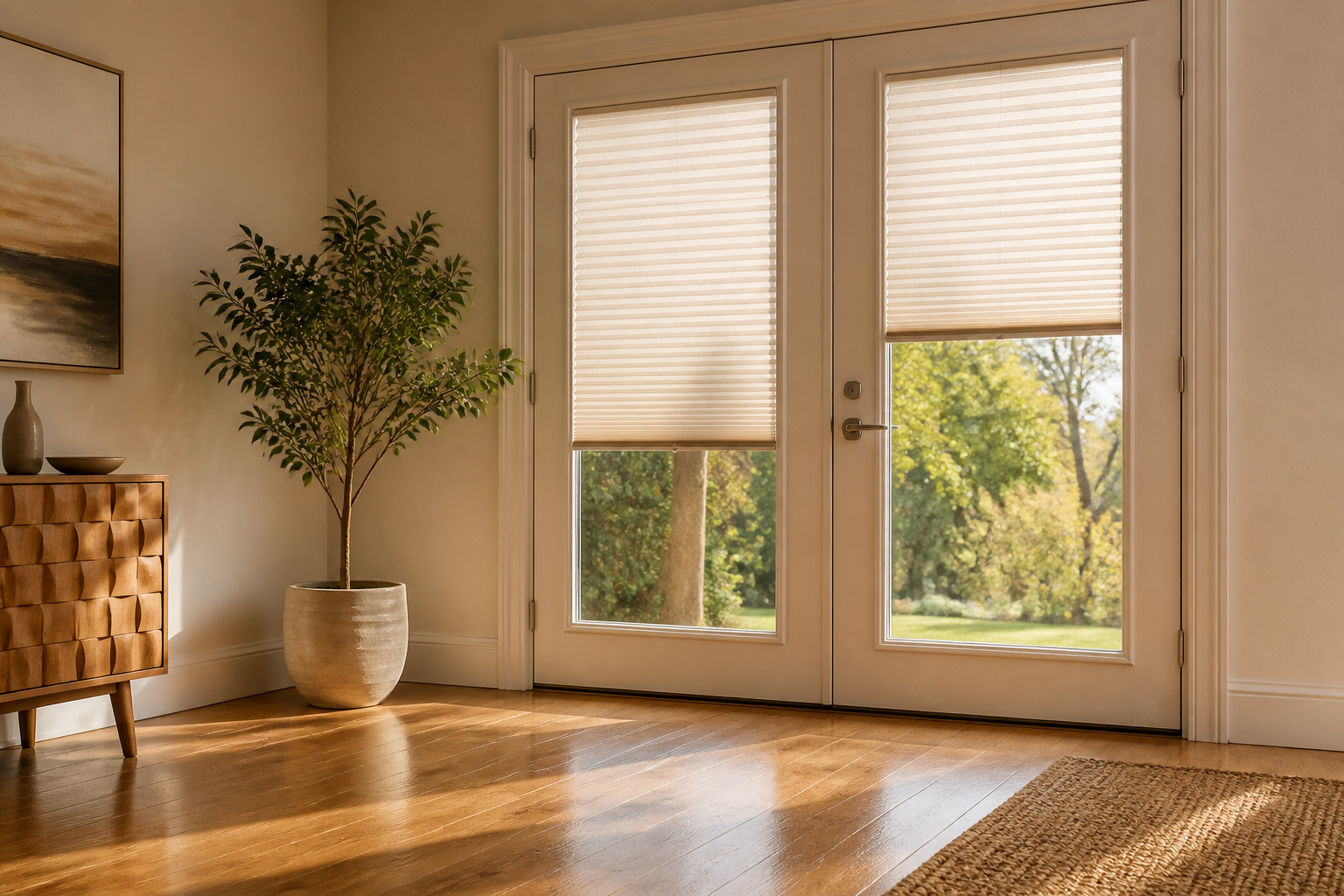
French doors blinds are window treatments built to survive constant swinging, handle clearance, and the dust stirred by foot traffic. The difference between a shade that lasts and one that frays in six months comes down to whether it was engineered for the door itself or adapted from a standard window size. Hunter Douglas solves this with adhesive TrackGlide rails on its Duette cellular shades, so the shade clips to the glass without a single screw hole.
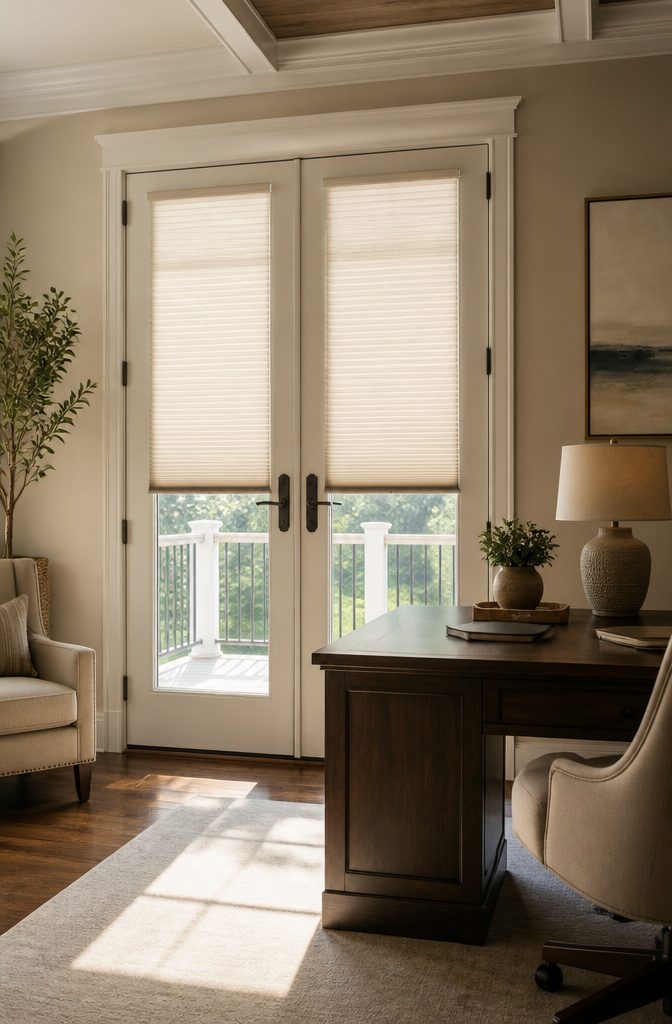
1. Cellular Shades and the TrackGlide System
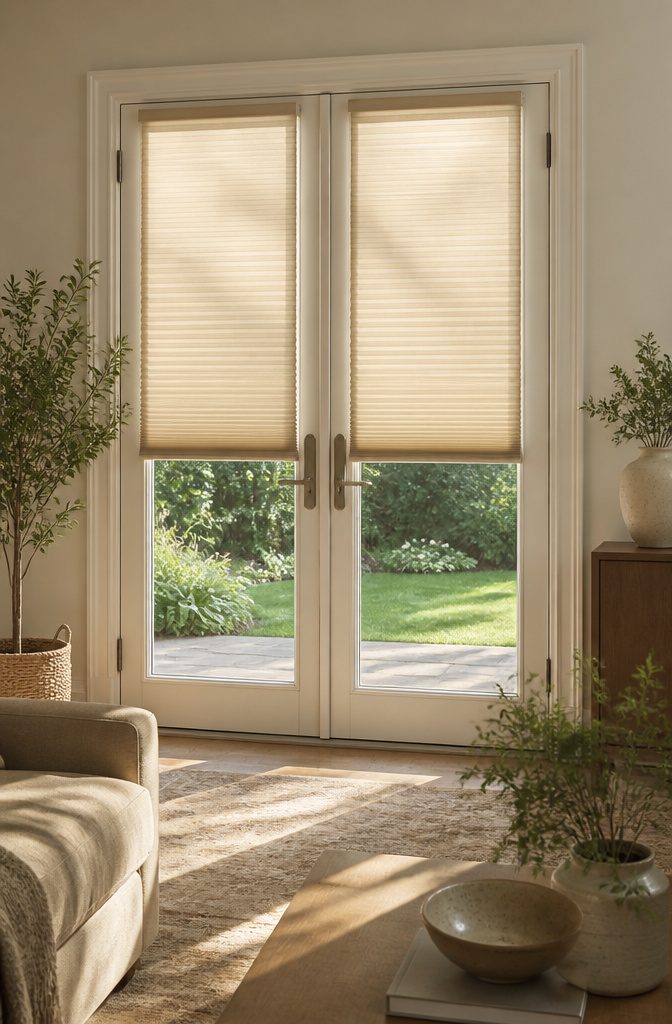
Cellular shades get interesting for French doors when they actually stay put. The Duette line from Hunter Douglas solves the swinging-door problem with a TrackGlide system: aluminum tracks run the height of the glass, and the shade clips in with side rails that attach by adhesive rather than screws. That means no holes in your door, which matters if you are renting or just hate patching things later.
The honeycomb construction traps air in pockets, so the energy efficiency is real enough to notice on a south-facing door in summer or a drafty one in January. Light control runs the usual cellular range, from sheer to blackout, though the track limits how far you can recess the shade. Detachable clips let you snap the whole thing off for cleaning, which you will want to do since door hardware gets handled constantly.
What stopped me on this option was the adhesive mounting. It works best on smooth frames and needs the surface prep you would give a Command strip, which is to say, cleaner than you think.
2. Palm Beach Polysatin Shutters
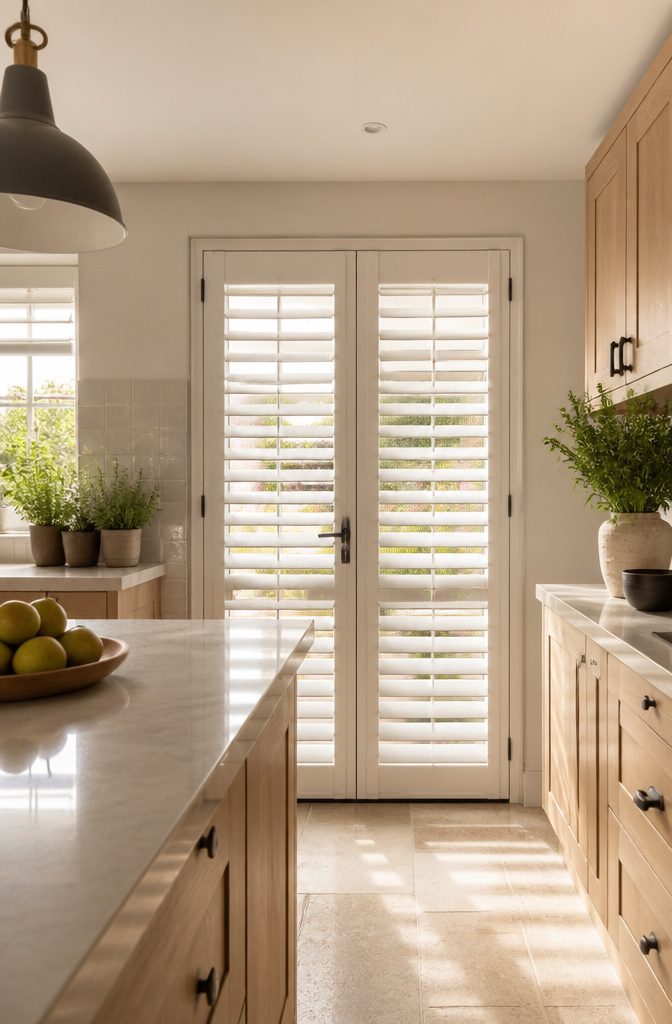
Plantation shutters on French doors solve the problem most door-mounted treatments ignore: they stay put. The frame attaches directly to the door itself, so the whole assembly swings with the panel instead of knocking around every time someone walks through. That secure mounting matters more than people expect until they live with a shade that doesn’t have it.
The adjustable louvers give real control over light and sightlines, and the slat sizes run wide enough that you can choose how open the view feels when they’re tilted. Wider slats mean more glass visible between them, narrower ones read more traditional.
For humid spaces or south-facing doors that take a beating, the polysatin material handles what wood eventually won’t. The UV-resistant finish is built for intense sun and damp air without warping, cracking, or the chipped paint that sends you back to the hardware store in three years. White Silk is the standard color, clean enough to work with most trim without fighting it.
3. Silhouette Window Shadings
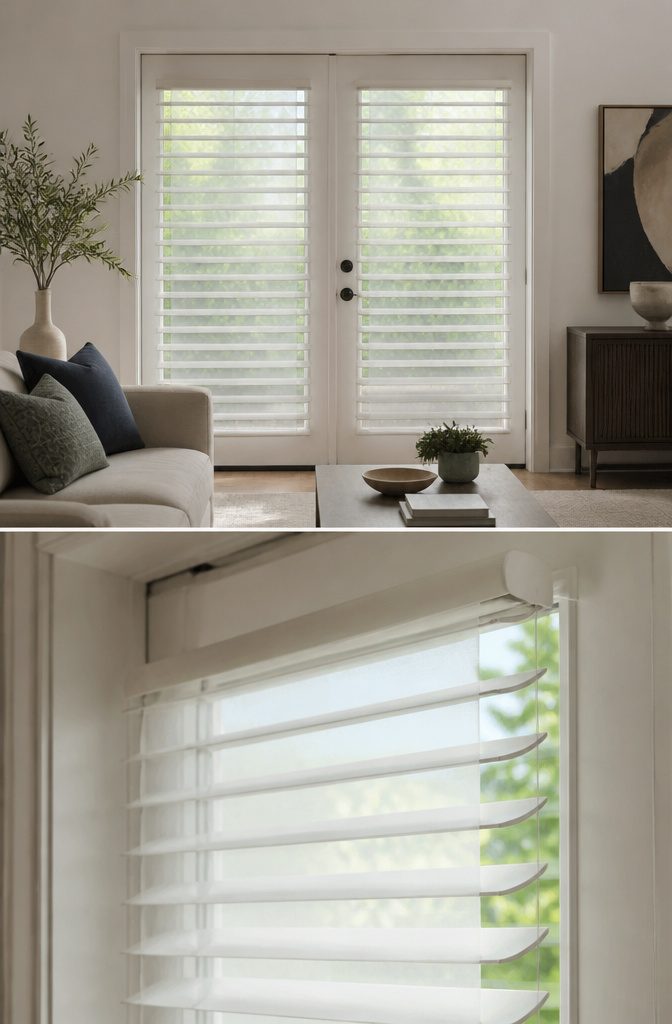
Silhouette Window Shadings sit between two sheers with S-shaped vanes that diffuse light while giving you privacy when tilted closed. The tilt-only system is 60 percent smaller than the standard version, which matters on French doors where a bulky headrail catches the wall every time you swing the door open. I spent longer than I care to admit measuring clearance around my own handle before realizing the slim mounting hardware was the whole point. The vanes float rather than stack, so the shade stays close to the glass even when open. Cord-free with a tilt wand is the option I’d look at first if pets or kids are part of the household, since dangling cords on a door that moves all day are a tangle waiting to happen.
4. Vignette Modern Roman Shades
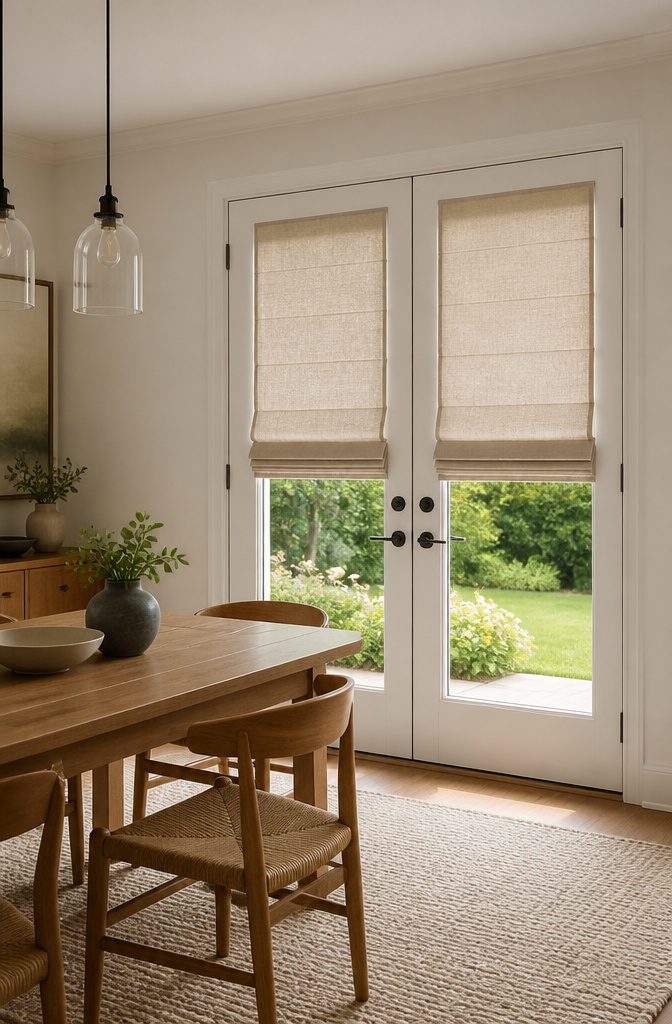
Flat construction Roman shades slide behind door handles without the bulk that turns other treatments into obstacles every time you leave the room. The Vignette Modern Roman Shades use this profile deliberately, keeping the fabric tight to the glass so the door swings clean.
The clean lines matter more on French doors than they do on standard windows. Roman shades can read fussy elsewhere, but here the flat fold version holds a straight edge that mirrors the door frame itself. Full fold and flat fold options are both available, and the flat fold wins for this application. Less stack, less interference.
Exposed rear cords are the usual giveaway on cheaper shades, threading across the glass like afterthoughts. These don’t have them, which removes the one visual detail that usually makes Romans look improvised on a door. Fabric choices run from sheer to blackout, so the door can still function as a light source or seal against it.
The practical cut-out for the handle is where most DIY installations fail. A shade that sits too proud of the frame will catch, bind, and eventually tear at the hardware. These are built to the clearance rather than adapted to it, which is the difference between a treatment that lasts and one that frays in six months.
5. Modern Precious Metals Mini Blinds
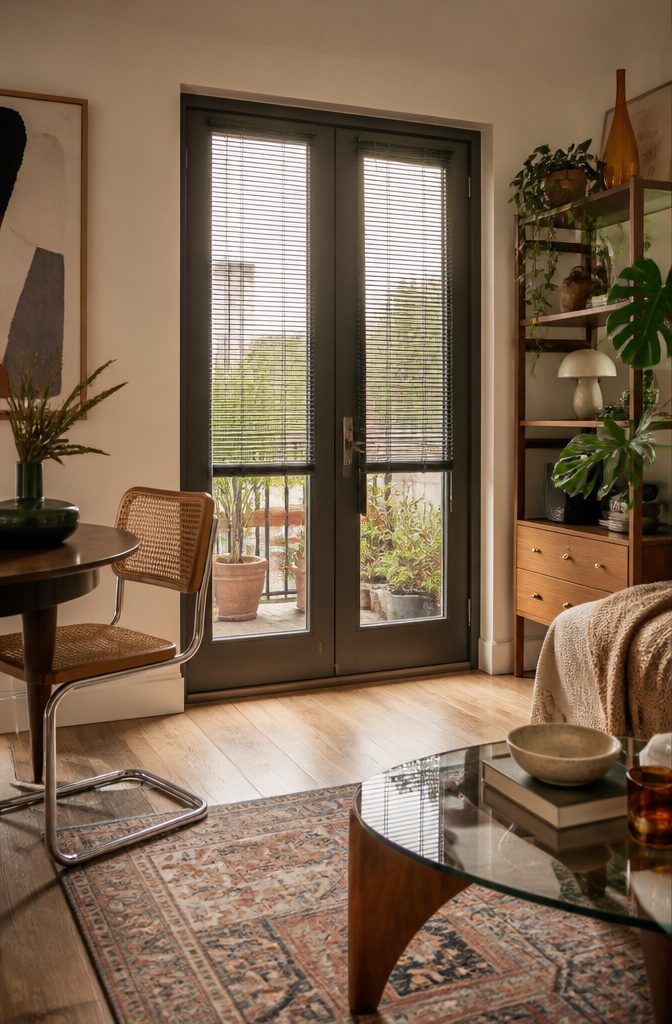
Metal slat blinds still belong in the conversation for French doors, especially if you want tilt control without lifting anything every time someone walks through. The slats come in ½-inch, 1-inch, or 2-inch widths, and the tilting mechanism means you can adjust light and privacy while the blind stays put at the same height all day. That matters on a door you open and close constantly.
The real problem with any blind on a swinging French door is the handle. Standard blinds stop where the handle starts, leaving a gap, or they bump and rattle. The cut-out option routes the slats around the handle so the blind passes behind it cleanly. You will need an outside mount so the headrail clears the door frame, plus hold-down brackets at the bottom to keep the blind attached to the door as it swings. Skip those brackets and the blind becomes a pendulum every time someone leaves the room.
6. Roller Shades for a Clean Look
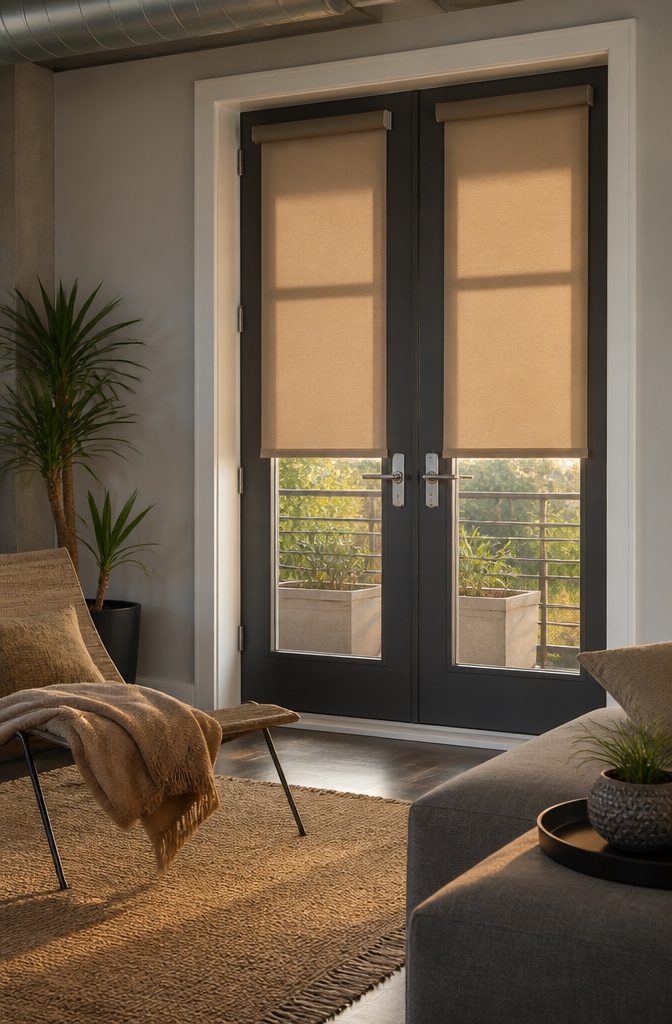
Roller shades on French doors need a retract mechanism that does not fight the swing of the door. Spring-loaded or motorized rollers solve this by holding tension without dangling cords or chains that catch on handles. The shade stays rolled tight against the frame when raised, and the fabric drops straight without billowing when the door opens.
The energy story surprised me. A lined roller shade with side channels can match the insulating value of a cellular shade, since both trap a layer of still air. The difference is in the seal: if the roller sits inside a shallow frame or you add magnetic edge strips, you stop the convection loop that makes bare glass bleed heat. Without that seal, the advantage disappears.
Motorized rollers cost more, but the wiring runs along the door frame and hides behind trim. Battery versions skip the wiring entirely and recharge from a small panel or a USB cord every few months. For a weekend project, a spring-loaded manual roller installs with four brackets and a drill, and the fabric rolls tight enough to clear most lever-style handles without a deep recess.
7. Built-In Blinds Between the Glass
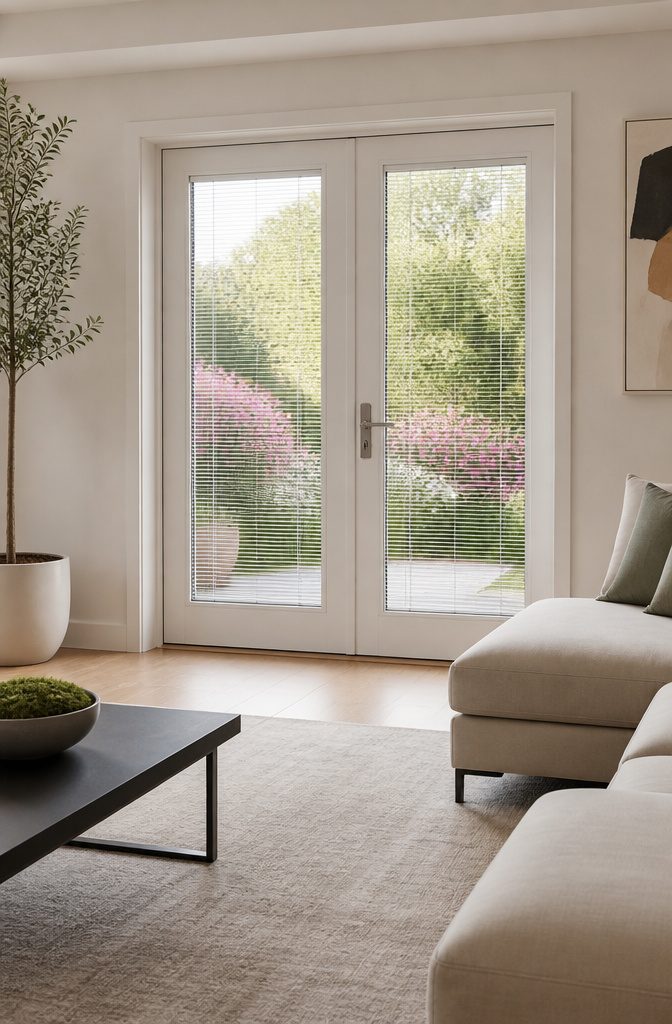
Blinds sealed between glass panes eliminate the two headaches that make most door treatments a pain. Dust never settles on the slats, and there are no cords dangling within reach of kids or pets. The raise-and-tilt mechanism sits inside the sealed unit, operated by a small slider on the frame edge.
The catch is what happens when that mechanism fails or the seal breaks. You cannot swap in a new headrail on a Saturday morning. The entire glass unit, and sometimes the whole door, has to come out. Prices from DoornMore’s catalog show why this matters: a 32-by-80-inch full-lite single door with built-in blinds runs about $576 on sale, while a matching double door jumps to $2,059. A 96-inch fiberglass double door with the same feature lists past $3,500 even discounted, and impact-rated versions with sidelites push past $11,600.
For renters or anyone planning to keep existing doors, this is not a retrofit option. It is a replacement-door decision, not a weekend project. The value shows up only when you are already swapping out the old unit for rot, efficiency, or remodeling, and you want the cleanest possible face for the next fifteen years.
8. iBlinds and Z-Wave Smart Retrofit Kits
Motorizing blinds you already own beats replacing them outright, especially on a rental French door where the hardware holes are already drilled. iBlinds kits retrofit 2–2½ inch horizontal corded-lift blinds with a Z-Wave motor that hides inside the headrail, so the slats still tilt and stack like before. The catch is compatibility: the headrail width and tilt mechanism have to match, and a Z-Wave hub is non-negotiable for scheduling or voice control. No electrician visits; the install is battery-powered and meant for a Saturday morning. If your existing blinds are cordless, cellular, or anything outside that 2–2½ inch horizontal range, this route closes. For renters, the appeal is leaving with the motor and blinds intact, patching only small bracket holes. For first-home owners, it is a way to test whether you actually use automated shades before buying a whole-house system.
9. Integrated Door Systems
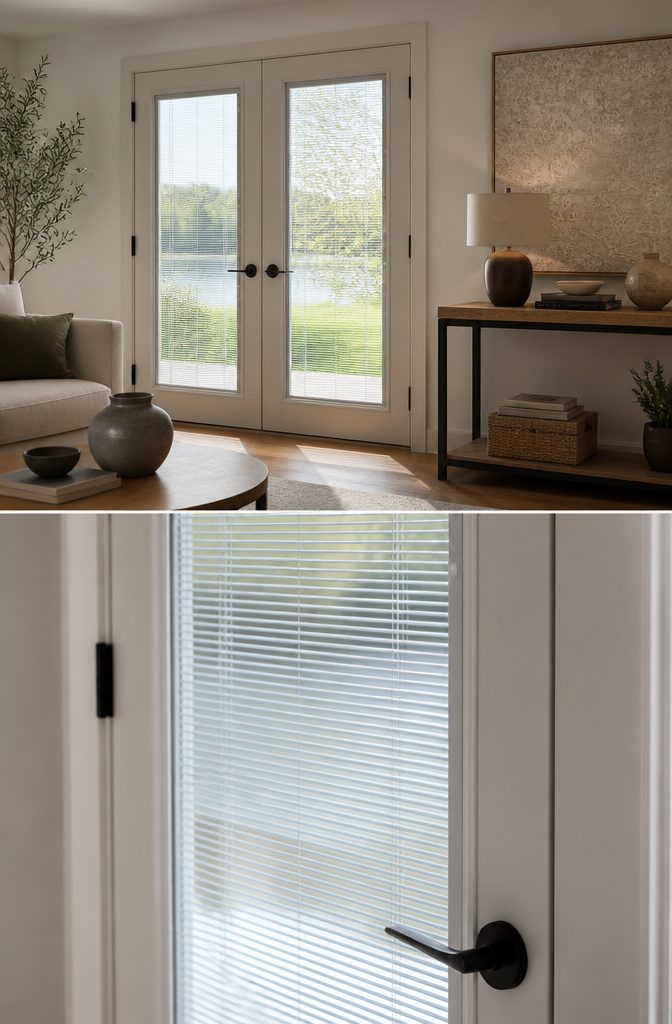
Factory-integrated blind systems sit inside the door frame itself rather than between the panes of glass, and that distinction matters more than I expected going in. The slats or shades travel in channels built directly into the stiles, giving the same flush profile you’d get with between-glass blinds but leaving the actual door construction alone. You keep the full glass thickness, which helps with thermal performance, and if the mechanism fails you can service it from the interior trim without pulling apart the sealed unit.
The tradeoff shows up in the jamb depth. These systems need a frame thick enough to house the headrail and the side channels, so they rarely retrofit cleanly onto older French doors with narrow profiles. New construction or a full door replacement is usually the practical path.
Between-glass options seal the blinds inside the insulated glass, which protects them from dust and damage but turns every repair into a glazing job. Integrated systems keep the blind assembly accessible behind snap-in covers or removable stops, so a broken cord or tilt wand lands in handyman territory instead of specialty-glass territory. For someone keeping a project inside a weekend and a tight budget, repair access can be the deciding factor between the two approaches.
The look is nearly identical from the living side of the room, which is probably why the difference gets buried in product listings. Ask specifically about frame-integrated versus between-glass before you order; the salesperson’s default may not match the maintenance story you want to live with.
What the Door Handle Means for Every Choice
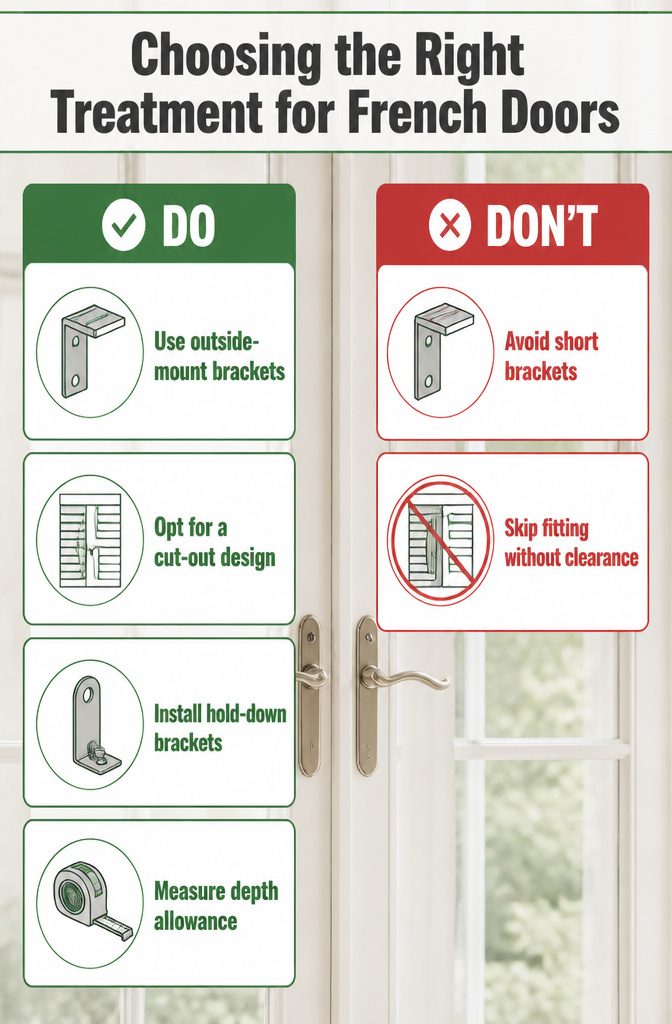
French door handles sit proud of the frame by one to two inches, and every treatment choice starts with that gap.
Outside-mount brackets are the baseline fix. Spacer blocks or extension brackets push the headrail beyond the frame so the blind or shade swings freely. Without them, the fabric or slats catch on the handle every time the door moves. Hunter Douglas lists this as standard for their "side-by-side doors" specialty mount, and the logic holds across brands.
A cut-out is the alternative when you want the blind closer to the glass. The slats notch around the handle instead of stopping short of it. Their Modern Precious Metals Mini Blinds come with this option, and it means the slats tilt for light control without lifting the blind at all. That matters on a door you open twenty times a day.
Hold-down brackets at the bottom keep the treatment from swinging away when the door closes. The same clearance problem shows up on sliding-glass doors, so the bracket math transfers if you ever switch door types.
Depth allowance is the first measurement to take. Handle projection varies, but the bracket or cut-out decision follows from it directly.
Privacy and Light Control by Door Direction
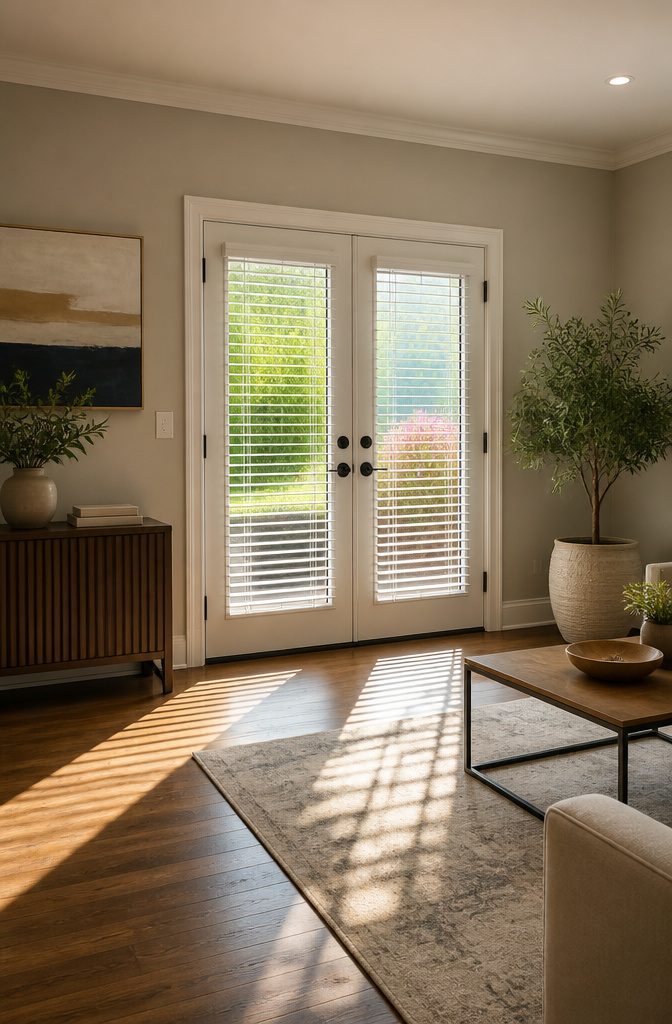
South-facing French doors collect glare the way a windshield does at 4 p.m., and the blinds you pick need to solve for that before anything else. Tilt-operable slats handle it better than anything you have to raise and lower every time the sun moves; tilt lets you cut the glare without opening the door at all. Hunter Douglas lists its Modern Precious Metals Mini Blinds with that exact use in mind, and the half-inch to two-inch slat range gives you real control over how much light gets through.
Street-facing doors are a different problem. Privacy matters more than filtering sun, and the gaps at a blind’s edges become the issue. Mounting outside the frame, which the manufacturer requires for French door headrail clearance, already helps close those gaps. Hold-down brackets at the bottom keep the blind from swinging away and exposing the glass every time you pass through.
Doors that open to patios sit at an awkward intersection: you want the light, you want the view, and you want to disappear from the neighbor’s sightline after dark. Layering works here, though it costs you the clean look of a single treatment. A shade paired with drapes gives you the blackout option for night and the lifted shade for morning coffee, but the door handle still needs its cut-out so nothing catches when you turn the knob.
Wood, Fiberglass, and Vinyl Care
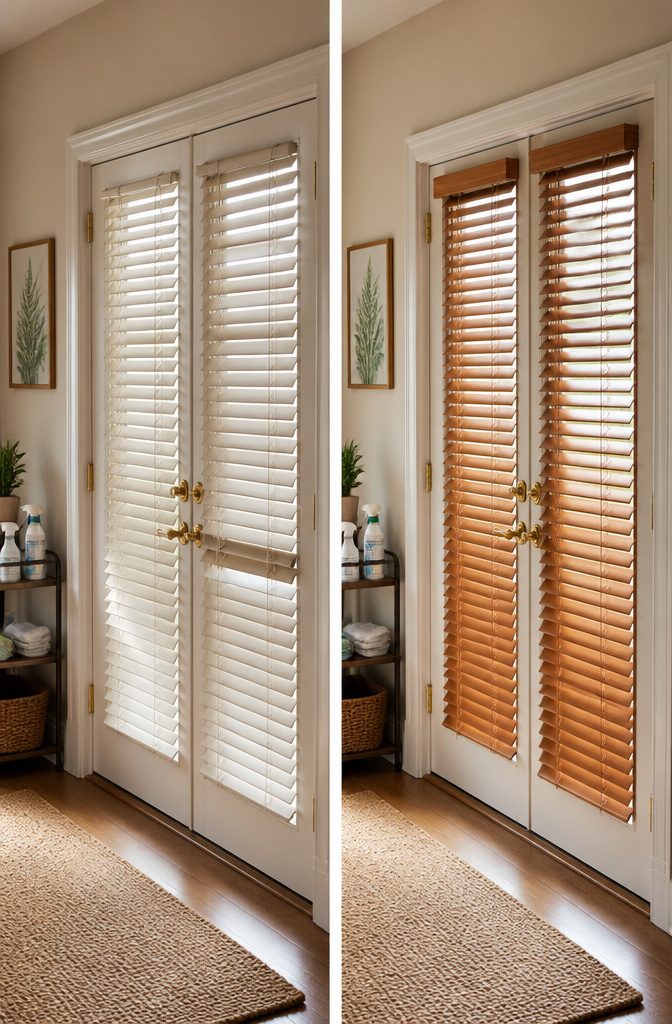
Wood blinds on a south-facing French door will eventually tell you what your humidity is doing. The slats start holding a curve, then the header rail warps enough that the tilt mechanism binds. I have seen this in a bathroom install where the difference between summer and winter swing was maybe an eighth of an inch, but that was enough to make the louvers hang crooked in a way no adjustment screw fixes. Fiberglass frames cost more upfront but do not move, which matters when the treatment hangs on a bracket that takes the full weight every time someone pushes the door closed harder than they meant to.
Vinyl is the easier clean, though the cleaning itself is what ages it. The usual mistake is treating it like painted wood and going at frames with something that has grit in it. Warm water and a drop of dish soap, then dry with a towel that is not your good ones. The plasticizers in cheaper vinyl will migrate over years and leave a tacky film that attracts dust; when that happens, no solvent fixes it, you just live with more frequent wipe-downs or replace.
The hardware sees stress differently depending on what you hang. A real wood shutter with operable louvers puts torque on a top-mount bracket that a vinyl roller shade never approaches. Fiberglass distributes that load better because it does not flex under temperature, so the screws stay seated. On a door that gets used ten times a day, that stability is what keeps the blind from sounding like a rattletrap by year two.
Single, Double, and Sidelite Layouts
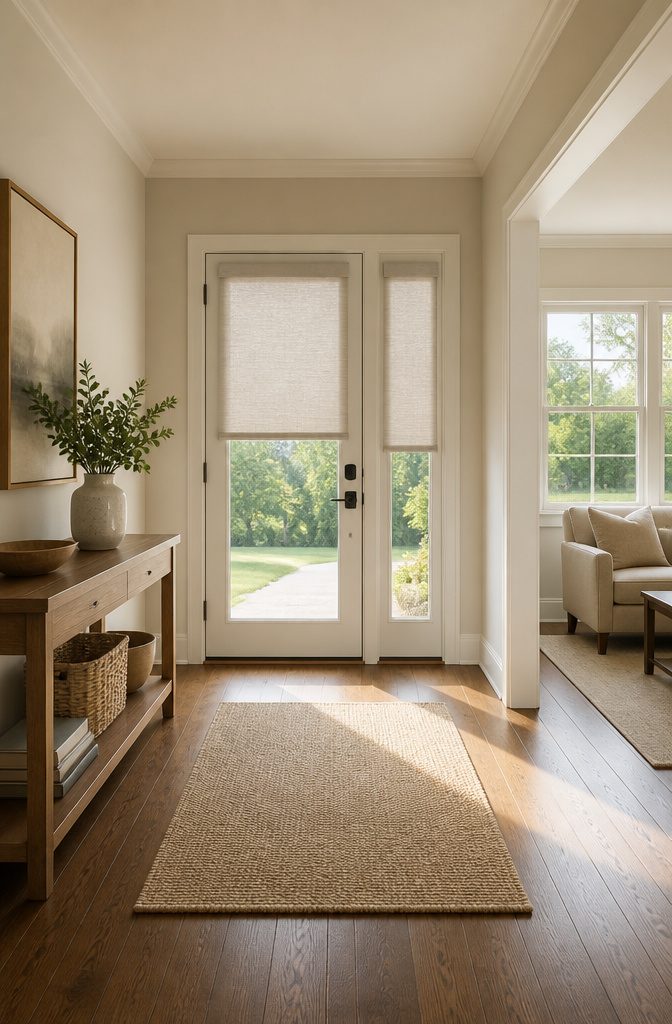
A single French door is simple enough: one shade, one frame, done. The trouble starts when the opening doubles. With double doors, you decide whether to order one wide shade or a matched pair, and that choice locks in how the doors function day to day. One shade spanning both leaves looks clean when closed, but every time someone walks through, the whole treatment stacks or lifts. A pair gives independent use; the traffic door opens without disturbing the other side.
Width limits the call. Sources note cellular shades and most other treatments can be built to fit French doors, yet a single unit wide enough for a full double opening gets heavy, and the hardware needed to keep it level starts to matter. At some point the practical move is two narrower shades whether you wanted the look or not.
Sidelites are the third question. Those narrow flanking windows can carry matching fabric for a unified wall, or they can get their own smaller coverings if privacy needs differ. In my reading, the systems meant to keep shades in place on operating doors, like side-rail clips and adhesive tracks, apply to the main leaves; sidelites do not open, so they do not need the same hardware. That difference in function is worth treating as a separate decision, not an afterthought.
Energy Performance and Glass Ratings
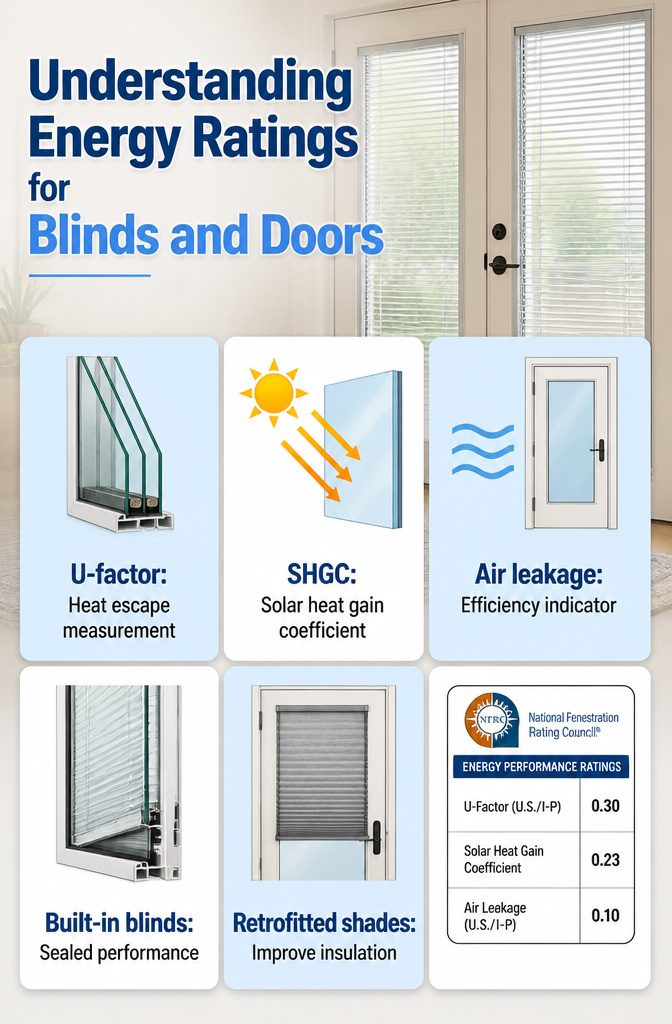
The glass package matters more than the blind for keeping a room comfortable through the seasons. NFRC ratings printed on a door label tell the story: U-factor measures how much heat escapes, SHGC tracks solar heat coming in, and air leakage is exactly what it sounds like. A door with built-in blinds between panes earns those numbers with sealed, low-e coated glass and argon fill, not because the slats themselves insulate much. The blind becomes a nice bonus for blocking afternoon glare, but the thermal work was already done at the factory.
Retrofitting blinds on existing French doors is a different calculation entirely. Surface-mounted cellular shades or room-darkening panels cover the frame gaps and block convection currents that glass alone cannot stop, which is where the real help comes from in an older unit. I spent an afternoon with a smoke pencil once, watching drafts curl around the edges of a retrofitted roller shade that fit fine but sealed nowhere, and the lesson stuck. If the door glass is already decent, a well-fitted shade with side tracks can tighten the assembly more than swapping glass would. If the glass is single-pane or the frame leaks, no blind thickness fixes that problem; the money belongs in the door first.
Cleaning and Long-Term Upkeep
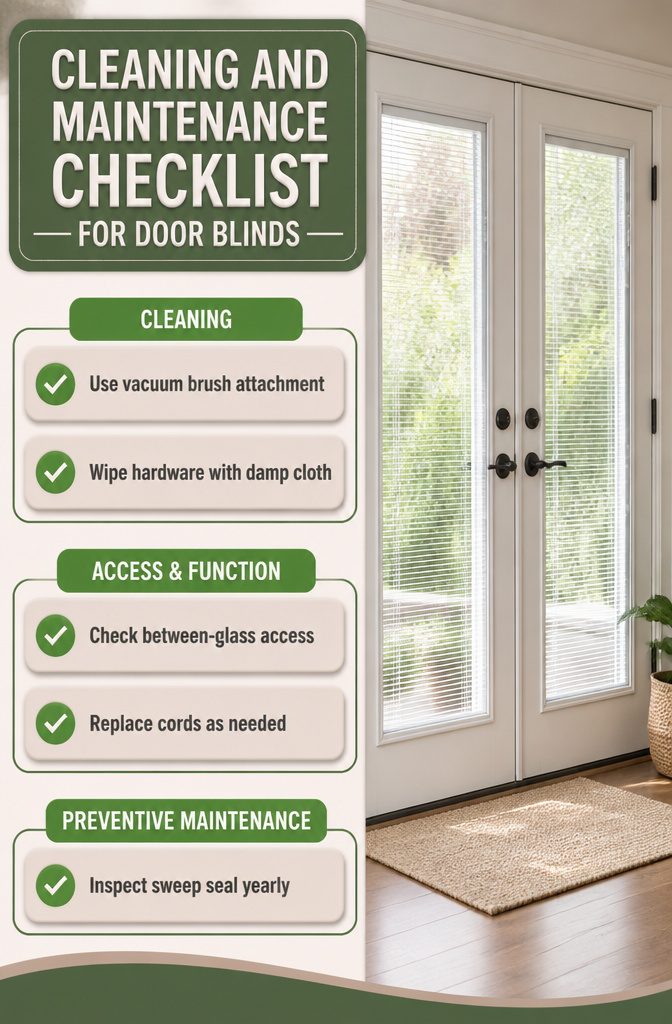
Dust settles on door-mounted blinds in ways wall windows never invite. Every swing of the door stirs air across the slats, and the hardware tracks collect grime right at hand level where people push through. A vacuum brush attachment reaches the louvers, but the brackets and tension pulleys need wiping with a damp cloth, then dry immediately, or the steel starts spotting.
Between-glass units trade that access for protection. The sealed cavity keeps dust out entirely, which sounds like freedom until a smudge appears on the inner surface. Then you are wiping glass through a narrow frame gap, or calling the manufacturer about seal failure if moisture follows.
Cord replacement on traditional blinds is a ten-dollar fix you do at the kitchen table. The sealed systems have no user-serviceable cord at all; the mechanism lives inside the glass, so a failed tilt wand means a service call or a new door lite.
Full door maintenance, either way, means checking the sweep seal at the bottom yearly. Blinds that bang against the jamb when the door closes have already loosened their own hardware. Tighten the mounting brackets before the screw holes wallow out, or you will be filling and re-drilling in a door that takes finish differently than frame lumber does.
Frequently Asked Questions
Can you put window treatments on French doors?
Yes. Almost any blind, shade, or shutter can be ordered to fit French doors, including cellular shades, shutters, mini blinds, and roller shades. The main constraints are the door handle, which sits proud of the frame, and the need for the treatment to move with the door rather than swing independently.
How do you account for the door handle?
You have two standard fixes. Outside-mount brackets with spacer blocks or extension brackets push the headrail past the handle so the treatment swings freely. The alternative is a cut-out, where slats or fabric notch around the handle so the blind passes behind it. The article notes Hunter Douglas offers this for their Modern Precious Metals Mini Blinds, and it lets the slats tilt without lifting the blind at all.
Will a shade move when the door opens?
It depends on the mount. Hold-down brackets at the bottom keep the treatment attached to the door so it swings as one piece. Without them, the blind becomes a pendulum every time someone walks through. Track systems like Hunter Douglas’s TrackGlide use side rails that clip the shade to the door, and plantation shutters attach directly to the door frame itself.
What are the best window treatments for French doors that let in a lot of light?
Cellular shades and Silhouette Window Shadings are the picks the article highlights for light control. Cellular shades run from sheer to blackout and trap air for insulation; Silhouette shadings diffuse light through S-shaped vanes between sheers while giving privacy when tilted closed. Both are built to stay put on a swinging door.