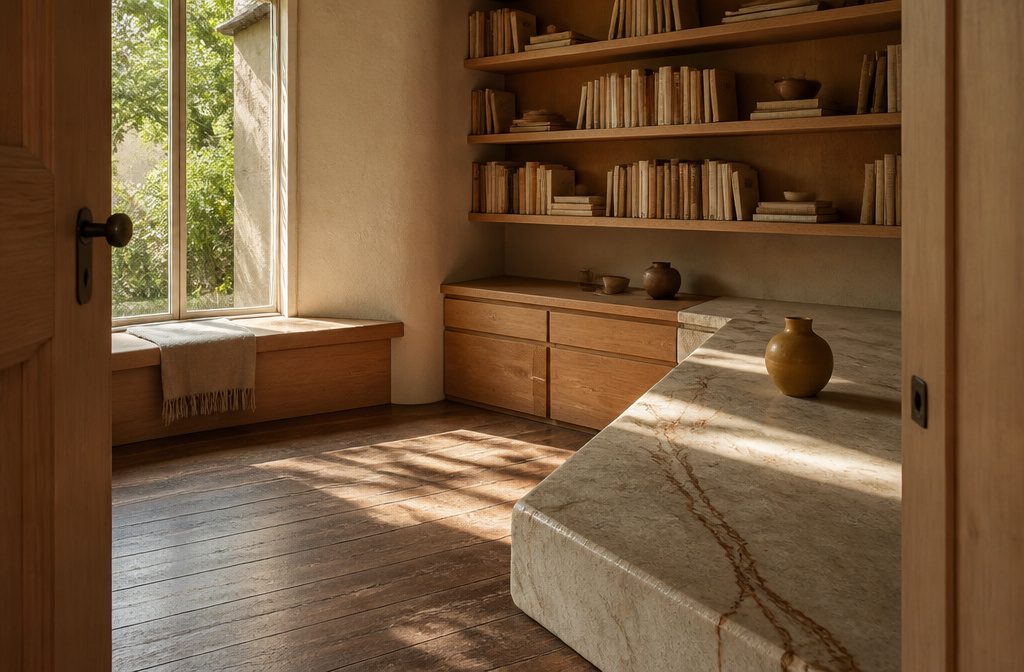
Organic home design brings natural materials, warm neutral palettes and curved shapes into a modern framework that stays uncluttered without feeling cold.
The palette skips cool gray entirely and centers on sand, oatmeal and taupe, with rust or chocolate for depth.
Wood grain stays visible rather than painted over, and stone shows up in 62% of organic modern kitchens as quartzite countertops that move with veining instead of reading flat.
What Organic Modern Design Means
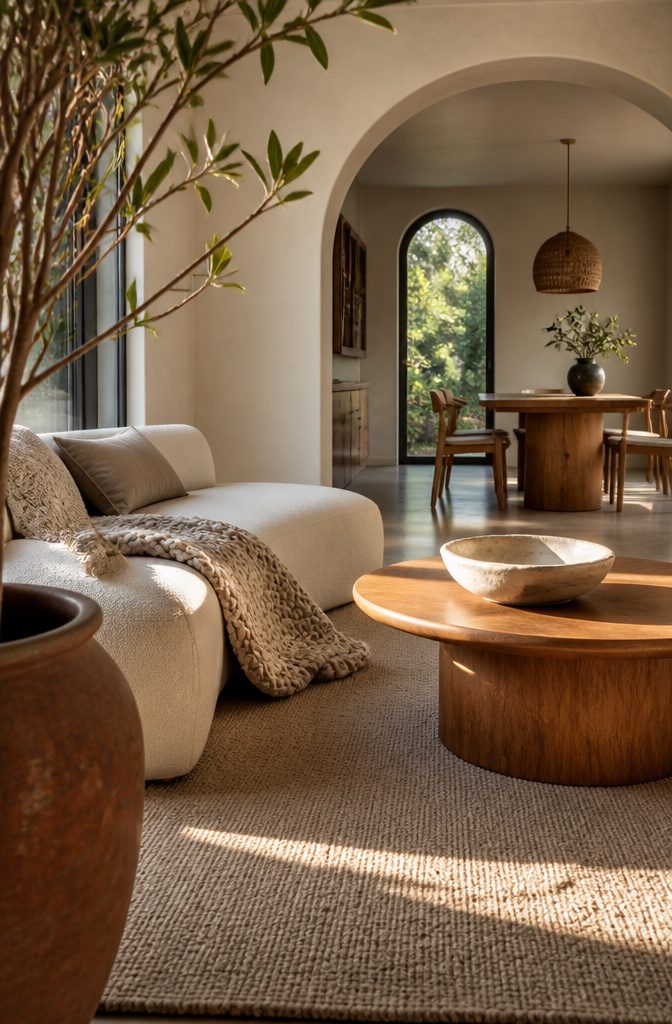
Organic modern design pulls modern simplicity and clean lines toward nature — the warmth of wood and stone, the give of linen, the imperfection of a hand-thrown bowl.
The palette stays neutral: sand, oatmeal, taupe, cream, with rust or chocolate brown for depth. Cool gray is out.
The shapes soften: curved sofas, arched doorways, rounded coffee tables instead of hard right angles. What you get is a room that feels calm and uncluttered without reading as cold or sterile, and natural without tipping into rustic.
The style borrows from mid-century modern’s warm wood and stone, from Scandinavian restraint, from biophilic design’s nature focus.
But where minimalism can feel empty, organic modern keeps the breathing room and adds texture back — a chunky knit throw, a live-edge dining table, terracotta pots.
The materials do the work. They’re not accents; they’re the room.
1. Natural Materials and Texture
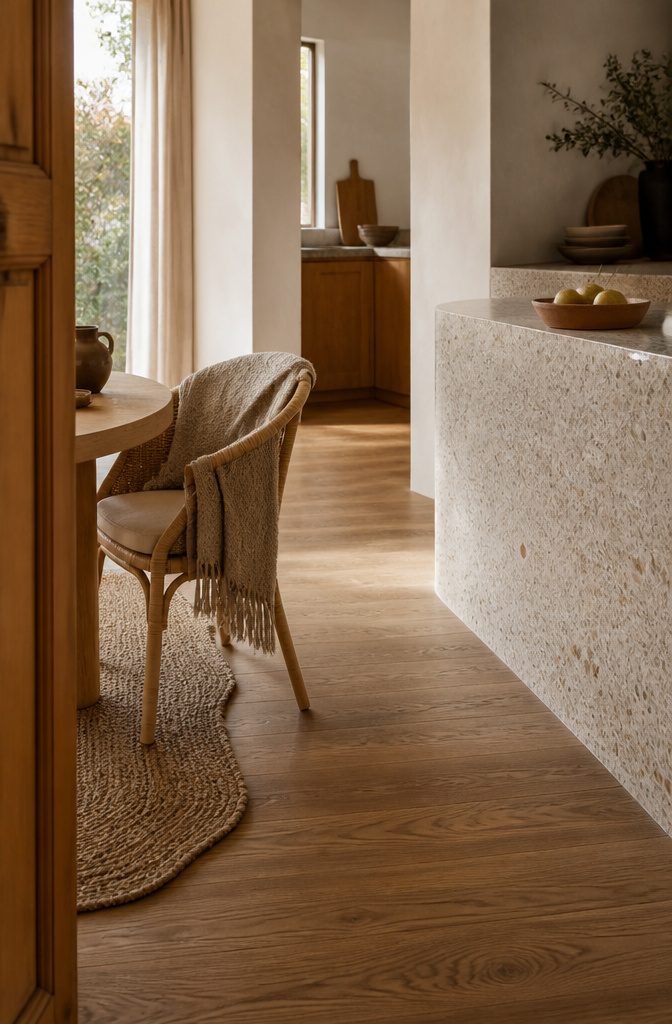
Wood, stone, linen, clay.
These are the materials that give organic modern its recognizable warmth. I start with wood flooring in oak or walnut, both for the grain and the color they bring without needing a stain.
Rattan chairs and linen upholstery add texture where the lines stay clean, and jute or wool rugs soften hard surfaces underfoot.
Stone shows up in countertops and accent walls, often as terrazzo, which layers color and pattern that read as natural without being literal. Toll Brothers puts it plainly:
With its colorful stone-like appearance, terrazzo does precisely that by emulating the hues and textures found in nature.
That mix of aggregate and binder gives you something handmade-looking at scale, and it pairs well with wood or plaster.
Bouclé, cotton, and wool bring in the soft layer. I use them in throws, pillows, and upholstered pieces where touch matters.
The contrast between woven fibers and smooth stone or concrete keeps the room from reading as one-note, and layering those textures is what makes a space feel finished rather than staged.
2. Earthy and Neutral Color Palettes
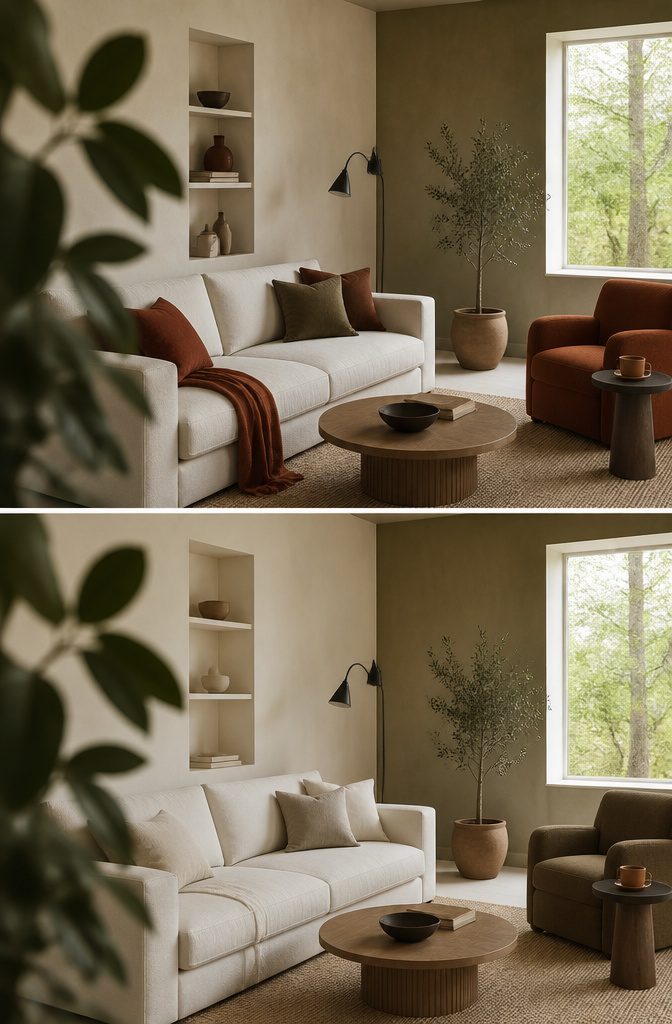
I start with warm whites covering 70 percent of the room: walls, large furniture, flooring. Sherwin-Williams Accessible Beige SW 7036 and Benjamin Moore White Sand OC-10 land in the sand-and-oat range; Sherwin-Williams Creamy SW 7012 and Benjamin Moore Simply White OC-17 sit warmer.
For taupe-leaning bases, Sherwin-Williams Balanced Beige SW 7037 and Benjamin Moore Pale Oak OC-20 both hold warmth without sliding cool.
The next 20 percent brings grounding mid-tones: rust, olive, chocolate, mushroom, sage, terracotta.
These show up in upholstery, throw pillows, smaller furniture. The final 10 percent anchors the palette with matte black iron or deep green in hardware, frames, or a single feature wall.
Skip cool grays and polished metals; they pull against the warmth the rest of the room is working to build.
Greens, browns, blues, and light neutrals borrowed straight from outside make the raw materials feel like they belong, and occasional pops of orange or rust mirror what autumn does to a forest floor.
3. Clean Lines Softened by Curves and Imperfection
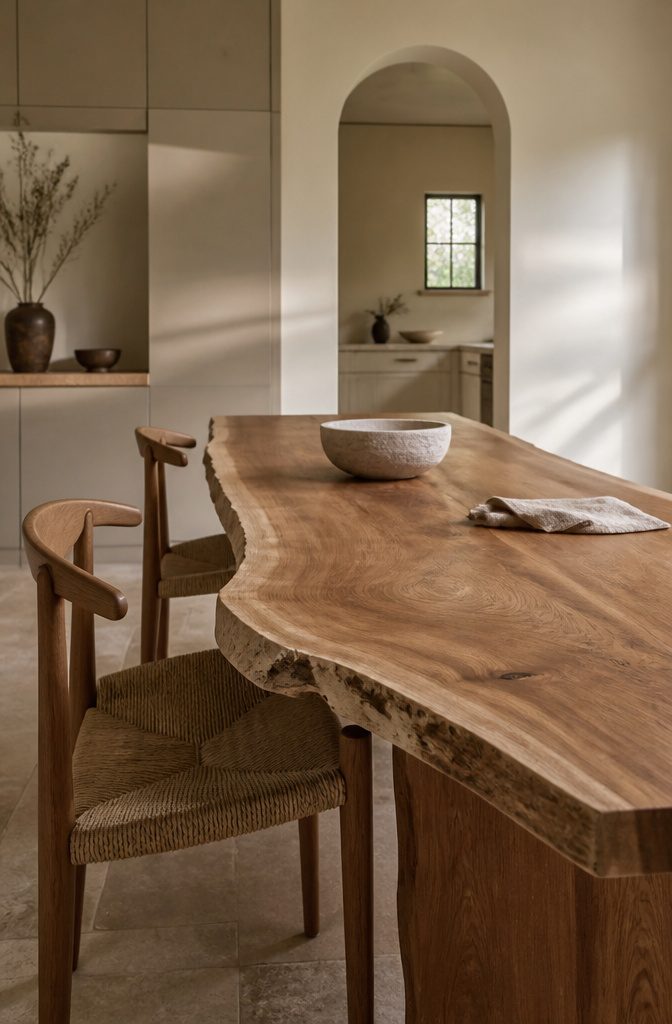
Organic modern depends on straight lines softened by curves.
The foundation stays minimal—clean-edged cabinetry, flat-panel walls, simple geometry—but the furniture and details introduce arcs and rounds. A curved sofa replaces the square sectional.
An arched doorway trades the builder rectangle. A kidney-shaped coffee table sits where the grid would put a box.
I treat the straight parts as background and spend the budget on sculptural silhouettes.
Houzz reports that searches for curved peninsulas and islands rose 123% and 61% respectively, and the shift shows up in stores: rounded sofas, circular mirrors, and bowled ceramic pieces now anchor most organic modern rooms.
The curves echo what we actually see outdoors—river stones, tree canopies, worn coastlines—so the space reads warmer without adding pattern or color.
Imperfection matters as much as shape.
Wood grain stays visible, edges stay raw, and finishes stay matte. The rough texture tells the story: this material grew, aged, or came from somewhere real.
I let those imperfections sit on display rather than sanding them smooth, especially on dining tables, hearths, and range hoods where the surface takes center stage.
4. Minimalism Balanced With Comfort
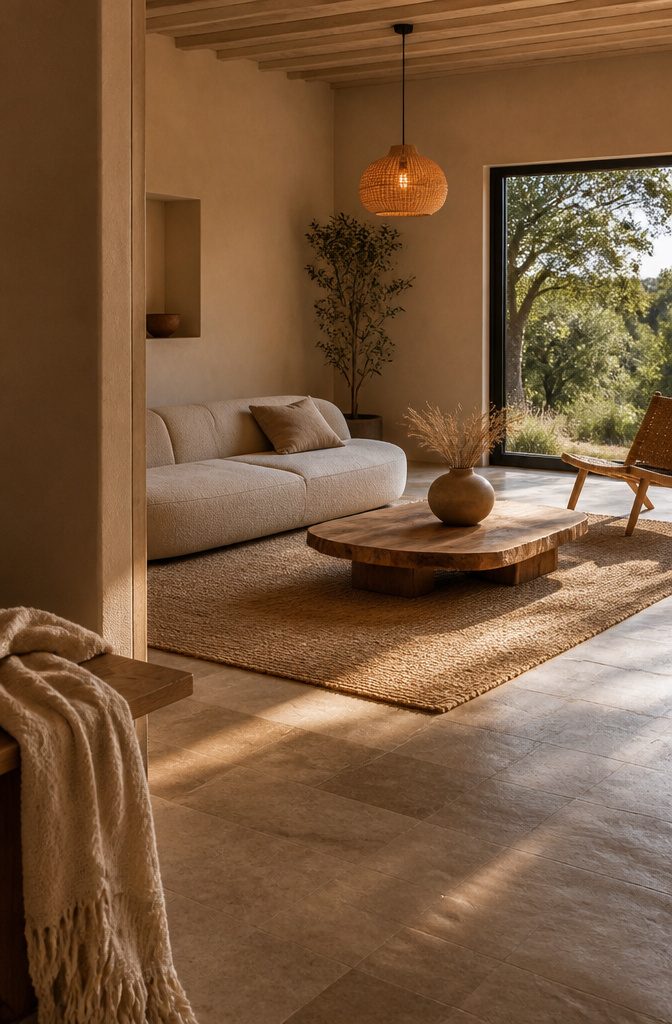
Organic modern works because it pulls off something most styles fail at: rooms that look intentional without feeling cold.
The three-texture rule gets repeated because it holds — a linen sofa, a jute rug, and a ceramic vase layer warmth without clutter, where one material repeated across every surface reads flat.
I look for rooms where you could count the furniture pieces on one hand, but the fabrics and finishes still give you something to rest your eyes on.
The line between edited and sterile sits closer than most people expect.
A low-profile sectional in cream bouclé, a live-edge coffee table, and a single clay vase can carry a living room if the materials do enough work on their own.
Add a fourth accent chair or a second side table and the balance tips — not because the room is full, but because nothing in it stands out anymore.
Fewer pieces with more presence wins over more pieces trying to share the stage.
I’ve watched people strip a dining room down to the table and chairs, then wonder why it feels like a showroom.
The fix is textile weight: upholstered chair seats instead of all wood, a wool runner instead of bare floor, linen napkins instead of leaving the table empty between meals.
Soft lighting helps too — a rattan pendant or a fixture with a matte patina diffuses enough to keep the room from reading harsh under overhead light.
5. Plants and Natural Light
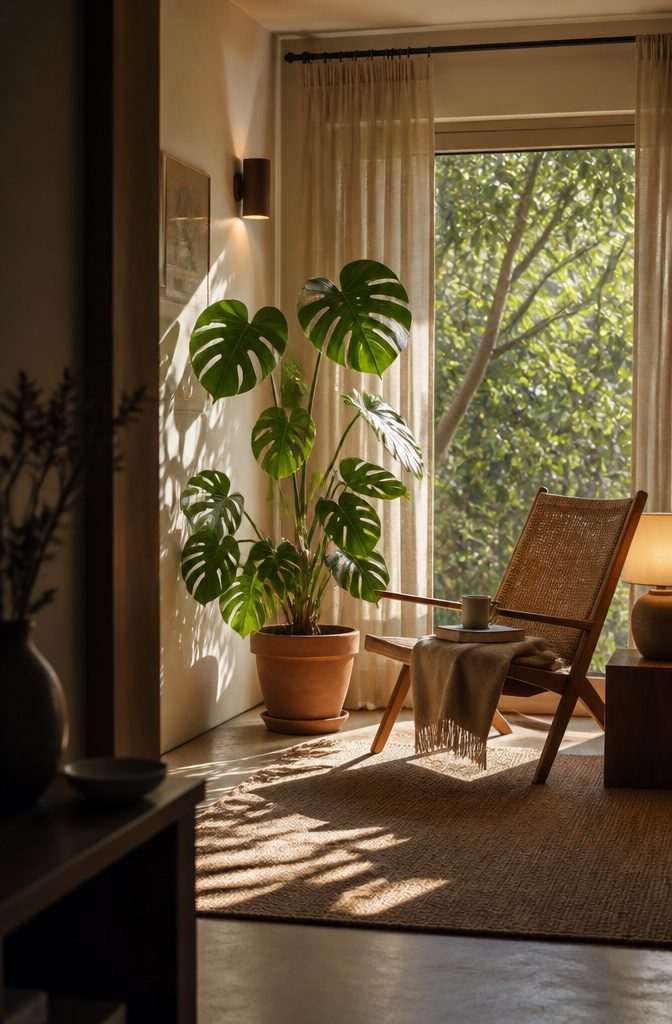
Natural light decides whether the palette reads as warm or washed out.
Swap heavy drapes for gauzy linen panels, or skip window treatments entirely where privacy allows. Light moves through your space with rhythm throughout the day, keeping the room connected to what’s happening outside.
When you’re planning furniture placement, let sunlight guide it: a reading chair earns its spot in front of a window, and a plant thrives where the light lands naturally.
Add one to two plants per room, not more. Snake plants, monstera and trailing pothos all work without much attention.
Vary height and pot material to keep it from looking uniform. Dried grasses or eucalucalyptus in a ceramic vase count just as much as a living plant and skip the watering schedule.
Lighting should layer at least three sources: ambient from sconces or hidden strips, task from a reading lamp or under-cabinet fixture, and accent from a single sculptural lamp or candle cluster.
I keep all ambient bulbs at 2700K to 3000K for a warm color temperature.
Higher-kelvin bulbs undermine the whole palette the moment you flip the switch. A single oversized pendant in rattan, rice paper or ceramic above the dining table replaces a traditional chandelier and pulls the eye up without crowding the room.
6. How It Appears in Living Rooms
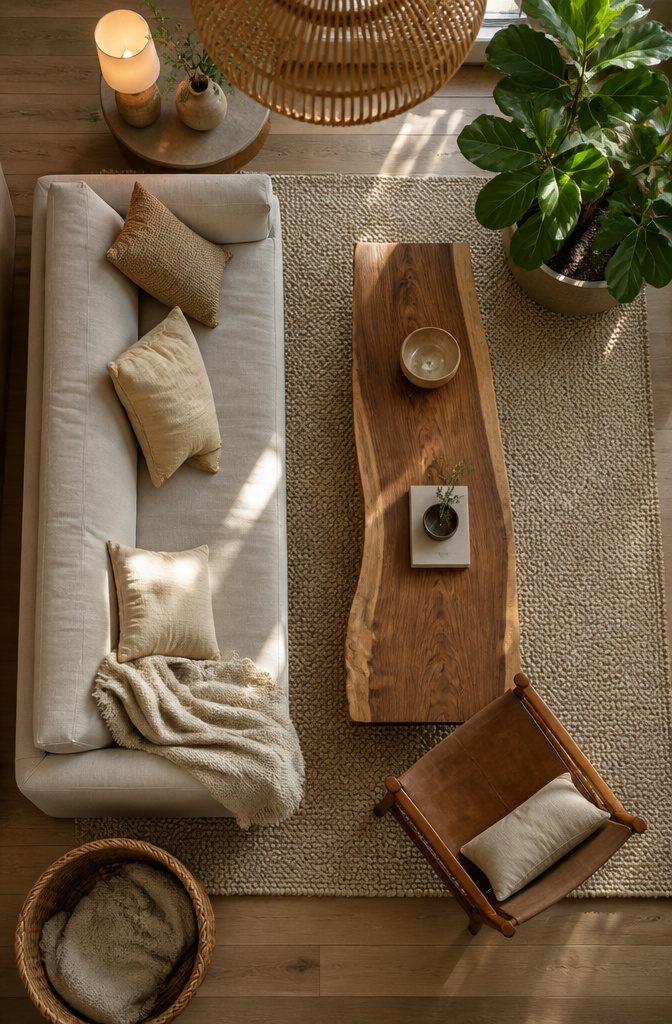
A neutral linen or cotton sofa gives you the low profile this style wants without the tufting or camelback bulk that fights it. The cleaner the lines, the easier the rest comes together.
From there, layer in texture and natural materials:
- Live-edge wood coffee table — reclaimed or new, the unfinished edge reads organic where a squared-off table reads polished
- Jute or handwoven wool rug underneath to anchor the seating and add underfoot warmth
- Eames lounge chair or a Danish teak armchair if you want a nod to midcentury forms
- Woven pillows and neutral throws in cream, stone or camel to soften the sofa without pattern
- Curved lighting fixtures or a large bamboo pendant to break up hard angles
- Ceramic vases like the CB2 Forma Handcrafted Vase and warm-toned table lamps such as the Ramble Lamp
- Macrame wall hanging if you lean bohemian, baskets if you prefer quiet storage
A fiddle-leaf fig or another substantial plant finishes the room and keeps it from reading sterile. The palette stays neutral, the materials stay natural, and the geometry stays simple.
7. How It Appears in Bedrooms
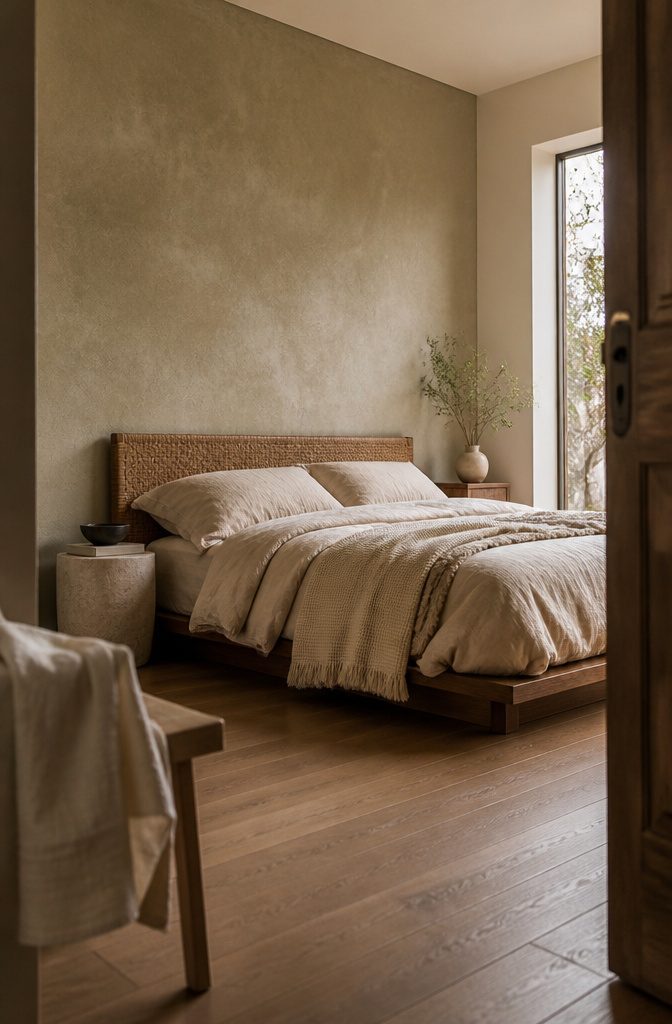
linen bedding sets the tone. The natural wrinkle, the matte finish, and the weight all read differently from sateen or jersey.
I keep mine in cream or undyed oats, then layer a waffle-knit blanket and a chunky wool or cotton throw in the same tonal family. Texture does the differentiation when color stays quiet.
The bed frame pulls equal weight. A low-profile platform bed in walnut or oak keeps the silhouette calm and puts the grain front and center.
Pair it with a woven headboard or a linen-upholstered one to soften the angular frame. Cane works too if the rest of the room stays warm.
Nightstands do not need to match.
One in stone, one in wood feels collected rather than ordered as a set. I round the corners where I can and look for hidden storage so the surface stays clear.
Walls stay simple. A lime-washed or micro-cement accent behind the bed adds depth without the visual noise of a gallery wall, and the remaining walls hold in warm white.
8. How It Appears in Kitchens
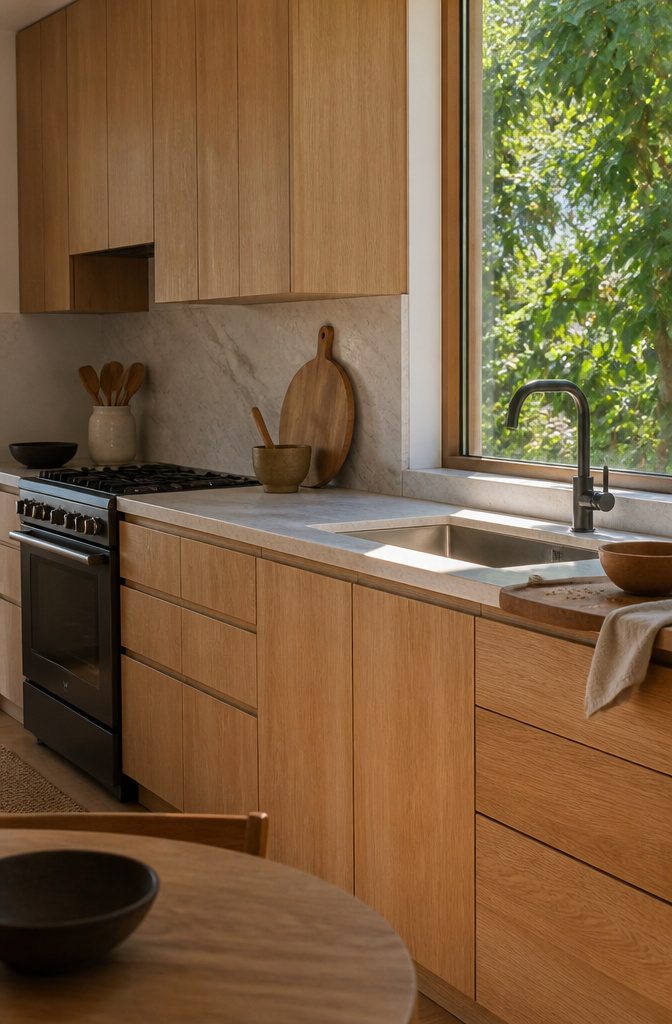
In kitchens that got the organic modern treatment, wood-grain cabinetry showed up in 59% of projects, with white oak landing at 51%. The grain stays visible rather than hidden under paint, which gives the room texture before you add anything else.
Stone counters followed the same pattern: quartzite hit 62% in the NKBA’s 2026 survey of 634 professionals, and that makes sense when you see how its veining moves compared to the flatness of solid quartz.
Natural light matters more here than in other styles, because it changes how wood reads through the day.
A north-facing kitchen in winter shows cooler tones in oak; south light warms it up. If you are specifying materials, MSI Calacatta Monaco on the backsplash gives you white with gray veining that does not fight wood tones.
For appliances that sit in plain view, Wolf’s SRT484DG-LP range and Moen’s S665BL pot filler in matte black keep the palette grounded without adding visual weight.
9. How It Appears in Bathrooms
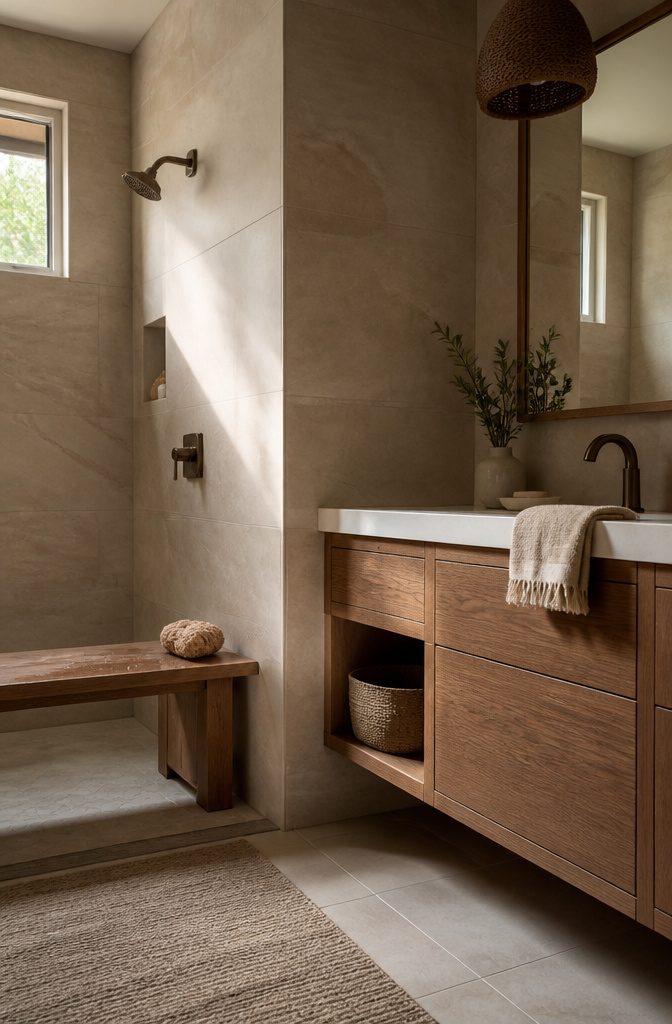
Stone shows up most clearly in the shower.
The Arizona Tile Shibusa Crema in 24×48 format runs floor to ceiling on three walls, its warm beige base and subtle veining close enough to travertine that most people assume it is stone rather than porcelain.
The large format keeps grout lines to a minimum, which matters more in a shower than anywhere else in the house.
For the floor, Schoch Tile Time 2.0 Snow Natural in 12×24 holds up under wet feet without reading as cold or institutional—the matte finish and faint texture keep it from looking like a subway platform.
A teak bench fits into the routine better than it photographs.
Twenty inches wide is enough to sit and shave your legs or rest a foot while you rinse it, and teak weathers water without sealing or fussing. It warms the space in a way tile alone will not.
Outside the shower, a pendant over the mirror adds height and breaks up the predictable sconce-on-either-side setup.
The Rejuvenation Butte 24-inch Cone Pendant in natural linen or rattan brings in organic texture at eye level, which is where a bathroom needs it most.
Origins and Related Styles
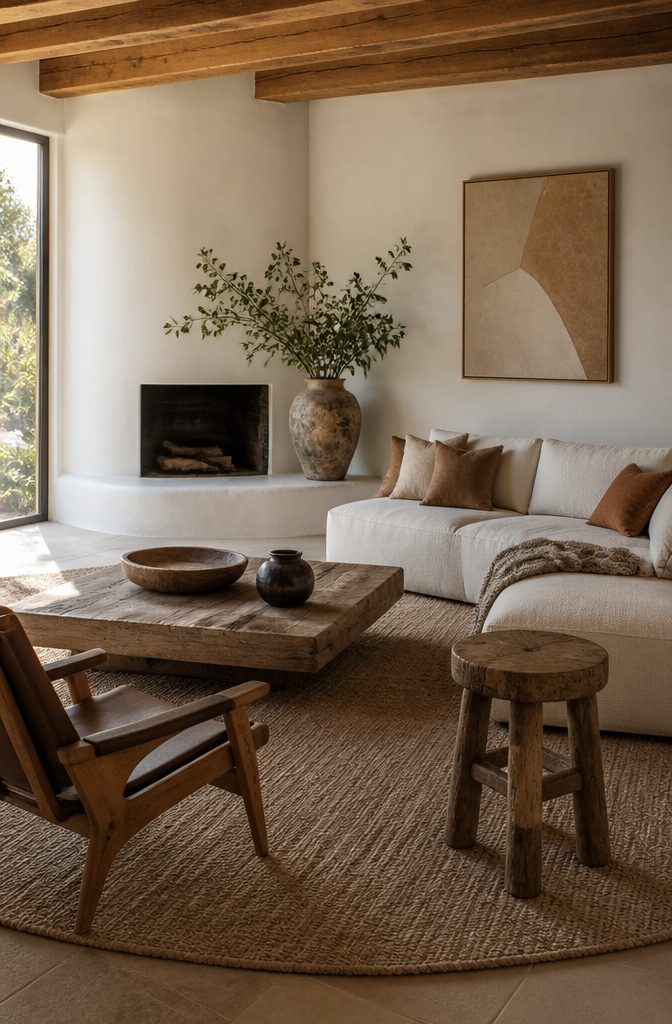
Origins and Related Styles
The roots run back to Frank Lloyd Wright and his idea that buildings should harmonize with their surroundings.
That philosophy spread into furniture and interiors through mid-century figures like Alvar Aalto and Charles Eames, shaping what eventually became Scandinavian minimalism and the sustainable design movement that gained momentum after World War II interrupted material supply and sparked a counter-cultural reaction to waste.
Today organic modern pulls from several overlapping traditions: mid-century Scandinavian design, California Casual, Boho, and biophilic design, which centers on bringing nature indoors. It shares ground with warm minimalism and Japandi but splits on form language.
Organic modern favors sculptural curves and raw textures like heavy-grained wood and rough stone. Warm minimalism sticks to straight lines, smooth plaster, and bouclé.
Japandi leans asymmetrical with dark-stained wood and hand-thrown pottery. If the room feels like a beachside architect’s house with visible wood grain and fluid shapes, that’s organic modern.
Where to Find Organic Modern Furniture
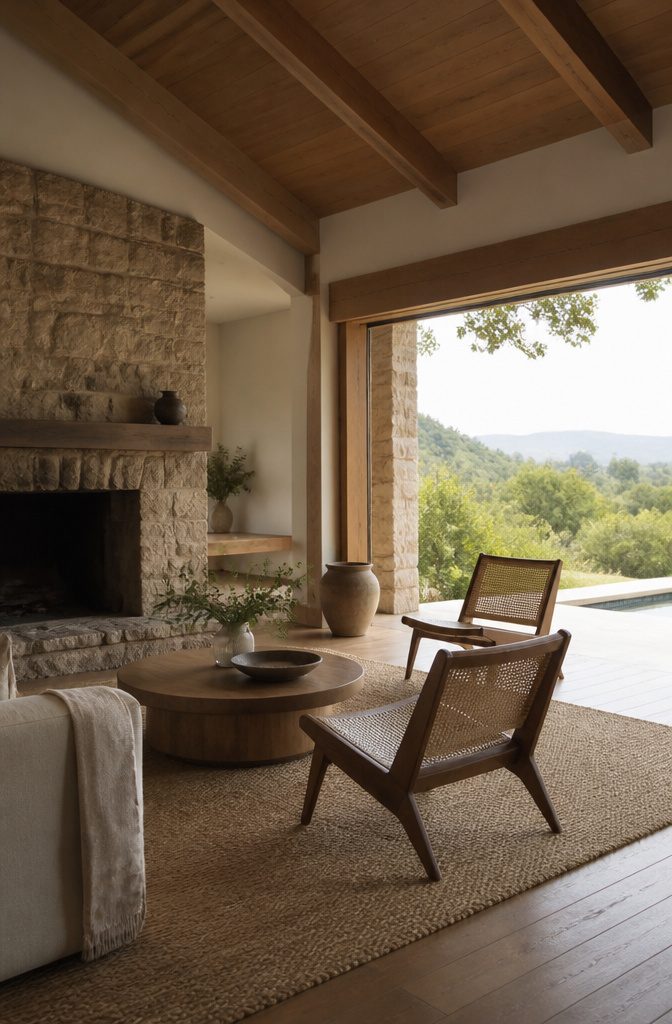
Most of the accessible lines live at Pottery Barn, West Elm, CB2, and Article, where you can filter for solid wood, linen upholstery, and the soft curves that define the look. A few other places worth checking:
- Restoration Hardware and Lulu and Georgia sit at the higher end, with heavier wood pieces and more sculptural forms.
- Design Within Reach and Crate and Barrel carry midcentury-leaning organic pieces, often with visible grain and natural finishes.
- World Market and Anthropologie stock smaller accent pieces like woven storage, ceramic planters, and carved wood bowls that fill in the texture.
- 1stDibs and Etsy are where I look for vintage finds, especially if you want something with patina or a story.
- Local vintage shops and independent makers often have reclaimed wood furniture and handmade ceramics that feel more grounded than anything mass-produced, and you skip the shipping cost.
The key across all of them is choosing pieces where the grain shows, the edges soften, and the upholstery stays natural.
Three Budget Moves Under $200 Total
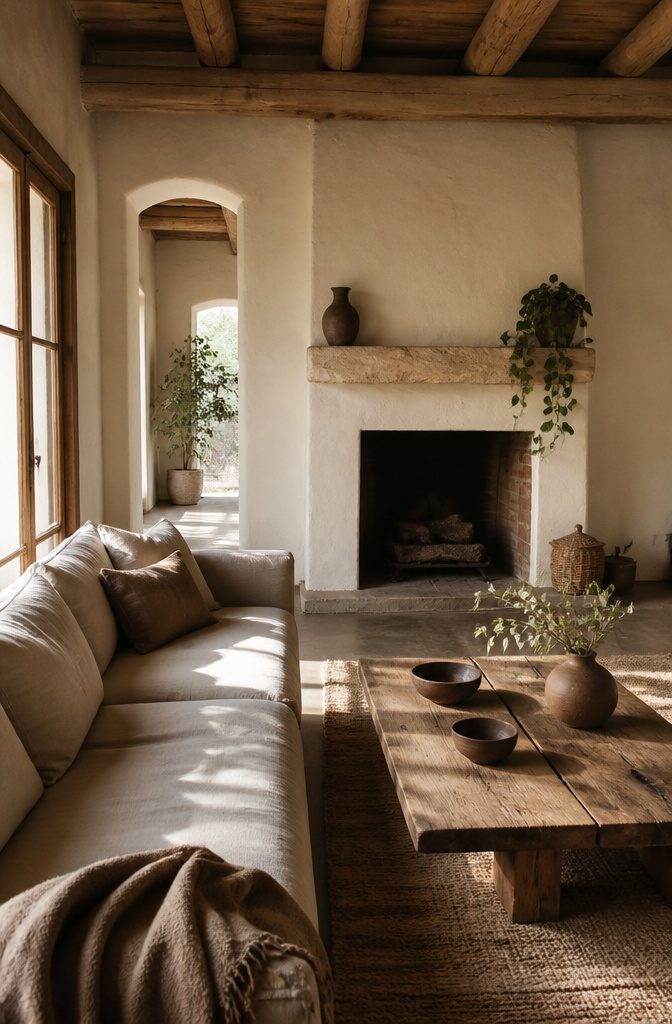
Paint, swap one light fixture, and layer a jute rug under your existing rug. These three moves cost under $200 total and shift the room immediately.
- Paint first. Go with lime wash or a warm neutral that reads flat rather than glossy. Lime wash gives you texture without adding pattern, and a warm neutral in the beige-to-taupe range grounds the space before anything else comes in.
- Replace one light fixture. Swap an overhead or a task light for a rattan or paper pendant. Either material softens the light and brings in the natural fiber the style depends on, and both read as deliberate rather than leftover builder grade.
- Layer a jute rug under your existing rug. This move costs less than replacing what you already own and adds the natural texture organic modern needs. The jute sits underneath, visible at the edges, and the rug you kept anchors the center.
Once those are done, add unglazed ceramic vessels and linen throw pillows as budget allows.
Frequently Asked Questions
What is organic modern style?
Organic modern style combines clean lines and minimal furniture from modern design with the warmth of natural materials like wood, stone, linen, and clay.
The palette stays neutral (sand, cream, taupe, rust), and the shapes soften through curves, arched doorways, and rounded furniture instead of hard right angles. It feels calm and uncluttered without reading as cold or sterile.
What colors are organic modern?
Warm whites and neutrals cover 70% of the room (walls, large furniture, flooring), earthy mid-tones like rust, olive, chocolate, sage, and terracotta make up 20%, and matte black or deep green anchor the final 10%.
Greens, browns, blues, and light neutrals borrowed from nature keep the palette grounded, with occasional pops of orange or rust for warmth.
What are the characteristics of organic modern design?
Wood flooring in oak or walnut, stone counters and accent walls (often terrazzo), sculptural curves like arched doorways and rounded coffee tables, and natural textiles such as linen, bouclé, jute, and wool.
The style depends on visible wood grain, raw edges, matte finishes, and a neutral palette grounded by earthy tones.
Is organic modern the same as warm minimalism?
No. Organic modern favors sculptural curves, raw textures, and heavy-grained wood, while warm minimalism sticks to straight lines, smooth plaster, and bouclé.
Organic modern pulls more from nature’s imperfection and fluid shapes, where warm minimalism keeps the geometry clean and the surfaces refined.
How do I start with organic modern on a budget?
Paint walls in a warm neutral or lime wash, swap one overhead or task light for a rattan or paper pendant, and layer a jute rug under your existing rug.
These 3 moves cost under $200 total and shift the room immediately. Add unglazed ceramic vessels and linen throw pillows as budget allows.
What furniture brands are known for organic modern?
Pottery Barn, West Elm, CB2, and Article carry accessible lines with solid wood, linen upholstery, and soft curves.
Restoration Hardware and Lulu and Georgia sit at the higher end with heavier wood pieces and more sculptural forms. For vintage finds, check 1stDibs, Etsy, and local vintage shops.
Can I mix organic modern with other styles?
Yes.
Organic modern pairs well with Japandi (shared natural materials and quiet forms), Mediterranean (stone and warmth overlap), and warm minimalism (same palette family). Avoid mixing with high-gloss or neon-heavy styles, as the clash reads as unintentional.
Is organic modern going out of style?
No.
Wood-grain cabinetry appeared in 59% of kitchen projects, with white oak at 51%, and quartzite counters hit 62% in the NKBA’s 2026 survey of 634 professionals. Searches for curved peninsulas and islands rose 123% and 61% respectively, showing continued momentum.