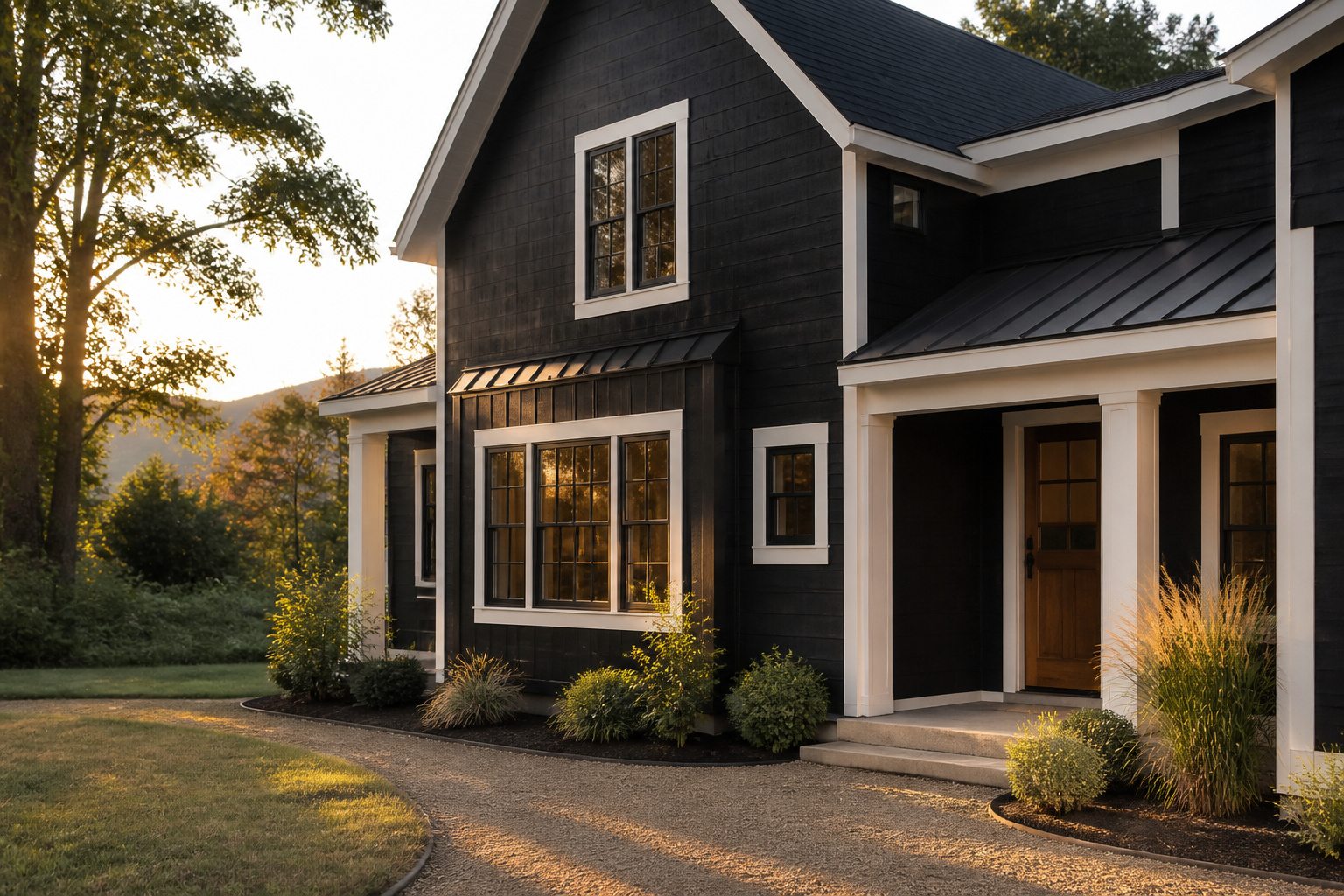
A black house with white trim exterior is a two-tone scheme that only works when the contrast is managed, not maximized.
The common mistake is treating the white as mere accent; in practice, the trim does the outlining and the black does the receding, which means the width of that white border and the undertone of the black body have to be chosen together.
Four to five inches of trim width starts to read as deliberate framing from the curb, while Sherwin-Williams Tricorn Black paired with Benjamin Moore White Dove gives enough warmth to keep the pairing from tipping into graphic harshness.
Emphasized Window Casings

Thick white trim around windows does more visual work than most people expect on a black house with white trim exterior.
The casing creates a sharp border that catches light differently than the wall, so the windows read as deliberate cutouts instead of holes punched into dark siding.
Width matters from the street: anything under three inches disappears at twenty feet, while four to five inches starts to look like a deliberate frame.
Six inches or more shifts the house toward a farmhouse feel, which works if the architecture supports it, but can look pasted-on against clean lines.
Paint pairing is where the effect lives or dies. Sherwin-Williams Tricorn Black holds up in very bright sun without going charcoal, and Benjamin Moore White Dove gives the trim enough warmth to avoid a clinical look against it.
White Dove reads slightly creamy in shade, which keeps the contrast from feeling like a graphic design exercise. Tricorn Black with a cooler white can tip toward harsh, especially on north-facing walls where the light stays flat.
The combination has enough body that you notice the trim first, then the black, which is the right order for this look.

Ready to use, pre-mixed door and trim paint offers a fresh new look on interior or exterior metal, wood and fiberglass

Ready to use, pre-mixed door and trim paint offers a fresh new look on interior or exterior metal, wood and fiberglass

Made in United States
Modern Paneling
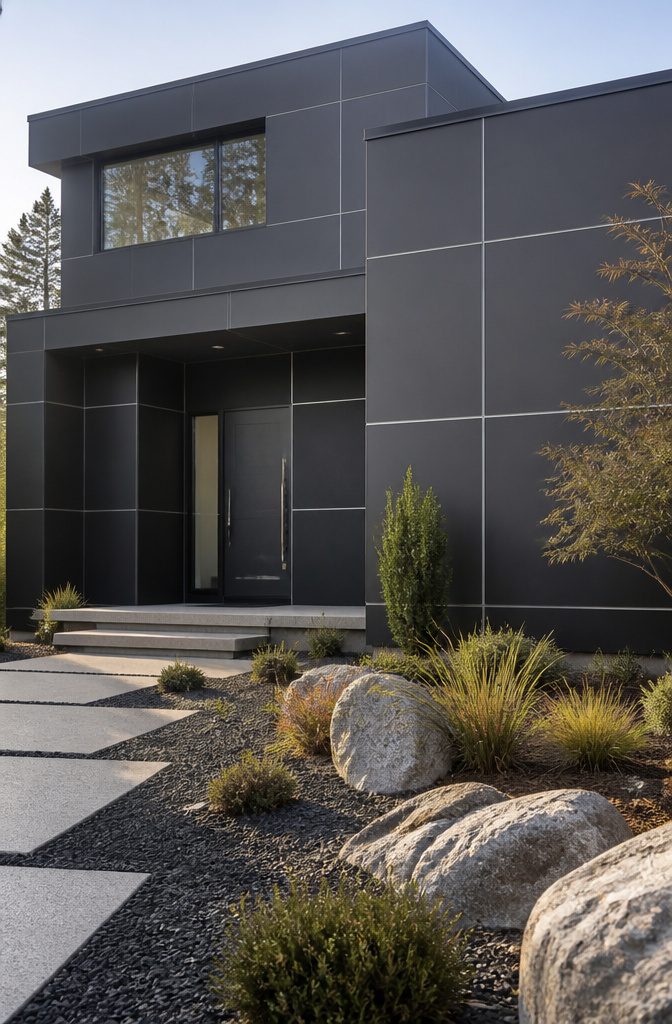
Smooth fiber cement paneling reads as genuinely contemporary on a black house with white trim exterior, especially when the surface stays flat enough that light skims across it in a single plane.
The grain in traditional wood siding fights a solid black finish; every variation telegraphs through and breaks the effect you are after.
Fiber cement and engineered wood both solve this, holding paint in a uniform film without the texture underneath arguing with the color.
Sherwin-Williams Iron Ore works particularly well here. It is not a harsh pure black; the softer depth keeps large flat panels from turning into visual voids, and the warmth pairs cleanly with most whites without the contrast feeling theatrical.
Tricorn Black or Black Fox run cooler or deeper, but for modern paneling with channel gaps in white, Iron Ore gives the trim somewhere to rest visually rather than making it pop too hard.
The channel itself becomes the detail.
Narrow gaps between panels, painted white, do the work that crown molding or corner boards used to do. Keep the channels consistent; uneven spacing reads as a mistake on this style, not character.

Requires one R20 or PAR20 bulb rated up to 50-Watts Max. (not included)

FINISH CURVES WITHOUT AWKWARD JOINTS - Rigid strips can leave gaps around rounded openings. Flexible trim moulding follows gentle bends and straight runs, while arch molding cuts to fit. Use flexible molding for arches to create a smoother, continuous outline around the frame

Decorative Solutions for Small Jamb Extensions
Staggered Edge Shake
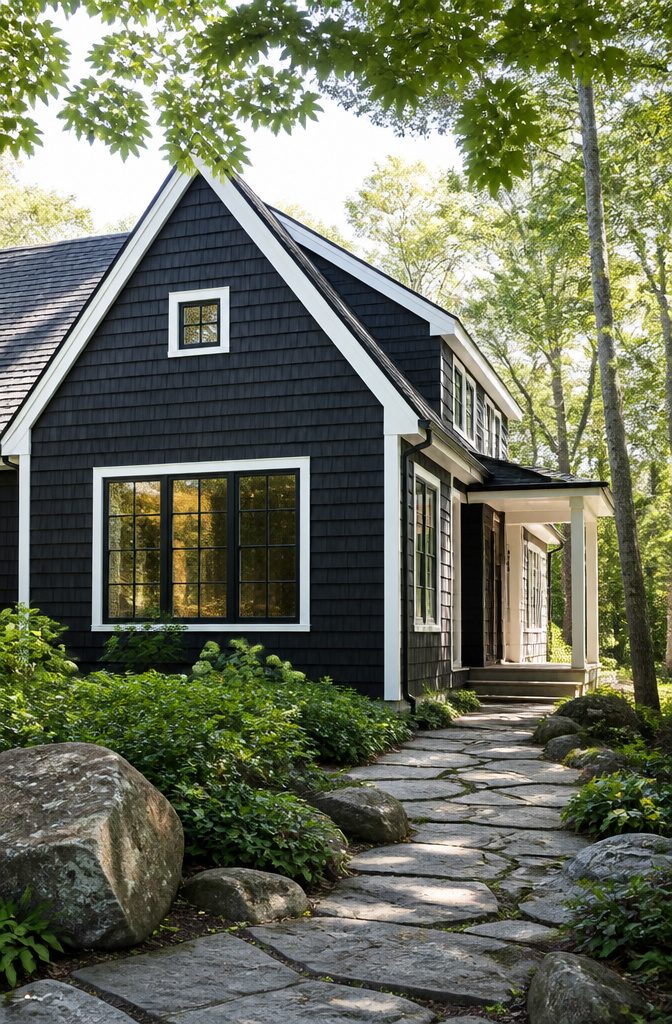
Cedar shakes staggered along the wall catch light differently than flat boards, each edge throwing a thin shadow that keeps black from reading as a solid mass.
The white trim at corners and eaves does the actual outlining, but the texture is what lets a black exterior feel dimensional rather than merely dark.
Shakes drink paint. The rough surface and end grain pull it in, so black on shakes needs reapplication sooner than the same color on smooth siding, sometimes by half again as many years depending on your climate.
Budget for that maintenance from the start, or the color dulls to charcoal-gray unevenly and the whole effect turns shabby.
For a black with enough warmth to suit cedar, Benjamin Moore Wrought Iron carries a brown undertone that keeps it from going cold or blue against the wood.
It reads as black in full sun but softens slightly in shade, which matters on a textured surface where light already plays tricks. Pair it with clean white trim, no cream, and the contrast stays crisp without feeling theatrical.

Flows on smoothly and dries to a tough, durable finish

【Everything You Need】Our comprehensive wood paint kit comes with all the essential tools to revitalize your furniture paint projects with ease.

Oslo Home has created a comparable color based on color specifications of the original color using industry leading technology.
Residential Lodge Architecture
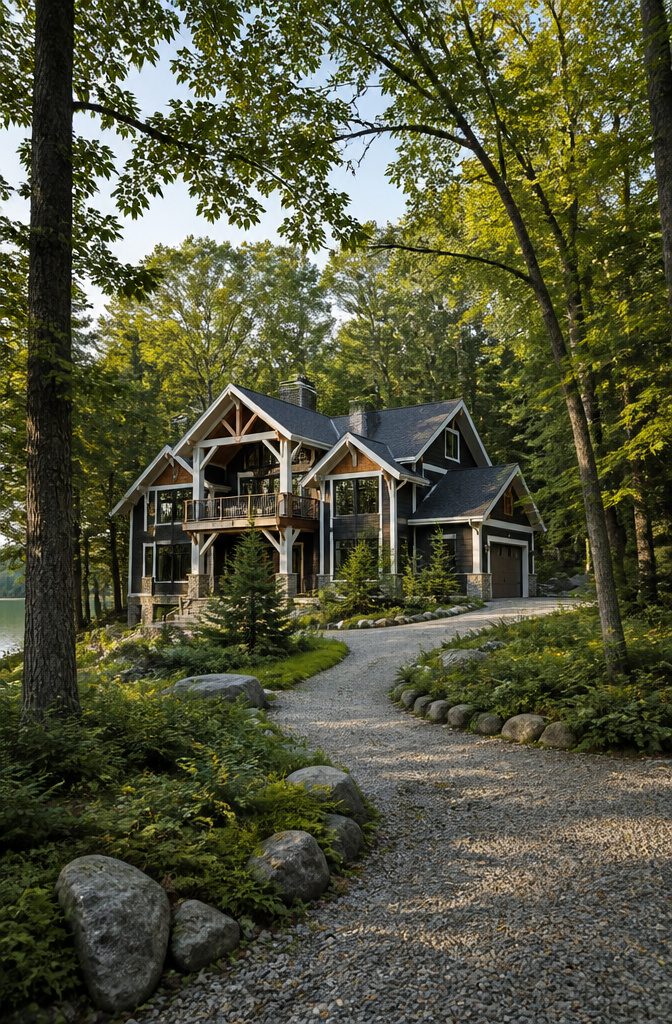
Heavy timber framing painted white against dark cladding is the mountain take on a black house with white trim exterior, and it reads differently than suburban trim work.
The beams become structural bones you see from twenty feet away, not polite edges. I have watched this go wrong when the timbers are too thin; they read as stick-on afterthoughts instead of load-bearing reality.
The scale of the white member has to match the weight of the dark wall behind it, or the whole thing flattens into graphic stripes.
Sherwin-Williams Urbane Bronze works here because it is not quite black.
Against natural wood stress, that near-black warmth keeps the exterior from looking like a photographic negative. The color has enough brown in it to let cedar or Douglas fir read as related rather than competing.
One way to play this: leave the timber natural and paint only the infill dark, which gives you a white skeleton on a bronze field.
The other way reverses it, dark structure with pale chinking between logs, and that version feels more Scandinavian lodge than Rocky Mountain.
The first option wins if your lot has heavy tree cover; the second needs open sky behind it to keep the white from washing out.

Excellent adhesion and durability

Durable & Weather-Resistant – Semi-gloss finish provides long-lasting protection against sun, rain, and harsh outdoor conditions.

【Everything You Need】Our comprehensive wood paint kit comes with all the essential tools to revitalize your furniture paint projects with ease.
Curved Features
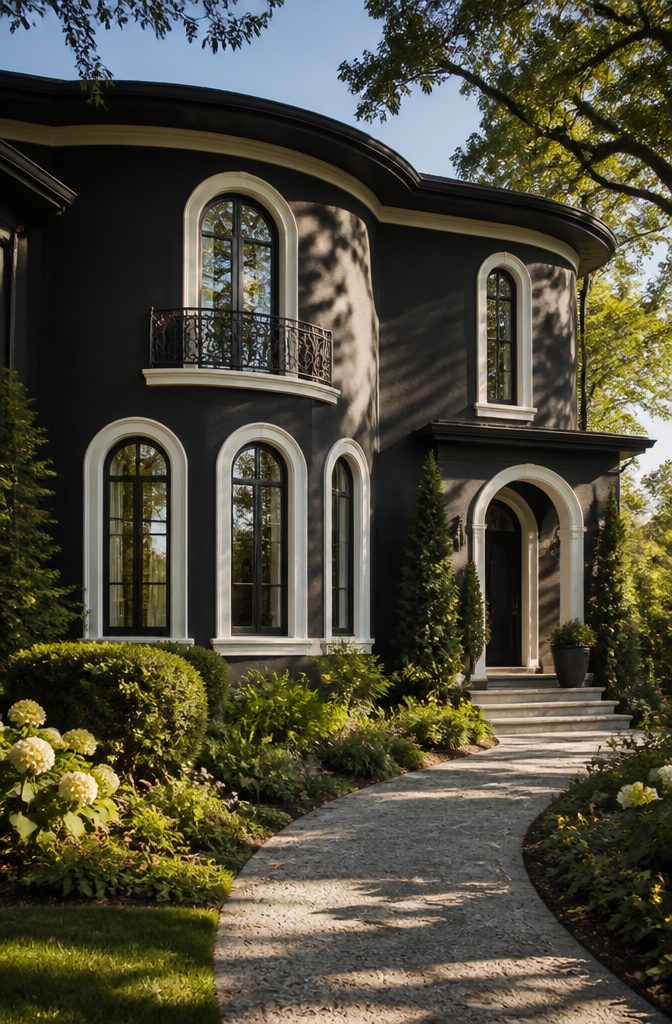
A flat black wall reads as a shape, not a building. Curved features change that completely.
The white trim shadow line becomes the whole sculpture when it traces an arch or barrel vault, because curves catch light at every degree instead of bouncing it back in a single plane. The trim shifts from border to modeling.
Arched windows are the most accessible place to try this.
The white casings follow the radius, and the shadow underneath deepens as the sun moves, so the opening seems to push into the wall or pull out of it depending on the hour.
Rounded bays do the same thing at scale, turning a rectangular box into something that reads as designed rather than painted on.
Barrel vaults over a porch or entry are harder to build, but even a small one changes how the black reads.
Flat surfaces absorb light; curved ones hand it back in gradients. The white trim is what catches those gradients and gives them to the eye as architecture.
Painted flat, black is a color choice.
With curves and trim that follows them, it becomes a material presence. The difference is what separates a house that photographed well once from one that holds up to walking past it every morning.

This 12 PACK Fits most 2-1/4" interior door and window casings

For attaching trim, window and door casing
FINISH CURVES WITHOUT AWKWARD JOINTS - Rigid strips can leave gaps around rounded openings. Flexible trim moulding follows gentle bends and straight runs, while arch molding cuts to fit. Use flexible molding for arches to create a smoother, continuous outline around the frame
Chevron Detailing
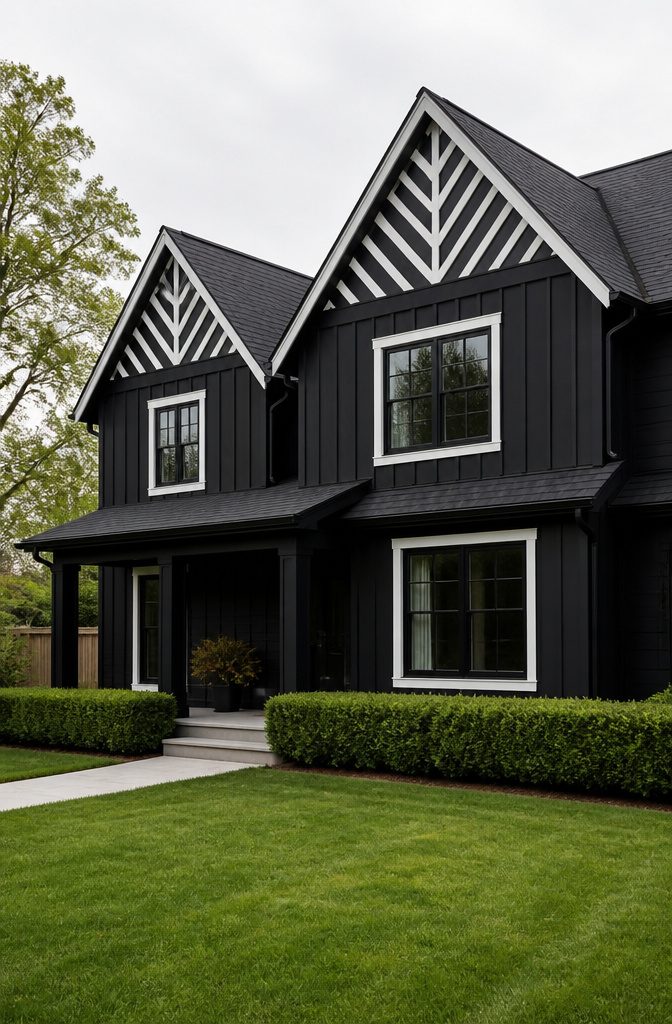
Diagonal lines on a black house with white trim exterior read from the curb before any other detail registers.
The chevron pattern works best where the eye already goes: gable ends, the wall behind a covered porch, or a single recessed bay that breaks up a long facade.
Full elevation coverage turns graphic into gimmick fast. I learned that watching a neighbor’s garage wall vibrate from across the street; the pattern had no resting place for the eye.
Painted chevrons cost only tape and patience, maybe a weekend between dry days. The key is a steady hand on the taping line, because black over white or white over black shows every waver.
Material options like mitered siding or shingle courses run steeper and need a carpenter who has done it before. For renters or first-home owners mid-project, paint is the practical move.
Mark the angle with a level and a spare board, not by eye. Two-inch painter’s tape, pressed hard at the edges, saves the redo that eats your Sunday.

Prestige Paints has created a comparable Color based on Color specifications of the original Color using industry leading technology
Ultra premium paint and primer in one

ALL SEASON PAINT & PRIMER-IN-ONE: Cascadia XL is a 100% Acrylic Latex Paint & Primer-in-One with advanced technology for rain protection and a superior finish
White Brick Exterior
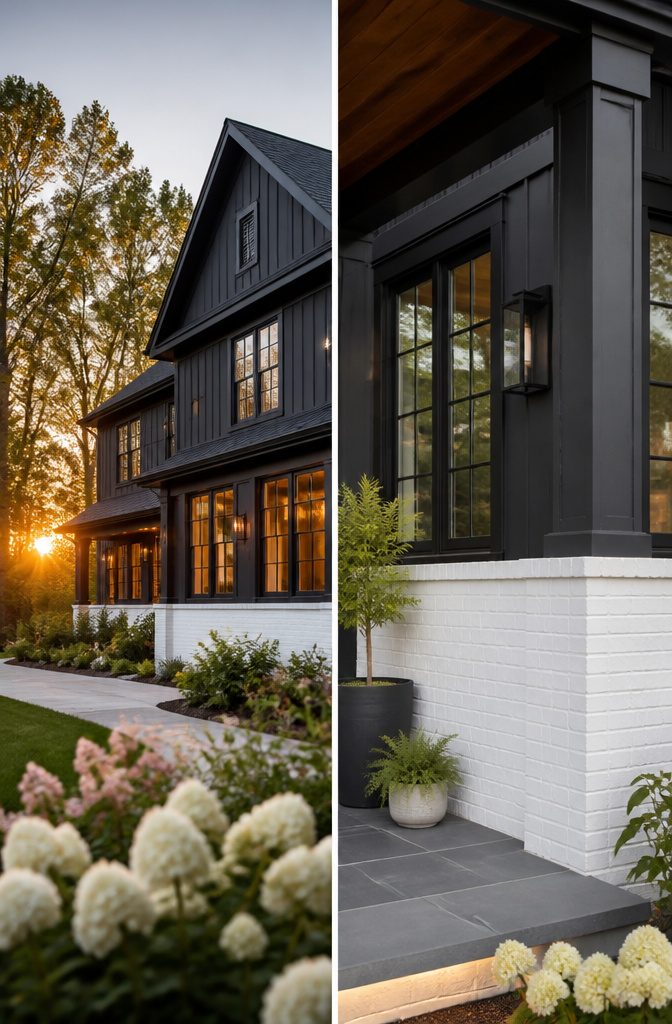
Painted white brick makes a surprisingly practical trim against black siding because it reverses the usual upkeep problem.
White brick stays cleaner than black brick ever would, since pollen, dust, and hard water marks vanish into the light color instead of etching themselves across a dark surface.
The mortar joints become part of the visual reading too; they widen the white band and give it a grid-like texture that flat trim boards cannot replicate.
Sherwin-Williams Pure White is the paint to reach for on exterior brick if you want a clean, clear white that will not drift toward yellow over seasons of sun.
I have watched warmer whites turn creamy on south-facing walls; Pure White keeps its neutrality because it carries no strong undertone to begin with.
That matters more on brick than on siding, since the rough surface catches light unevenly and any warm shift reads as inconsistent across the wall.
A black house with white trim exterior built this way reads heavier at the top than the standard formula, so the roofline and any upper windows need enough mass to balance the bright lower band.
Solid black roofing helps ground the look and keeps the white brick from feeling like it is floating free of the structure.
The texture of the painted brick does the rest, giving the eye something to settle on without breaking the two-tone discipline.

PREMIUM EXTERIOR & INTERIOR BLACK PAINT: Kompozit ONE Paint & Primer is a high-quality, Made in USA, 100% acrylic coating, perfect for both exterior paint and interior paint projects, offering exceptional durability and finish.

Fast-drying, interior/exterior acrylic latex line marking traffic paint that can be applied with a brush, roller, hand or automatic line markers.
Dynamic Texture
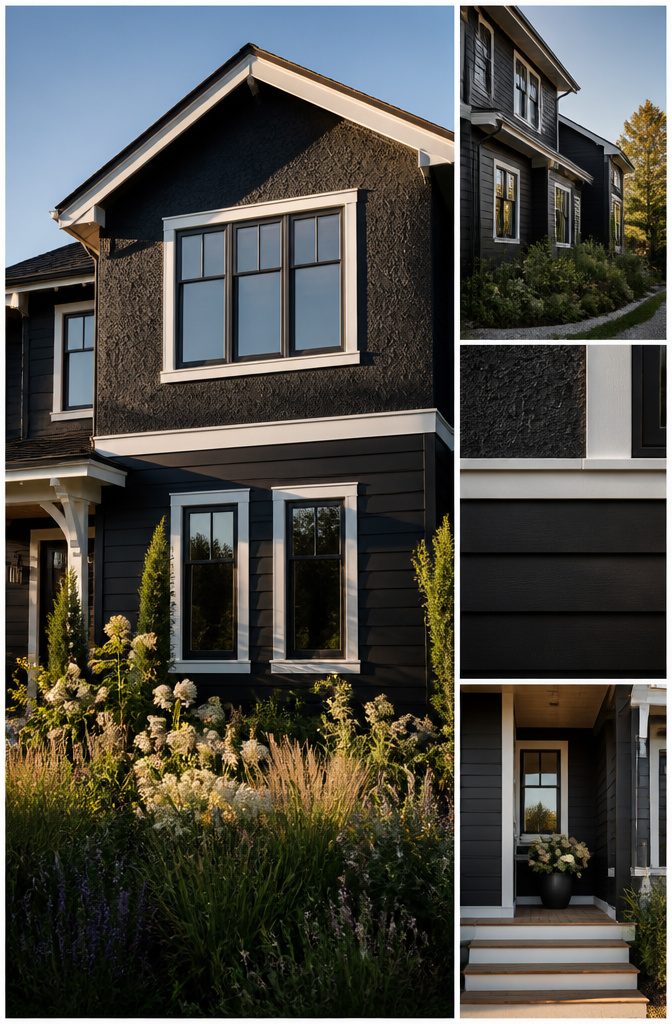
Smooth siding reads flat from the street if every surface matches, so texture variation is what keeps a black house with white trim exterior from looking like a solid block of paint.
On a renovation I followed closely, the homeowner paired horizontal lap in a matte black with rough stucco on a second-story gable, then ran smooth fiber cement panels as a skirt below.
The white trim stayed identical at every junction, a 3-inch flat stock that caught light differently against each black surface and made the whole facade read as intentional rather than patched together.
Older houses carry texture already, whether original clapboard or decades of repaints that leave slight ridges, and that history lets you get away with two black finishes without the contrast feeling forced.
New builds need the variation built in deliberately; otherwise the eye slides across uniform planes and the drama of the palette collapses into monotony.
Brick, even painted white, holds enough natural irregularity that solid black roofing and trim can calm it without competing, but that same brick painted black would fight any smooth siding you set next to it.
The rule I pulled from comparing projects: keep one texture dominant, let the second accent a single plane or volume, and lock both to the same white trim profile so the color does the unifying, not the material.
FINISH CURVES WITHOUT AWKWARD JOINTS - Rigid strips can leave gaps around rounded openings. Flexible trim moulding follows gentle bends and straight runs, while arch molding cuts to fit. Use flexible molding for arches to create a smoother, continuous outline around the frame
FINISH CURVES WITHOUT AWKWARD JOINTS - Rigid strips can leave gaps around rounded openings. Flexible trim moulding follows gentle bends and straight runs, while arch molding cuts to fit. Use flexible molding for arches to create a smoother, continuous outline around the frame
FINISH CURVES WITHOUT AWKWARD JOINTS - Rigid strips can leave gaps around rounded openings. Flexible trim moulding follows gentle bends and straight runs, while arch molding cuts to fit. Use flexible molding for arches to create a smoother, continuous outline around the frame
Heighten with Board and Batten
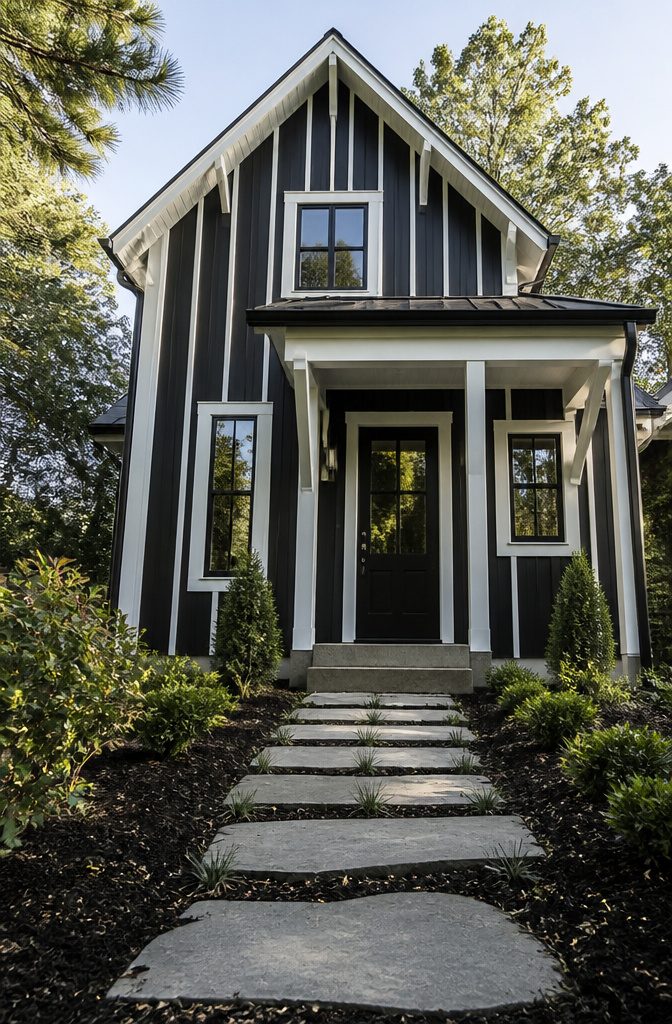
Vertical boards read differently than horizontal lap siding. The eye follows those lines up, and a modest single-story house suddenly carries itself like something taller.
Board and batten works this way by design: wide boards set 12 inches apart with narrow 2-inch battens covering the seams, a proportion that has not really needed updating.
Painting the boards black and the battens white keeps the geometry sharp. The black recedes, the white joints pop, and the whole wall becomes a grid that emphasizes height without shouting about it.
Benjamin Moore Seapearl is the white I would reach for here, a warm white against a cool black that keeps the contrast from going sterile.
Traditional proportions still look right because they are; 12-inch boards with 2-inch battens is the spacing that lets the pattern read from the curb without turning busy.
I would keep the black to the boards and maybe the entryway, letting the white battens do the vertical work.
Too much black on a vertical surface and the house starts to feel like a monolith rather than a structure with dimension.

ALL SEASON PAINT & PRIMER-IN-ONE: Cascadia XL is a 100% Acrylic Latex Paint & Primer-in-One with advanced technology for rain protection and a superior finish
ALL SEASON PAINT & PRIMER-IN-ONE: Cascadia XL is a 100% Acrylic Latex Paint & Primer-in-One with advanced technology for rain protection and a superior finish
Spanish Revival Architecture
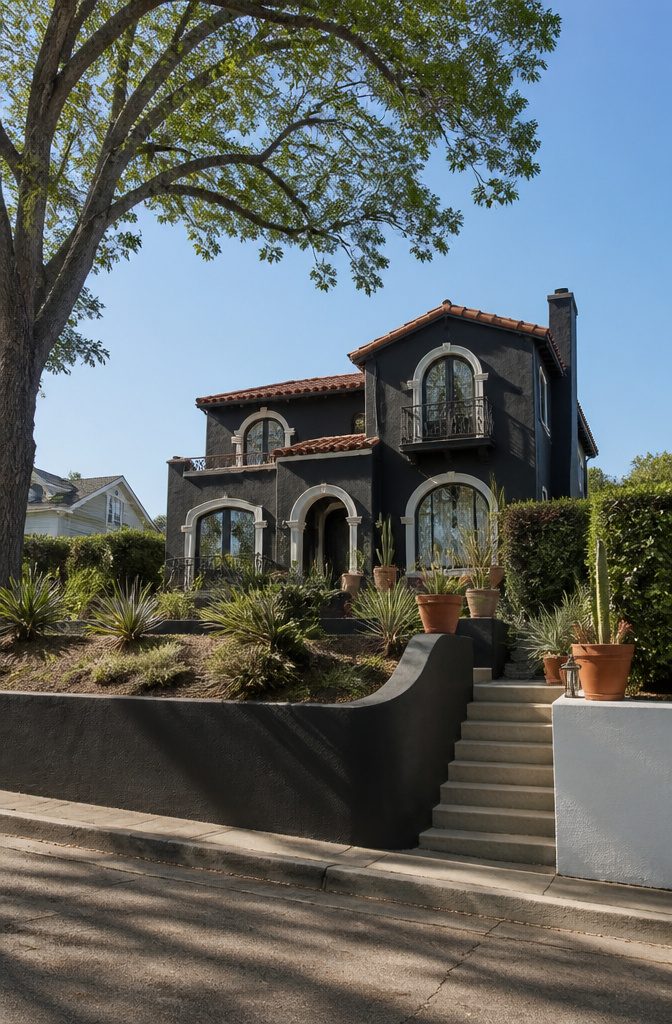
Black stucco walls paired with white trim at arched openings, wrought iron balconies, and clay tile roof edges feel unexpected on a Spanish Revival home.
Browns and reds are more typical for the style, but the black-and-white theme reads crisp and deliberate when the lines are clean.
The catch is the heat. Black absorbs significantly more solar energy than lighter tones, and in southern zones that thermal load pushes harder against your cooling bill.
Fiber cement panels can imitate the stucco look without the same mass, which helps, though the color itself still pulls warmth inward.
If the house sits under mature shade trees or deep overhangs, the trade becomes manageable; in open sun on a Texas or Arizona lot, the white trim alone will not offset what the walls collect.
Wrought iron balconies painted black against white casements sharpen the contrast the style already favors. Clay tile roof edges, left in their natural terracotta or painted white, create a three-tone roofline that keeps the house from reading too stark.
The arched openings matter most: the white trim there acts as a frame, and the curve softens what otherwise risks looking severe.
Grounded in Natural Materials
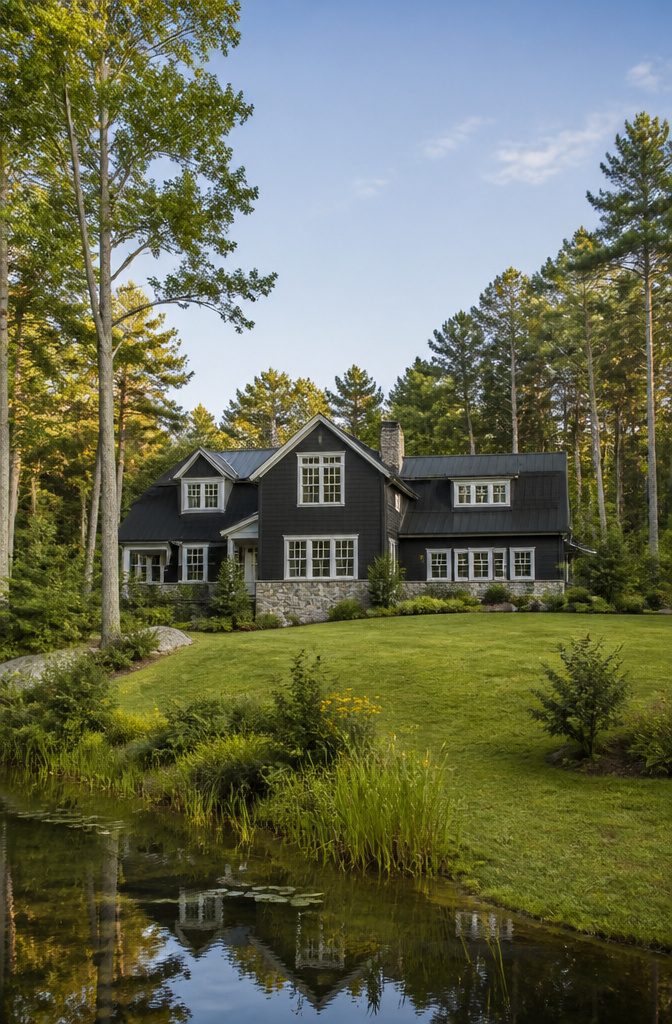
A black house with white trim exterior risks looking like a floating box if the siding meets the lawn with nothing in between. Stone along the foundation breaks that line and ties the whole thing to the grade.
Gray-blue fieldstone reads right here, especially the rougher, uncut kind that catches shadow. Pink granite or anything with a warm cast fights the cool tone of most black paint and turns muddy against white trim.
Unpainted wood can do the same job on a chimney or porch post. Cedar or oak left to silver gives you a stripe of living color that shifts with the weather, which keeps the black-and-white scheme from feeling too finished.
The key is keeping it below the window line so it reads as ground, not as decoration competing with the trim.
What convinced me, reading through a dozen of these, is that the stone layer only needs to climb 18 to 24 inches above grade to do its work.
Any taller and it starts to read as a feature wall; any shorter and it disappears behind foundation plantings inside a season.
Set the top edge level, not stepped with the grade, so the black siding above has a clean baseline to sit on.
Architectural Styles That Carry It
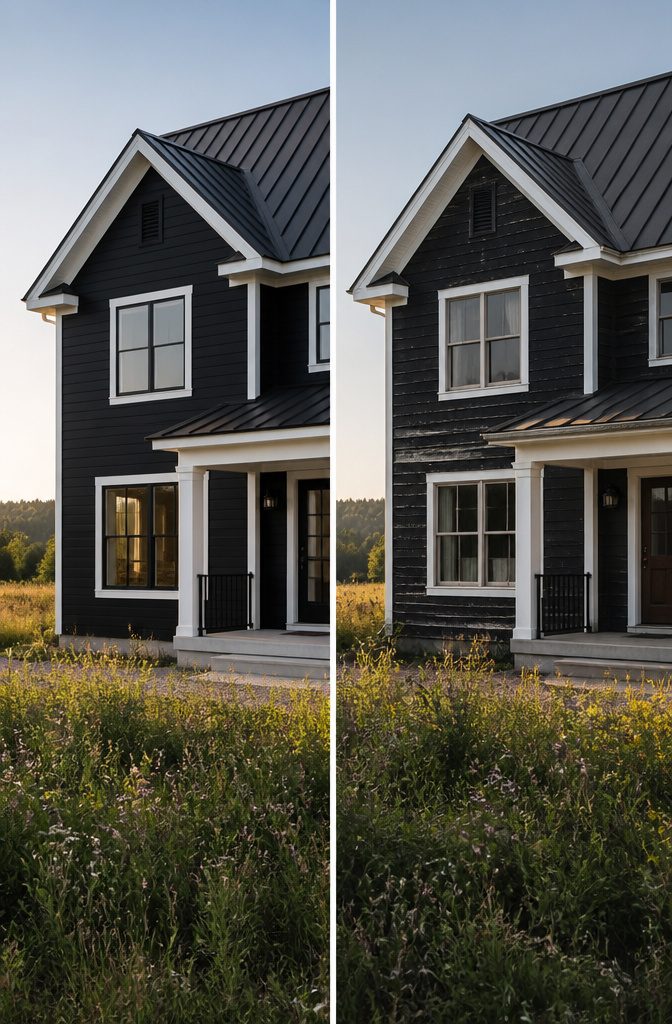
Modern farmhouse, colonial, and Mediterranean are the three styles that keep surfacing for a black house with white trim exterior, and each brings something the color scheme can actually work with.
Farmhouse gives you plain forms: broad gables, uncomplicated rooflines, siding that reads as one quiet plane. Black settles evenly across that surface, and white trim picks out the edges without fighting for attention.
Colonial adds symmetrical discipline, windows paired and spaced so the white casings create a rhythm you read from the street. Mediterranean contributes massing and shadow, stucco walls that turn charcoal in low light and white architraves that catch the sun.
The source material notes Spanish colonial revival specifically, where fiber cement panels can stand in for adobe and still carry the same stucco-like surface in crisp white against black.
If your house is none of these, the move is to borrow the principle rather than the style.
Look for what your architecture already offers in plain surfaces, symmetry, or weighty massing, then let the trim do the work of emphasis.
A ranch with a low roofline gains farmhouse calm from black siding and white corner boards. A split-level with a centered entry reads more settled with white casing that mirrors colonial spacing, even without the columns.
Paint Colors That Actually Work
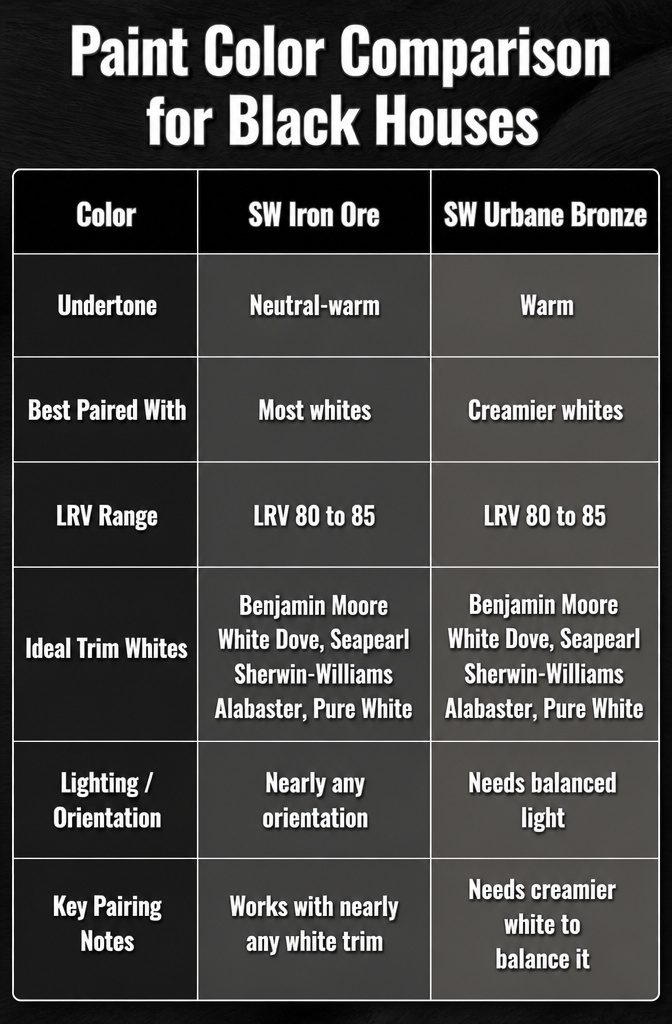
White paint for trim on a black house sits in a narrow band.
Too bright and the glare bounces off siding like a flashbulb; too soft and it turns muddy against the dark body. The range that works is LRV 80 to 85, high enough to read clean without that institutional shine.
Benjamin Moore White Dove and Seapearl both land here, along with Sherwin-Williams Alabaster and Pure White. Alabaster carries the slightest cream, which is why it pairs well with warmer blacks.
For the body color, straight black reads flat on most houses.
Off-blacks with actual undertone do the heavy lifting. Sherwin-Williams Iron Ore runs neutral-warm and works with nearly any white trim.
Urbane Bronze skews warmer and needs that creamier white to balance it. Black Fox goes deeper and richer, best when the trim or the porch posts bring in wood.
Benjamin Moore Wrought Iron is the cool outlier; it holds up on west-facing walls where afternoon sun would bake a warmer black into something brown.
| Color | Undertone | Best Paired With |
|---|---|---|
| SW Iron Ore | Neutral-warm | Most whites |
| SW Urbane Bronze | Warm | Creamier whites |
| SW Black Fox | Warm-deep | Warmer whites & wood accents |
| BM Wrought Iron | Cool | Bright sun / west-facing |
Testing means painting a 2-by-2-foot board, not the wall.
Move it around the house across two days, morning and evening. What reads crisp at 9 a.m. may sink into the siding by 5 p.m.
Lighting and Landscaping
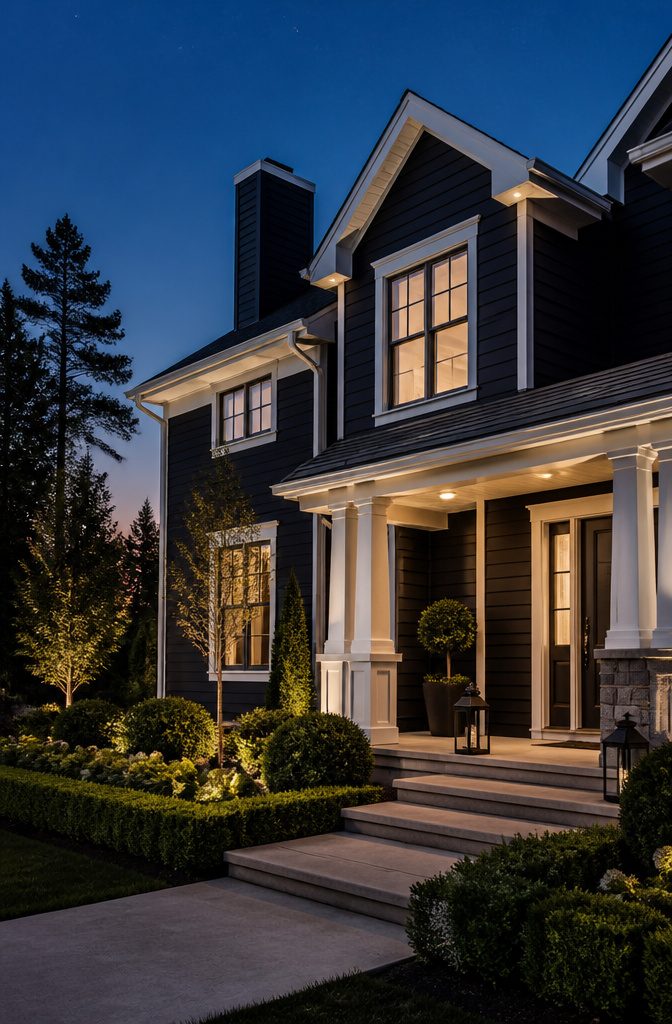
Warm light at 2700K does something specific against a black house with white trim exterior.
It grazes the trim without washing out the shadow line that makes the whole scheme read as architecture instead of paint. Cool white fixtures, anything above 3000K, flatten the contrast and the house starts looking like a rental sign photo.
I learned this the hard way with a string of cheap solar path lights that threw a bluish ring onto pale siding. The white trim turned sickly.
Swapping to black-finished fixtures in weathered brass, placed to catch the edge of door casings and corner boards, fixed it. The light pools downward and the trim seems to glow against the wall instead of competing with it.
Landscaping follows the same rule. Dark-leaved plants, especially the purple ones, disappear against black siding and read as holes.
Green structure, simple boxwood or upright juniper massed in blocks, holds the monochrome together. One clipped shape reads as calm; three different textures fighting for attention turns the yard into noise.
The house is already doing the graphic work. Let the plants be the quiet frame, not another pattern.
Frequently Asked Questions
What are the best paint colors for a black house with white trim exterior?
For the black body, Sherwin-Williams Iron Ore works with nearly any white, Urbane Bronze pairs with creamier whites, and Benjamin Moore Wrought Iron suits west-facing walls.
For trim, Benjamin Moore White Dove and Seapearl both land in the ideal LRV 80–85 range, along with Sherwin-Williams Alabaster and Pure White. Alabaster carries the slightest cream, which pairs well with warmer blacks like Iron Ore or Urbane Bronze.
How do I choose the right white paint for trim on a black house?
Aim for a white with an LRV between 80 and 85.
This range reads clean without the institutional shine of brighter whites or the muddiness of softer ones. Benjamin Moore White Dove and Seapearl both fall here, as do Sherwin-Williams Alabaster and Pure White.
Test by painting a 2-by-2-foot board and moving it around the house across two days, since morning and evening light change how the color reads against dark siding.
What architectural styles work best with a black house and white trim exterior?
Modern farmhouse, colonial, and Mediterranean are the three styles that carry this palette most naturally. Farmhouse offers broad gables and quiet planes for black to settle evenly across.
Colonial brings symmetrical window spacing so white casings create street-readable rhythm. Mediterranean contributes massing and shadow, with stucco walls that turn charcoal in low light and white architraves that catch the sun.
If your house is none of these, borrow the principle: find plain surfaces, symmetry, or weighty massing in your existing architecture, then let the trim emphasize what is already there.