
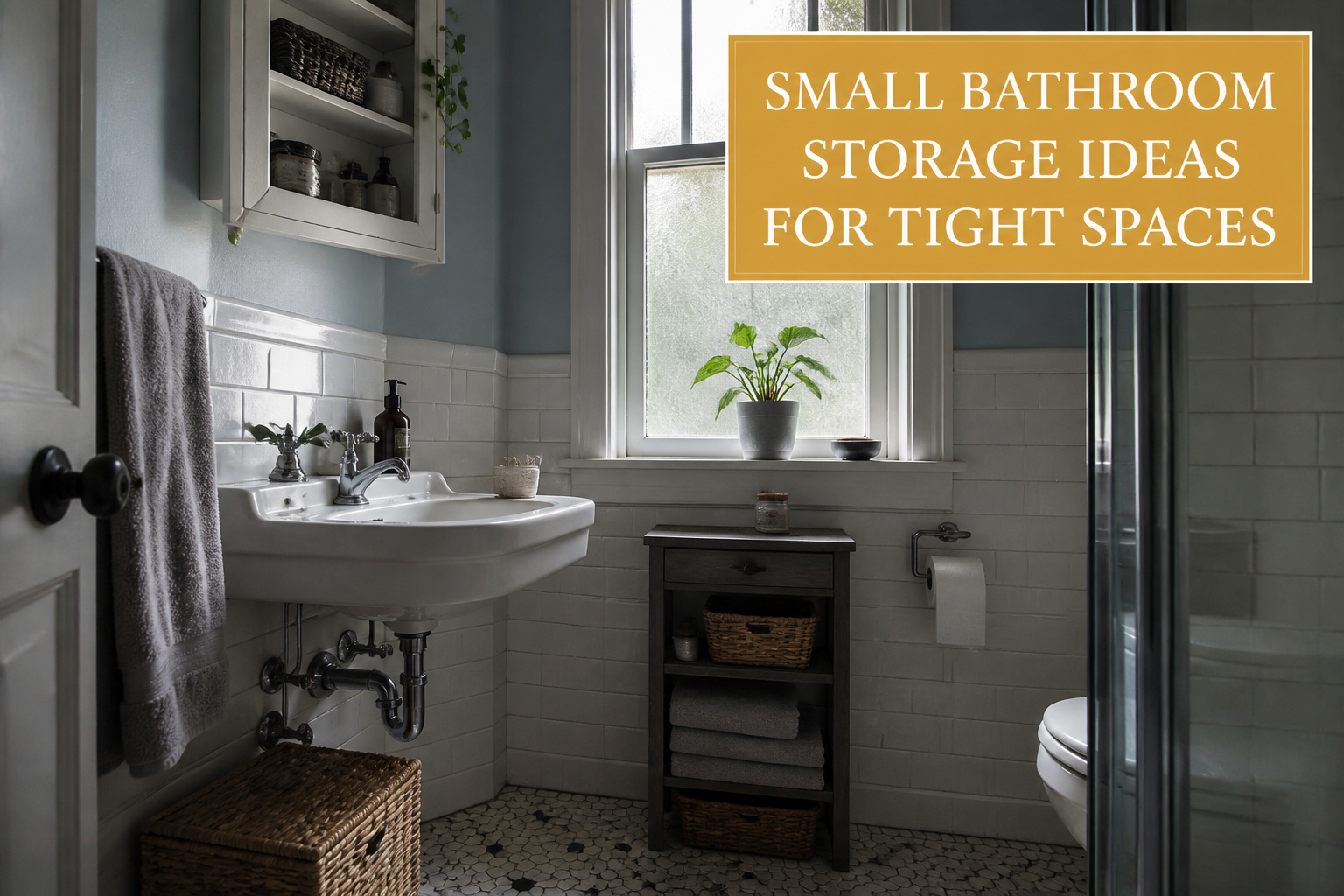
The right storage idea for a small bathroom depends less on the square footage than on whether you rent, how humid the room gets, and whether you are willing to put holes in tile you do not own.
A $72 over-toilet etagere buys twenty minutes of setup and three years of rust near the shower.
A $14 pine board from Home Depot disappears into the wall if you paint it to match, but space it at 16 inches, not 22, or your towels hang over like flags.
1. Over-the-Toilet Storage Units
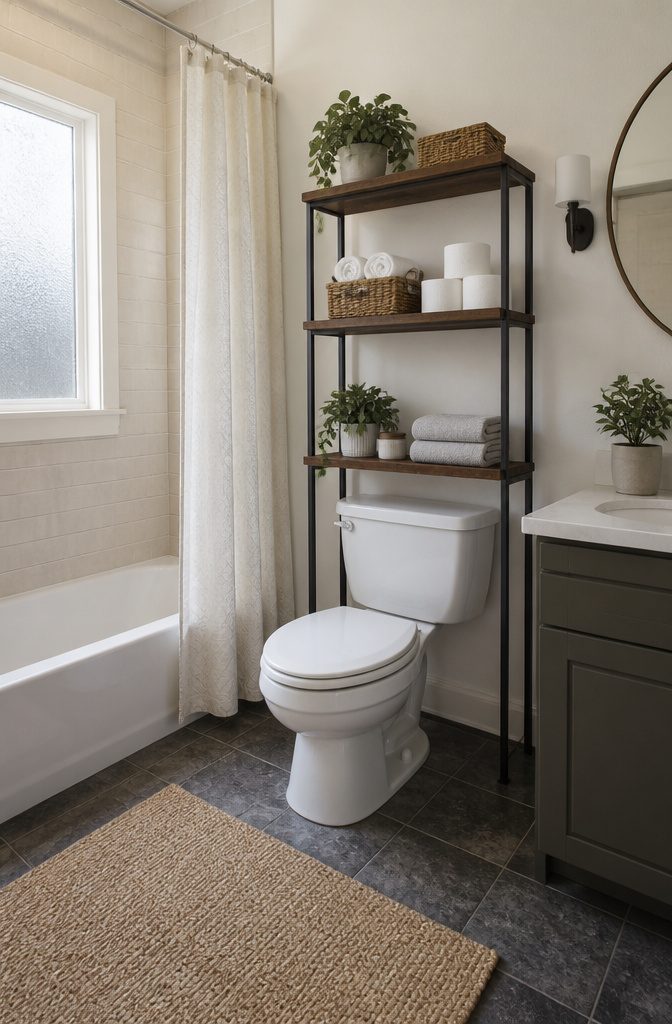
The dead zone above a toilet tank is usually 24–27 inches of wall space that does nothing until you put a unit there.
A freestanding etagere running 60–70 inches high turns it into three or four shelves of real storage, and most renters can set one up in twenty minutes with no tools beyond what comes in the box.
The wall-mounted kind needs a stud finder, a level, and a drill, plus the nerve to put holes in tile you do not own.
I bought a $72 metal-and-wood rack from Target in 2019. It held everything, toilet paper to skincare, until the humidity rusted the lower shelf brackets in year three.
Open shelving keeps a small bathroom from feeling boxed in, and a basket or two on the middle shelf hides the clutter that open storage otherwise advertises.
If you are buying for a household with small children, the bottom shelf should sit at least 36 inches off the floor; anything lower becomes a climbing gym.

【Create Vertical Storage Space】This bathroom shelf cleverly utilizes the unused area above the toilet, providing ample storage capacity without taking up additional room. It can not only hold towels, shower gels and shampoo, but also potted plants.

CREATE VERTICAL STORAGE SPACE: Say goodbye to cluttered countertops and limited floor space! This over-the-toilet bathroom cabinet utilizes the unused area above your toilet, offering generous storage capacity without taking up additional room. Featuring 3 mesh shelves, a toilet paper holder, and 5 versatile hooks, it's ideal for organizing bathroom accessories, towels, bathrobes, or small baskets, keeping essentials neatly arranged and easily accessible.

DO’T WASTE SPACE ABOVE the TOILET: Designed to make full use of the blank space above the toilet, this space-saving toilet storage rack give you 3 adjustable shelves to hold all your bathroom essentials. Besides, placed it above the washing machine to store care supplies also would be a good idea
2. Floating Shelves
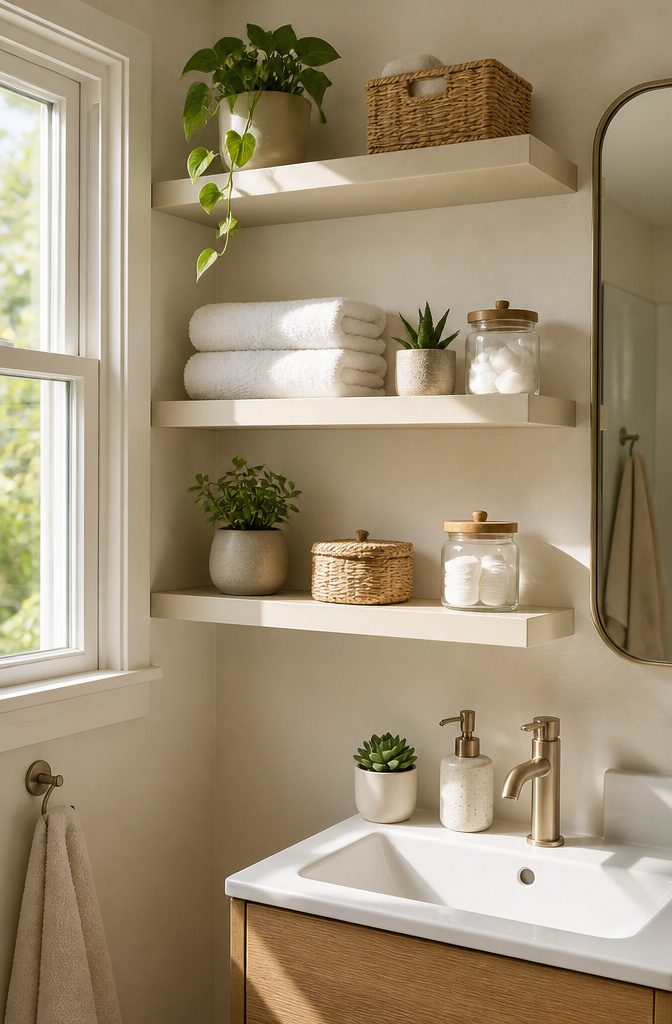
Pine boards from Home Depot run about $14 each for a 24-inch length, and three of them painted to match the wall color will disappear against the surface instead of adding visual clutter.
Mount them 16 to 18 inches apart if you plan to store folded bath sheets; that spacing leaves enough height for a standard towel folded once without the bottom edge drooping past the shelf lip.
I spaced my first set at 22 inches, and the towels hung over like sad flags.
That extra six inches sounds minor until you live with it. For smaller items like matching jars of cotton rounds or toiletries, 10 to 12 inches between shelves keeps everything within reach without wasted air space.
Always anchor into studs, especially if you are stacking glass containers or loading up with more than one towel per shelf.
The hardware finish is worth matching to your faucet or towel bar if you want the whole wall to read as intentional rather than patched together.

Vertical Capacity Expansion: This 4-tier over the toilet storage cabinet utilizes unused wall areas in compact bathrooms. The 64-inch tall frame offers four levels of organized shelving, effectively managing daily essentials and keeping towels or tissues within reach without occupying extra floor space.

5 Hanging Shower Organizer Set for Sufficient Bathroom Storage Space:The bathroom organizer comes with 5 pieces for different uses, including 2 shower caddies, 2 soap holders,1 toothbrush holder and 5 adhesives. Accommodate wash supplies or cooking seasonings easily with large capacities to make full use of space and facilitate your life; ideal for the dorm/bathroom/kitchen/toilet/tool room.

COMPLETE 6-PIECE SET: Includes three large shower shelves, one toothbrush holder, two soap holders, and six adhesive strips. The shelves feature 24 built-in side hooks for razors, loofahs, towels, and other bath accessories
3. Narrow Cabinets and Storage Towers
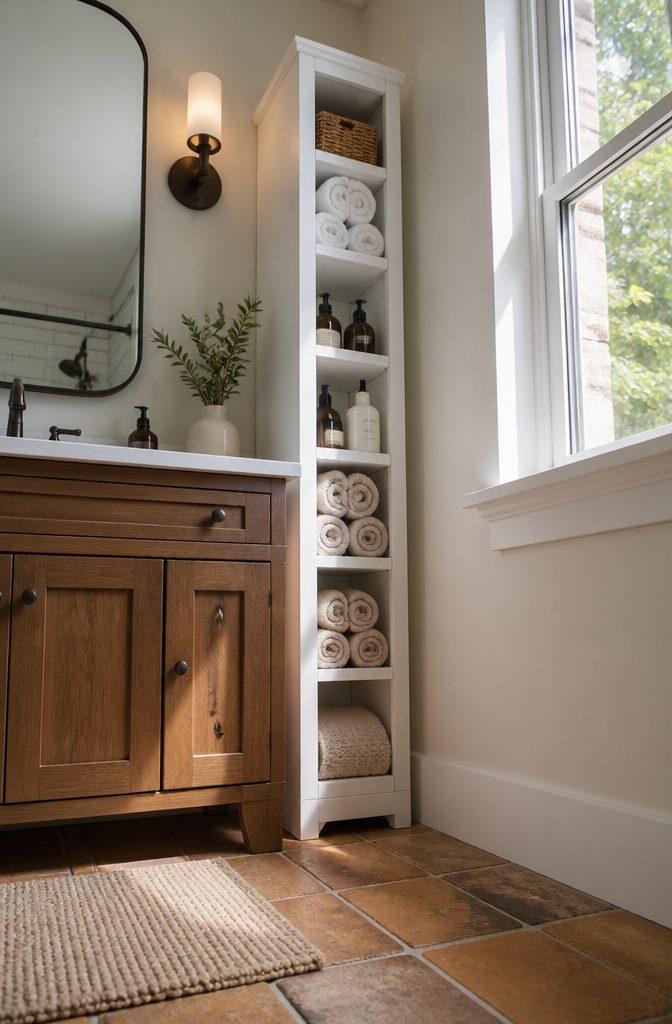
A 6-inch gap between the vanity and the wall is where most bathroom plans give up.
The right tower turns that dead zone into four or five shelves of actual storage — enough for a couple dozen rolled towels or the backup shampoo bottles that never fit under the sink.
IKEA’s HEMNES narrow shelf unit runs 10 inches wide and 78 inches tall, but I tracked down a knockoff at Tuesday Morning for $45 that survived two apartments and a move between them.
Casters look like a convenience until you hit a bathroom floor that sloped toward the drain in the 1980s building. Fixed feet would have left the thing rocking on two legs, so the rolling base became non-negotiable quicker than expected.
The Yamazaki Tower Rolling Storage Cart goes the opposite direction at about 5 inches deep and $165, elegant enough to face outward but light-duty enough that its wheels complain under real weight.
Wood-veneer tops still mark from month-old shower splatter even without warping, and steel needs wiping down if it lives near the tub.
Two ways to play this: roll the cheap tower wherever the gap appears and replace it when the finish goes, or splurge for the slim profile and commit to cleaning schedules that the price tag demands you keep.

Material: Medium Density Fiberboard, outlasts wood in damp bathroom environments

Wide Use Scenes - Our floating shelves for wall not only can be used in the living rooms, bedrooms, but also the bathrooms and kitchens. Perfect for displaying and holding collectibles, small plants, frames, and more.

Use Every Bit of Wall Space - Installing white and gold floating shelves (Size: 17"L x 6"D x 2.2"H) set of 3 can help you add both storage and style to your bathroom, bedroom, closet, nursery etc., and they don’t need to take up a single square foot. Forbena Floating shelves bathroom can hold everything from daily essentials like skincare serums and washcloths to decorative items like indoor plants, fresh flowers or framed artwork.
4. Under-Sink Organizers
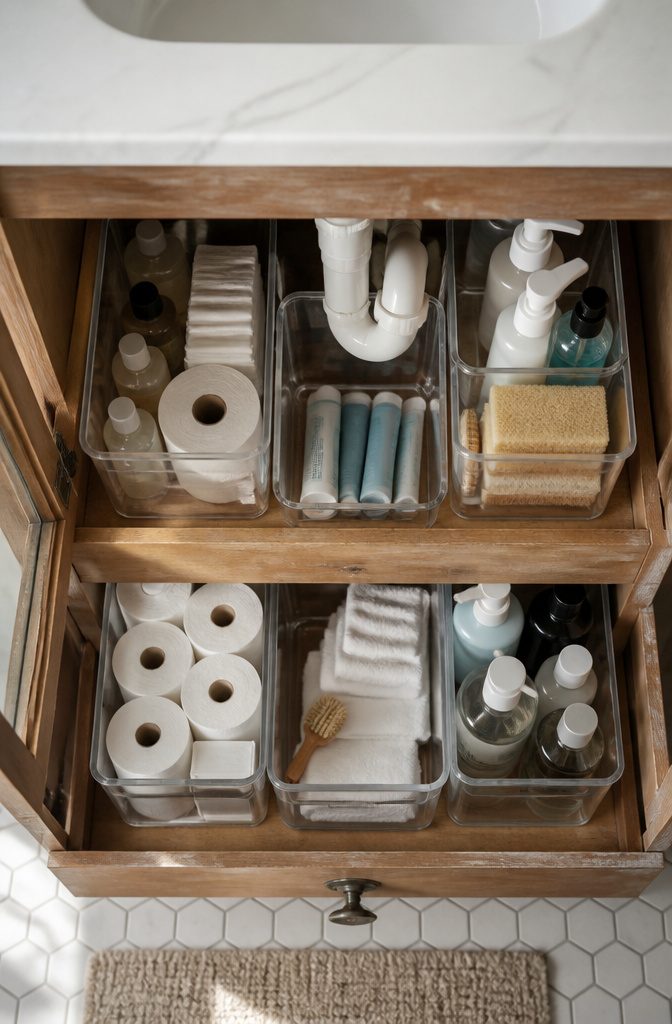
The cabinet beneath a bathroom sink looks like usable space until you account for the P-trap, supply lines, and drain hose that chew through the middle of it.
My first attempt at organizing under there was one large tub from the hardware store. Within a month it had become exactly what the sources warn against: a black hole of half-empty bottles where backup toothpaste went to disappear.
Stackable bins, drawer-style organizers, and tiered shelves are what actually work, because each one routes around that plumbing instead of pretending it isn’t there.
A $12 set of three clear bins from The Container Store let me see backup toothpaste without unpacking everything. Drawer-style organizers pull forward so the back tier stays accessible; the sources suggest keeping daily essentials in front and reserves behind.
For pipes that sit low, U-shaped organizers or adjustable two-tier systems fit the contour rather than fighting it. The sliding 2-drawer organizer and Chrome 2-Tier Sliding Organizer are built for this geometry.

【Narrow Unique Design】Our 3 tier narrow ladder shelf measures only 9.85 inches in length and 11.65 inches in depth. Ideal for placing in corners or any narrow location to make the most of limited space, it's a perfect standing shelf option that maximizes vertical space.

Stable Premium Material Bathroom Shelf: Sturdy, strong corrosion resistance, maximum load to 40lbs each, duarble and easy To clean

1.Gap Storage Expert: 4-Tier Intelligent Height Differential Design:(4.9"W x 38.7"H x 15.3"D)Engineered for modern compact living! With its slim 4.9-inch profile, this organizer fits perfectly into narrow gaps between furniture and appliances. Its core advantage lies in the innovative four-tier height differential design: the lower two tiers provide generous 12.5" , while the upper two tiers feature an optimal 9.2" height . One unit accommodates all sizes, maximizing vertical space utilization.
5. Rolling Carts
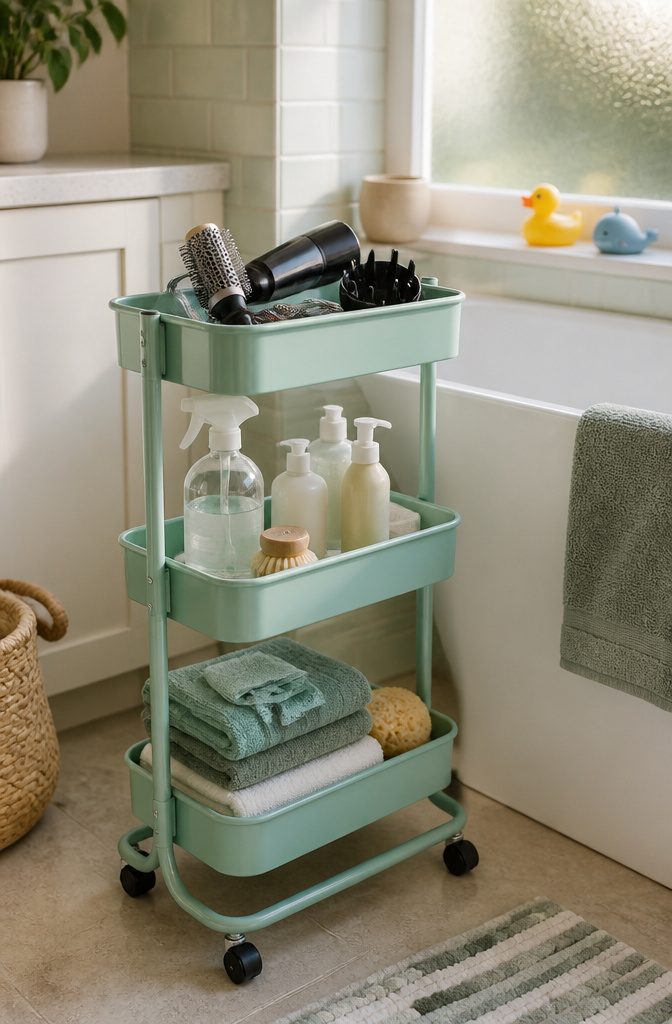
A rolling cart gives you the same six- to ten-inch width as slim towers, but it follows the project instead of staying put.
My own three-tier metal cart from Amazon, thirty dollars at the time, lived in my bathroom for two years morning to night: hair tools on top before work, cleaning supplies loaded in after dinner, rolled beside the tub when I needed it, then tucked back against the wall.
The top shelf picked up rust spots where my wet comb sat; a silicone trivet fixed that. Now it holds paint cans in the garage.
The slotted trays allow water to drain through, so no mildew can collect from the wet toys between bath times. And when she needs it out of the way, the lockable wheels help it stay put until it’s time to roll back over.
For a reader, this means the cart survives humidity if the finish holds, and rust prevention is on you, not the manufacturer.
The IKEA Råskog, at the same $30 price point, builds in that epoxy-coated steel frame and lockable wheels; either way, the investment is low enough that repurposing it later feels like a win rather than a loss.
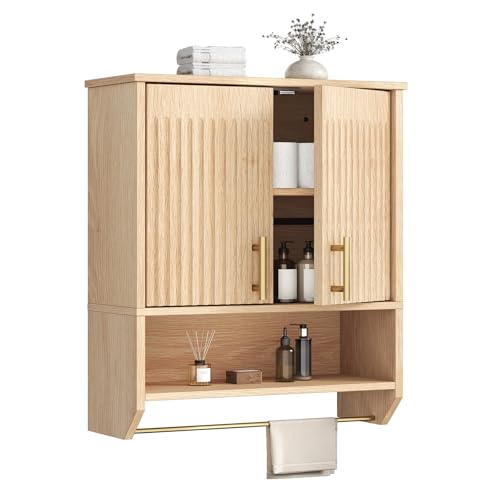
Perfect for Small Spaces: Struggling with limited bathroom space? This narrow wall cabinet is designed to maximize vertical storage without taking up floor space—perfect for small bathrooms, apartments, and tight wall areas

Dual-Door Convenience for Easy Storage: This bathroom wall cabinet boasts a dual-door cabinet with a 3-height adjustable shelf, providing ample space for daily essentials like toiletries. Smooth opening and closing make accessing items a breeze

Compact Wall Storage: Make better use of empty wall space with this small bathroom wall cabinet, designed to help reduce countertop clutter in bathrooms, powder rooms, kitchens, or laundry areas.
6. Behind-the-Door Storage
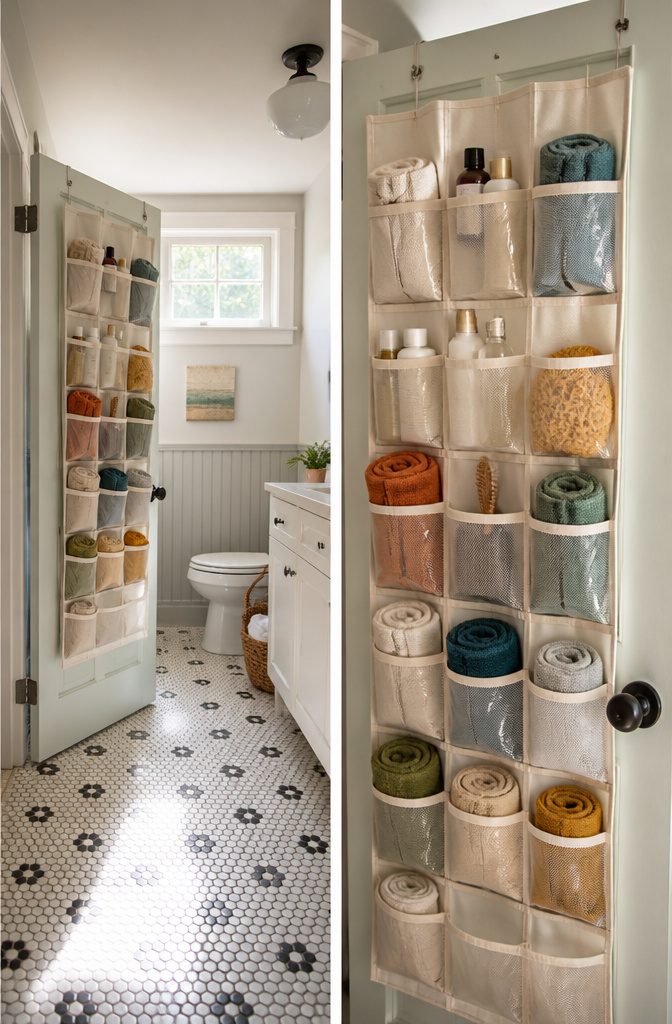
The back of a bathroom door holds 12-16 square feet of unused space, and over-door hooks and pocket organizers tap it without touching walls or floors.
That matters in rentals where a single chip in the paint comes out of your deposit.
Standard over-door hooks carry 10-15 pounds, enough for a robe and a towel but not much else.
For heavier loads, organizers built for extra weight keep the pocket from sagging. Clear ones let you spot the contents fast; fabric reads softer if the door stays visible from the hall.
I hung a $9 fabric shoe organizer once for rolled washcloths, backup deodorant, stray razors, the small stuff that colonizes a counter otherwise. It worked until move-out, when the hooks had left faint marks along the door top.
Touch-up paint ran me $23. For the math to work, the organizer needs to outlast more than one lease, or you need a hook with protective foam under the frame.
The rounded rubberwood knobs on one steel rack held up through steamy showers without staining or snagging. That detail costs a few dollars more upfront, but it beats buying the landlord a quart of semi-gloss.

Utilize Limited Vertical Bathroom Space: The perfect pick for small bathrooms, 3-tier freestanding over the toilet storage unit helps keep your toiletries organized without taking up too much floor space, you don't have to bend over to get stuff under the sink

【Over Toilet Storage】The bottom shelf can easily fits into space behind your toilet. Featuring three mesh shelves, it provides ample storage for bathroom accessories, shampoo, shower gels, towels, and hair dryers. Keep daily necessities organized and easily accessible.

【Snap & Set Up in Minutes】No guesswork, no frustration. Our manual includes clear, step-by-step instructions with real photos, plus all installation tools are included. You’ll have this shelf assembled and ready to use in no time — even if you’re not a DIY person.
7. Shower Organizers
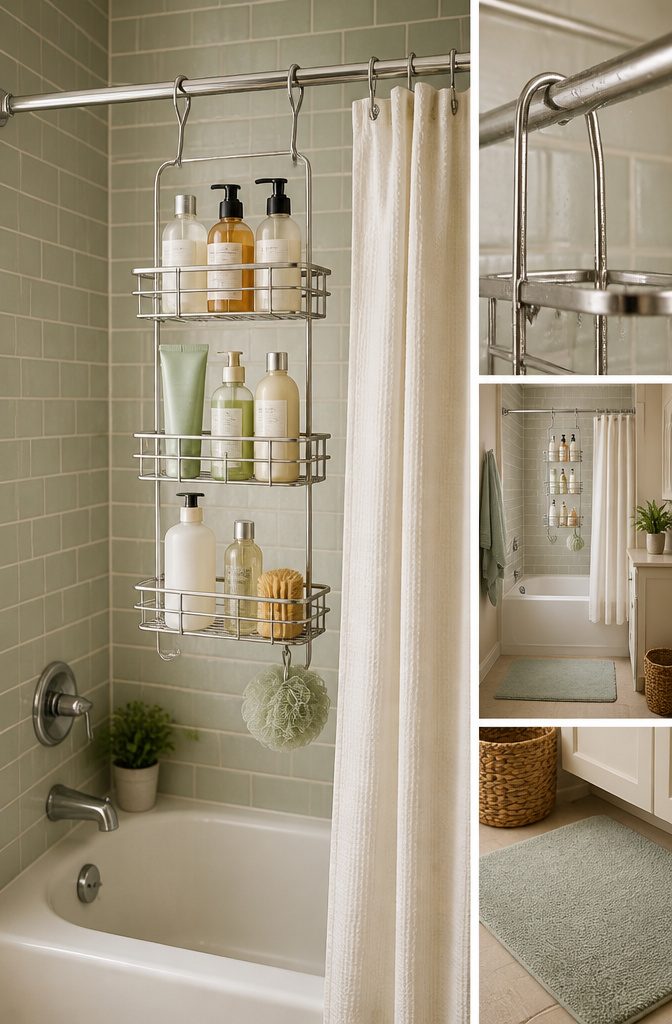
Shower caddies that hang from the head keep bottles off the tub rim where pink slime collects, but the metal ones corrode faster than you’d expect.
My $7 tension-pole caddy lasted eighteen months before the spring rusted solid; I had to cut it out with a hacksaw.
The $16 adhesive corner shelves I tried next have held four years now, though once the glue sets, they cannot be moved without taking the tile with them.
Wall-mounted dispensers for body wash and shampoo cut my bottle count from six to two and eliminated the domino effect when someone bumps the ledge.
For renters, a hanging organizer beats anything that needs drilling or permanent adhesive; the stability comes from weight and a couple of suction cups, not engineering.

MAXIMIZE YOUR STORAGE SPACE: Measuring 33.1" W x 12.6" D x 57.2" H, this wide 4-tier shelving unit provides ample vertical space. The flat wire shelves allow you to organize large boxes, kitchen appliances, and daily essentials efficiently, keeping your space neat and easily accessible without any clutter.

【Sturdy Metal Frame】Upgrade your morning routine with this bathroom mirror with shelf, designed with a sturdy, moisture-resistant metal frame that stays strong even in humid bathroom environments. The matte black finish blends naturally with modern or farmhouse bathrooms, making it a stylish yet practical focal point above your sink.

- **Glossy Ceramic Basin:** Smooth, high-glaze ceramic surface, stain-resistant and easy to clean, suitable for daily washing.
8. Vanity Trays and Countertop Organizers
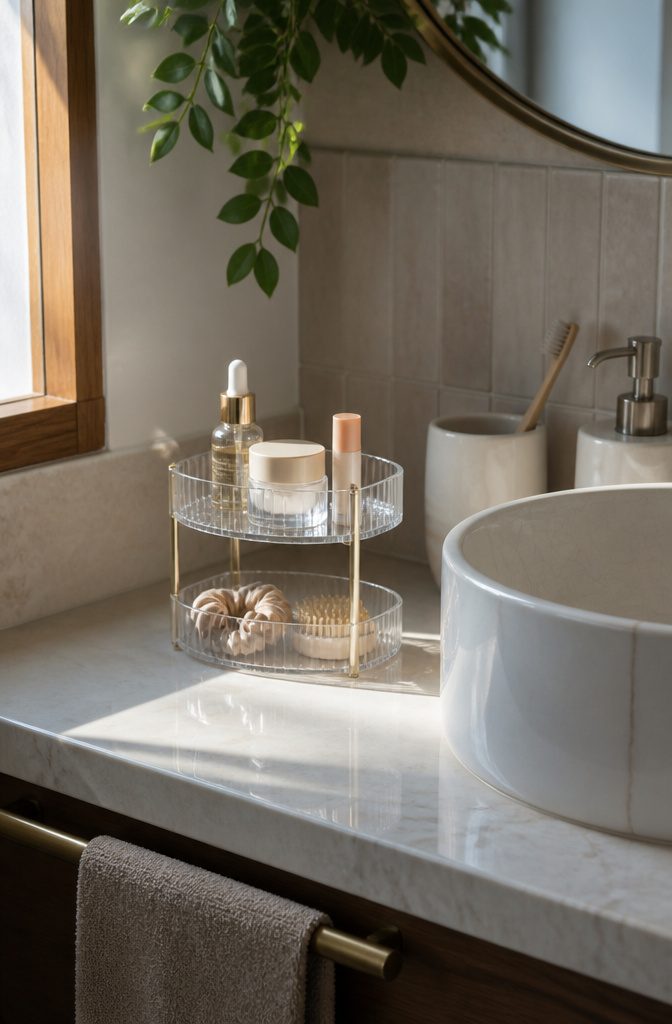
A $15 two-tier acrylic tray from Marshalls sits on my bathroom counter and does more work than anything else in the room. The two levels force a hard limit: serum, moisturizer, sunscreen, and one lip balm on top, nothing else invited.
Everything that used to crowd the sink went to the medicine cabinet or under it, and the visual quiet was worth more than I expected.
Tiered organizers maximize vertical space on compact counters, which matters when the surface is barely there to begin with.
Moisture-resistant materials hold up against humid air: bamboo, stainless steel, or acrylic like the one I found. The rule that keeps it working is daily essentials only.
Toothbrushes, hand soap, and two or three frequently used products belong out. Everything else earns closed storage or it earns the door.
The discipline is the storage.
A new product means an old one leaves. Without that, the tray fills and the counter looks like it always did.

Solid Paulownia Wood: Our floating shelves are crafted from 100% paulownia wood with a fine wood grain and attractive finish. Paulownia wood is naturally resistant to decay, warping, and pests, making these bathroom shelves perfect for wall decor in any living space.
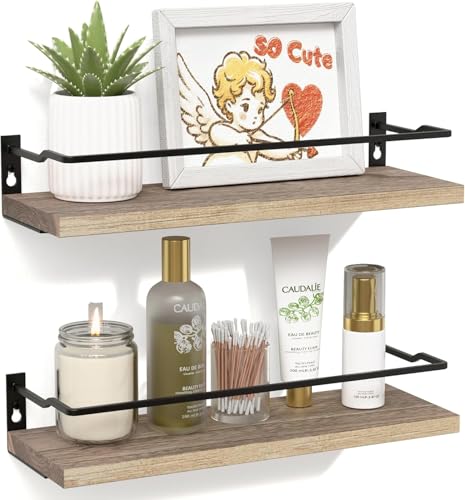
Unleash Possibilities -Fall decor, maximize your wall space by transforming empty areas into functional storage and stylish displays. Whether you're seeking to declutter your bedroom with a chic sideboard, tidy up your bathroom with a convenient bathroom storage wall shelf, or enhance the ambiance of your dining room with an eye-catching display, our solution covers all your needs.

𝐄𝐱𝐩𝐚𝐧𝐝 𝐒𝐩𝐚𝐜𝐞 𝐚𝐧𝐝 𝐌𝐨𝐝𝐞𝐫𝐧 𝐃𝐞𝐬𝐢𝐠𝐧: With clean lines and a warm finish, these small bathroom shelves expand wall space in dry bathroom zones and double as stylish bathroom organizers and storage. Effortlessly organize towels, toiletries, and decor with the invisible bracket that creates a sleek, modern display appearing to float seamlessly on your wall — perfect for over the toilet bathroom organizer setups and completing your bathroom wall decor
9. Medicine Cabinets
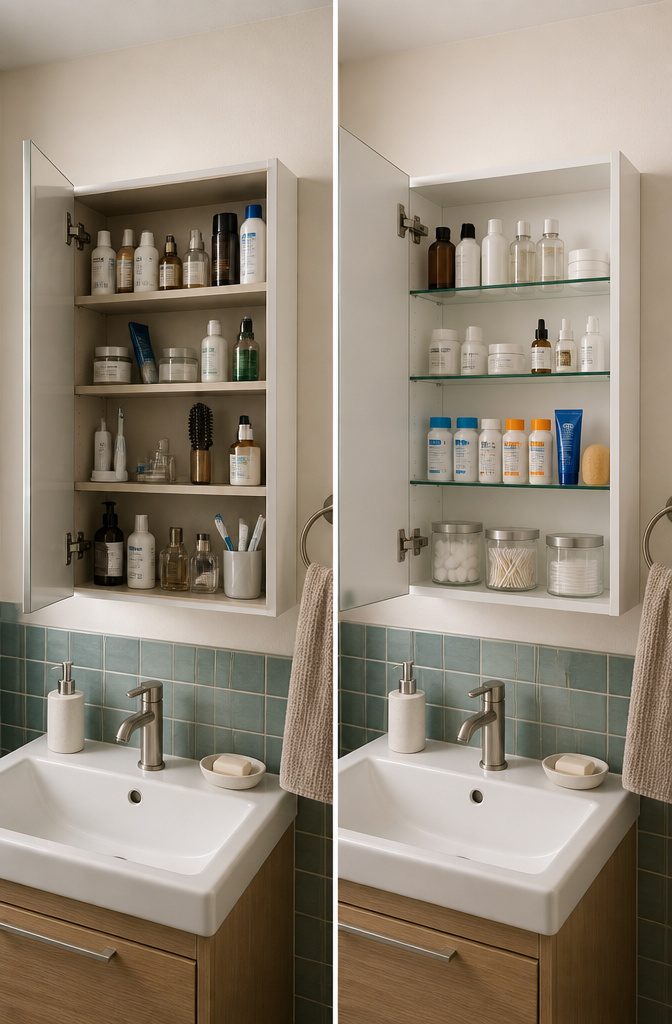
Standard medicine cabinets sit 3–4 inches deep, which sounds like enough until you try to line up a bottle of ibuprofen, a tube of sunscreen, and a contact lens case on the same shelf.
I replaced a surface-mount cabinet last year with a deep-profile unit running 5–7 inches, and the difference was immediate.
The shallow original held thirty items, but only if I stacked them like a puzzle and pulled everything out to find the thermometer.
The deep replacement still holds those same thirty items, except now I can see them all at once.
The swap took one Saturday and cost $140 for the unit. Recessing it into the wall was another option, though that meant finding a contractor and budgeting closer to $400.
Surface-mount works fine for most renters; the cabinet protrudes slightly, but you keep your Saturday and your damage deposit. If you do go recessed, the flush finish looks cleaner in tight spaces where every inch of wall matters.

【Maximize Small Spaces】The narrow storage cabinet is designed for newly renovated small bathrooms, and measures 7.87" x 7.87" x 70.87", making it a space-saving storage solution. Its tall, slim design efficiently utilizes vertical space while taking up minimal floor area
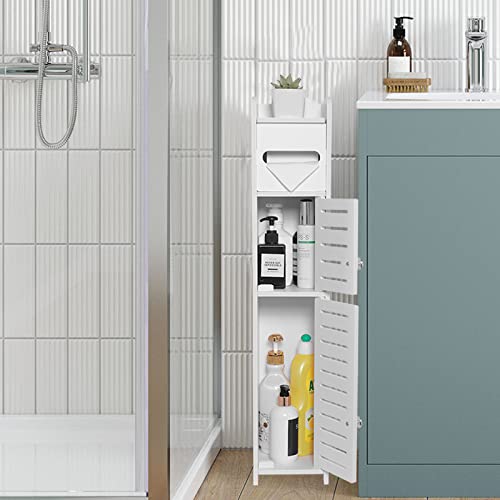
【Ideal Toilet Paper Dispenser】This bathroom toilet paper storage cabinet with two door and shelves modern design, provides much storage space in your tiny room. This toilet paper storage cabinet can use for 4-5 rolls toilet paper (normal size) one-time storage. A sleek bathroom organizer as a toilet paper dispenser. (Can not fit oversized rolls of Charmin toilet paper)

Eco-friendly Bamboo: Our bamboo bathroom shelves are made of high-quality bamboo, which is smooth, waterproof, and very easy to clean. Our bathroom storage shelf is more sturdy than other rusted metal shelves.
10. Baskets and Bins
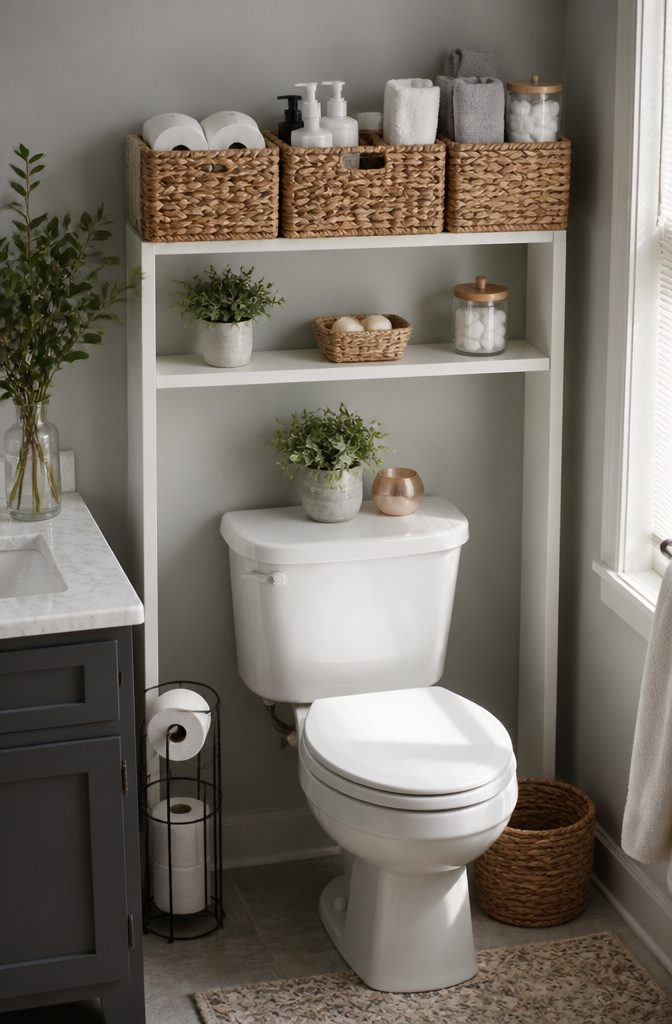
Open shelves in a bathroom collect visual noise fast. Baskets and bins turn that clutter into something you actually want to look at.
Woven seagrass, wire mesh, or a clean plastic bin each give a different texture to an otherwise utilitarian space, and all of them let you pull a whole category out at once instead of digging past three bottles to reach the fourth.
I bought a set of four seagrass baskets from World Market for $38 and lined them up on an over-toilet unit.
Toothpaste backups, extra razors, the backup shampoo I do not like the color of, all of it disappeared behind the weave.
The system worked until about a year in, when the seagrass started darkening from the humidity. It did not fall apart, but it stopped looking like the warm neutral I had picked out.
If I were choosing again for that same spot, synthetic rattan would have been the smarter call. It holds the same look and actually survives a steamy bathroom without the gradual fade.
Washable options matter more here than in almost any other room. Plastic bins wipe down in seconds; wire baskets let wet items dry through the gaps.
The basket is doing storage work, but it is also sitting in the space your eye lands on. Pick the material for how it will look after a year of showers, not just how it photographs on install day.

Space-Saving: This 15.0"L x 7.9"W x 24.4"H bathroom cabinet wall mount is made for small areas. It clings to the wall, using vertical space well. It fits bathrooms, living rooms, kitchens, laundry rooms, and offices

【Classic Farmhouse Style】Small medicine cabinet adopts sturdy MDF board, smooth off-white paint surface, and elegant black handles, blending beauty and practicality
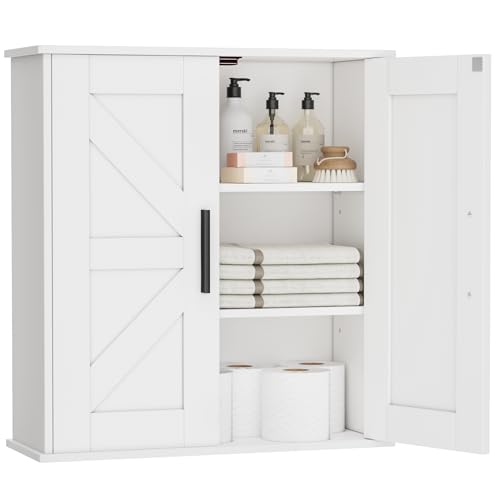
Ample Storage Space: This cabinet boasts a roomy interior with adjustable shelves, you can customize the storage layout to fit your needs. Whether it's toiletries in the bathroom, spices in the kitchen, or cleaning supplies in the laundry room, it provides plenty of room to keep your items organized.
Vertical Storage in a 5×8 Foot Room
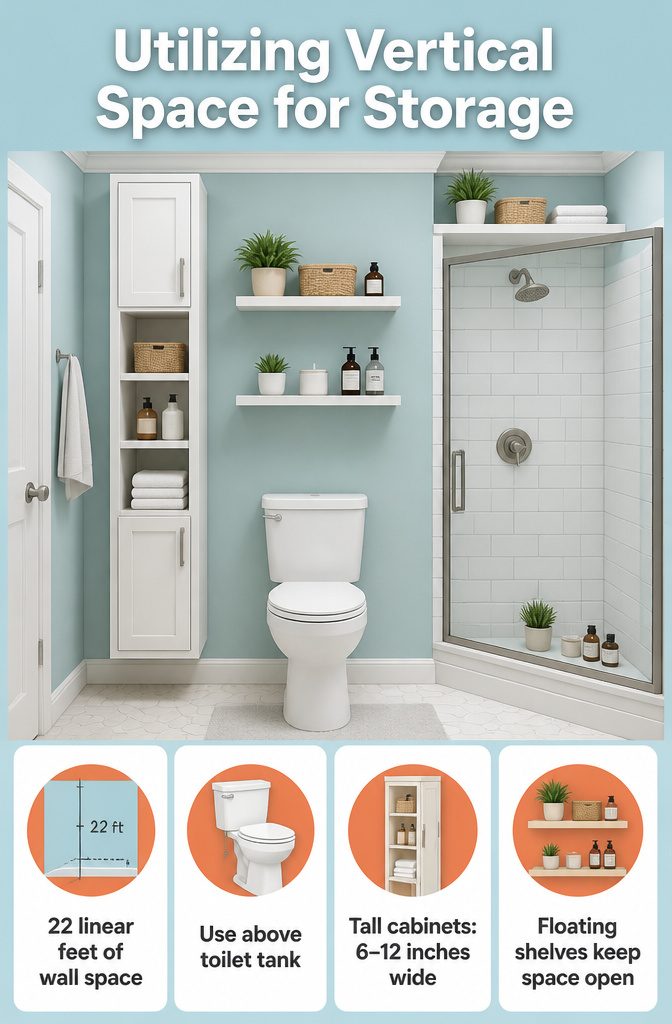
A 5×8 foot bathroom leaves almost nothing on the floor, so the walls carry the load.
I measured my last one and found 22 linear feet of wall below the 7-foot ceiling. Using the bottom four feet for storage made the room feel smaller; keeping everything between five and seven feet up kept it open.
The toilet tank alone gives you a full wall width most people ignore.
Above the shower head, there is usually a foot or two of dead space before the tile ends. Even the inches above the baseboard can hold a shallow ledge for small bottles if you are willing to look for it.
Tall narrow cabinets, 6–12 inches wide, sit flat against the wall and do not block the walkway the way a floor-standing unit would. Floating shelves in that same upper zone keep daily items reachable without bringing the walls inward visually.
The key is starting your search at eye level and working up; anything below about four feet starts to read as floor clutter in a room this size.
What Humidity Does to Storage Materials
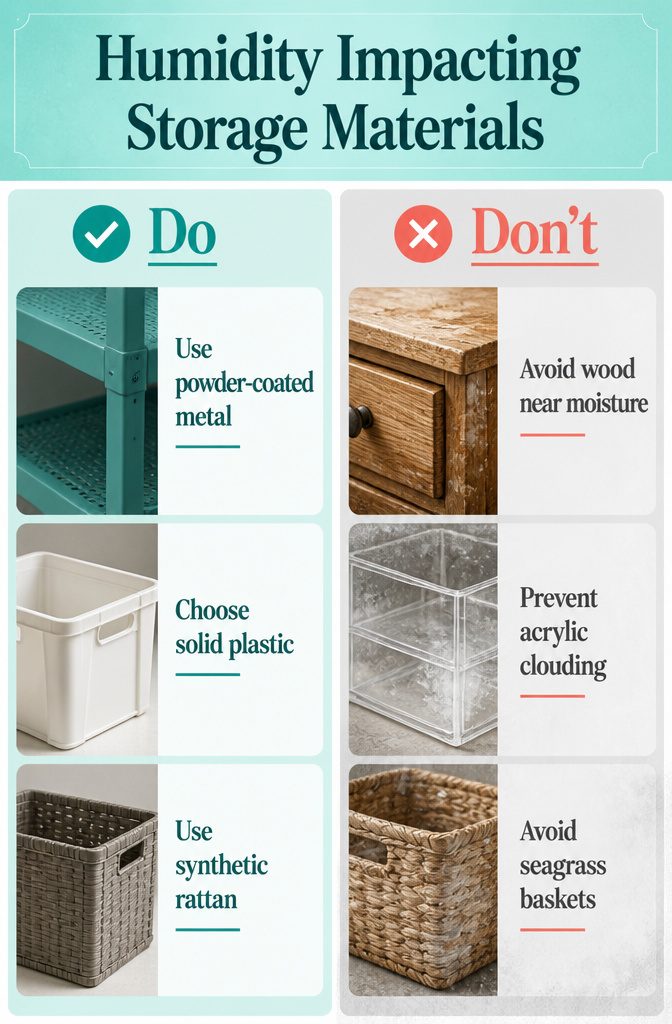
Metal rusts where powder coating chips. Wood swells at the joints until drawers jam.
Seagrass baskets, the pretty ones, grow a gray film on their weave within a season if they sit near a shower. I learned that last one twice before I gave up on natural fiber.
Acrylic looks indestructible until you set it in direct spray.
The surface clouds, not all at once, but in patches that never polish clear again. Powder-coated metal, solid plastic, or synthetic rattan are what I default to now for anything that stays in the bathroom full-time.
Solid plastic means the molded kind, not the brittle shell kind, and you can tell by weight in the store.
Ventilation matters as much as material. A cabinet needs breathing room, even a plastic one, or the air inside turns still and warm and everything stored in it takes on that faint towel odor.
I check where the vent sits before I place anything with a door. If the airflow misses the spot, I leave it for open shelving or accept that I will be wiping down the contents every few months.
Magnetic Strips and Repurposed Kitchen Tools
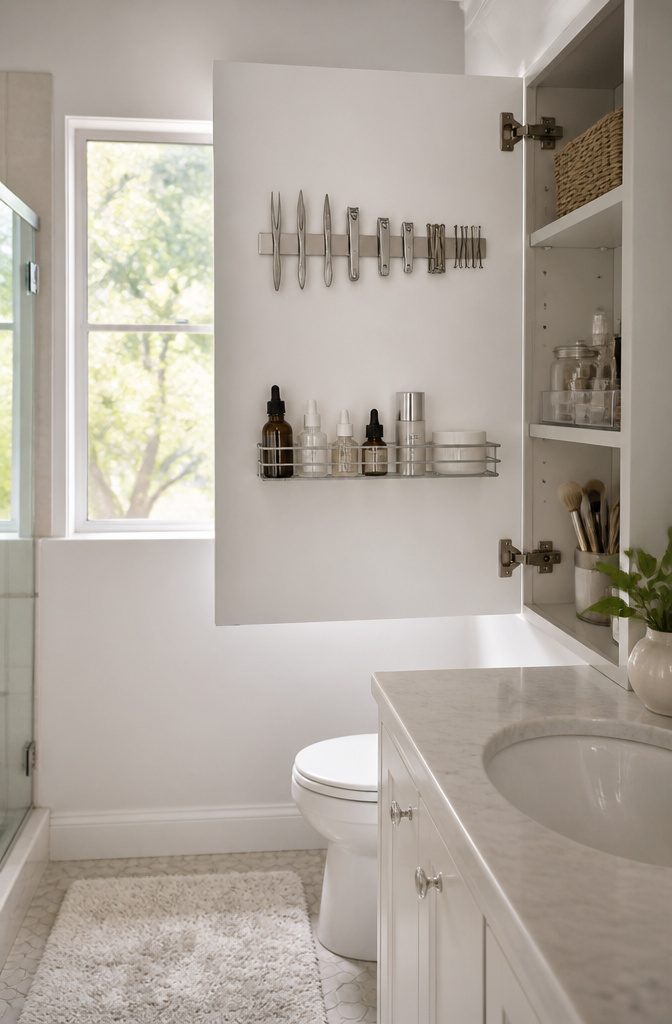
A magnetic knife strip mounted inside the medicine cabinet door keeps tweezers, nail clippers, and bobby pins visible and dry, where they vanish into drawers. The same strip holds makeup with magnetic packaging if you already own it.
Kitchen markup beats bathroom markup. A wire spice rack screwed to the inside of that same cabinet door adds a second tier for small bottles without touching the original shelves.
Plate organizers from the same aisle can separate makeup palettes or hair tools if the drawers run shallow.
These are not solutions you find in the bathroom aisle, which is exactly why they work.
They borrow tools priced for kitchen competition and press them into overlooked spaces: the thin air behind a cabinet door, the metal side of a vanity.
The hardware costs less than a single over-the-toilet unit, and the rental deposit stays intact if you patch two screw holes later.
Matching Storage to Your Bathroom’s Look
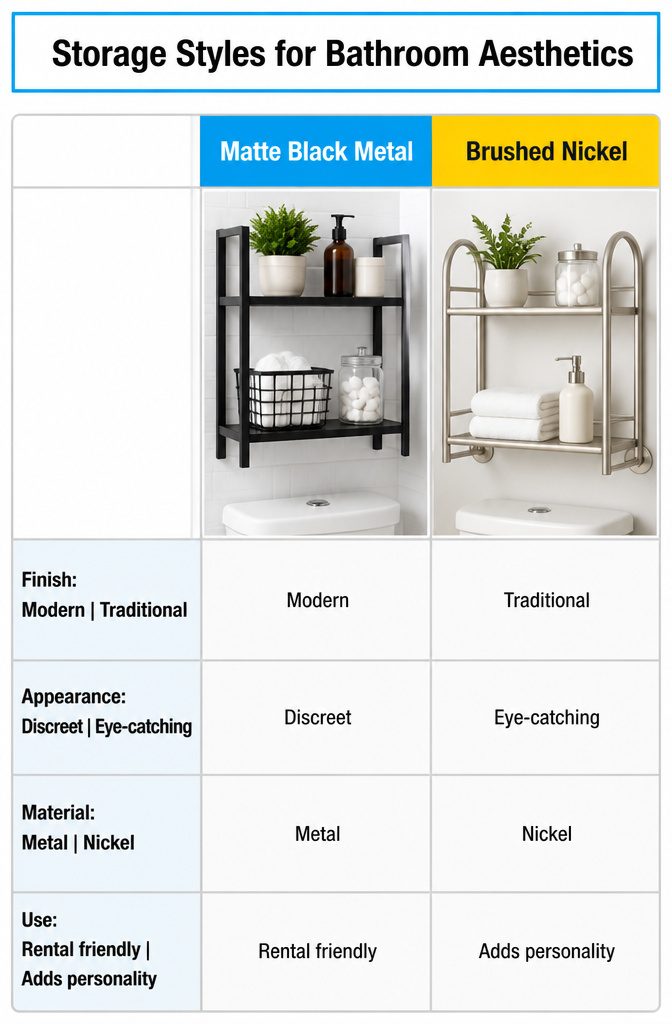
Matte black metal reads modern; brushed nickel leans traditional; natural wood warms a white-tile rental. The finish you choose matters as much as the shelf itself.
I painted two $14 pine shelves to match my wall color and they disappeared into the room. The same shelves in oak would have shouted "add-on" every time I walked in.
The storage exists. Whether it looks like it belongs is a separate choice.
Most advice stops at "measure your space" and never addresses the harder question: what finish lets this piece live in your bathroom without announcing itself?
In a rental with standard chrome fixtures, a brass shelf above the toilet fights everything around it.
A chrome or white-painted unit recedes. If you own and your hardware is matte black, carry that finish to the new piece so it reads as intentional, not improvised.
Wood tone needs the same discipline. A warm oak etagere against cool gray tile looks like it wandered in from another house.
Paint can fix cheap pine; it cannot fix expensive oak that clashes. Match the undertone of what you already have, not just the material.
Rolling Carts and Shower Storage Compared
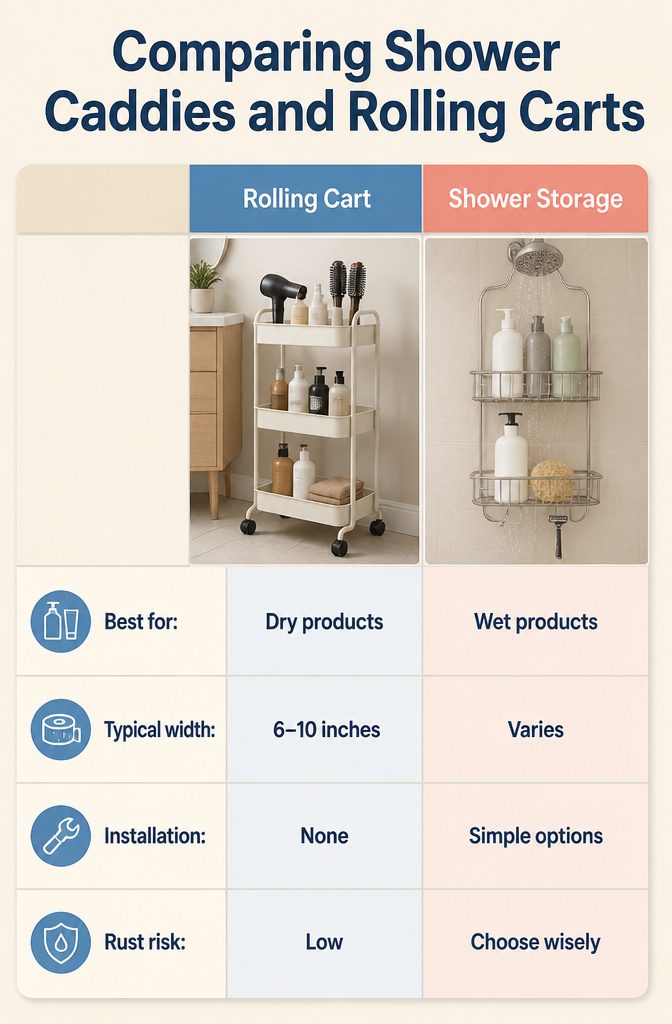
Rolling carts and shower storage both answer the question of where products live, but they serve different rhythms in a morning routine. A cart rolls with you from mirror to vanity to closet; shower caddies stay where the water is.
I spent three weeks carrying a slim rolling cart to the shower and back before admitting the obvious: wet products belong in the shower, dry products belong on the cart.
The cart now holds styling products and backup bottles; the shower caddy holds only what actually gets wet.
| Rolling Cart | Shower Storage | |
|---|---|---|
| Best for | Dry products, styling tools, backup bottles | Shampoo, conditioner, body wash |
| Typical width | 6–10 inches | Varies by type |
| Installation | None | None for tension pole, suction, or hanging options |
| Shared bathroom use | Excellent; rolls to whoever needs it | Fixed location; each user needs their own plan |
| Rust risk | Low | Choose stainless steel or plastic; wire with open slats drains better |
Shower caddies come in several forms: tension poles that run floor-to-ceiling, corner units with suction cups, hanging organizers over the showerhead, or built-in niches if you are already remodeling.
For existing showers, the tension pole or a hanging caddy skips installation entirely. Carts with 3–4 tiers fit into 10–12 inch gaps beside a toilet or vanity and work especially well when two people keep entirely different products.
Frequently Asked Questions
What is the best storage solution for a very small bathroom?
Over-the-toilet storage units are the most effective choice because they reclaim 24–27 inches of wall space that otherwise goes unused.
A freestanding etagere running 60–70 inches high gives you three or four shelves of real storage without touching the floor, and most renters can assemble one in about twenty minutes with no extra tools.
How do you maximize storage in a narrow bathroom?
Focus on vertical storage between five and seven feet up, where walls carry the load without bringing them inward visually.
Floating shelves, tall narrow cabinets 6–12 inches wide, and behind-the-door organizers all tap dead zones like the gap above the shower head or the 12–16 square feet on the back of a door, all without blocking the walkway.
Where should I store towels in a small bathroom?
Roll them into baskets on over-toilet shelves, or hang backup sets on behind-the-door hooks.
If you use floating shelves, mount them 16 to 18 inches apart so a standard towel folded once sits without drooping past the lip; anything closer and the bottom edge hangs like a flag.
How can I organize bathroom counter clutter?
Use a two-tier acrylic or bamboo tray and limit it to daily essentials only: serum, moisturizer, sunscreen, one lip balm, toothbrush, hand soap.
The two levels force a hard cap, and everything else earns closed storage or it leaves. Without that discipline, the tray fills and the counter looks exactly like it did before.
What should I store under my bathroom sink?
Cleaning supplies, extra toiletries, and backup products belong there, routed around the P-trap and supply lines with stackable bins, drawer-style organizers, or U-shaped shelves that fit the contour rather than fighting it.
Keep daily essentials elsewhere; accessing under-sink storage means crouching down repeatedly, so the front tier is for what you reach for often and reserves go behind.