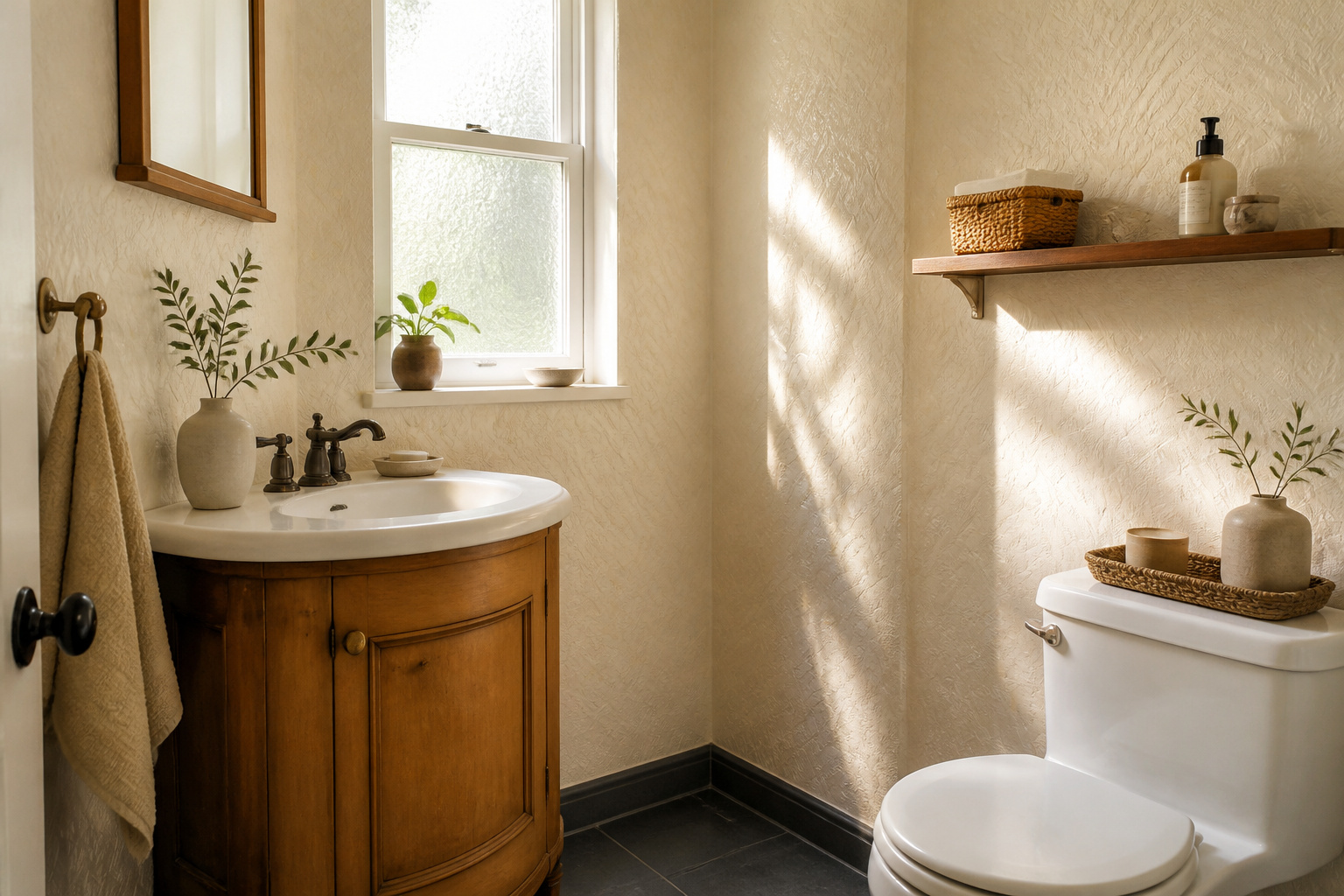
Small toilet room design ideas run from a $12 miter box to an afternoon with a hair dryer and peel-and-stick wallpaper, and the one you pick depends on whether you own the place or answer to a landlord.
The catch is that humidity ruins edges, misaligned corners waste rolls, and the wrong shelf traps your tank lid when the toilet runs at 10 PM.
I learned the 31.5 by 55 inch minimum the hard way, after ordering a cabinet that blocked the door swing entirely.
1. Wall Color and Paint
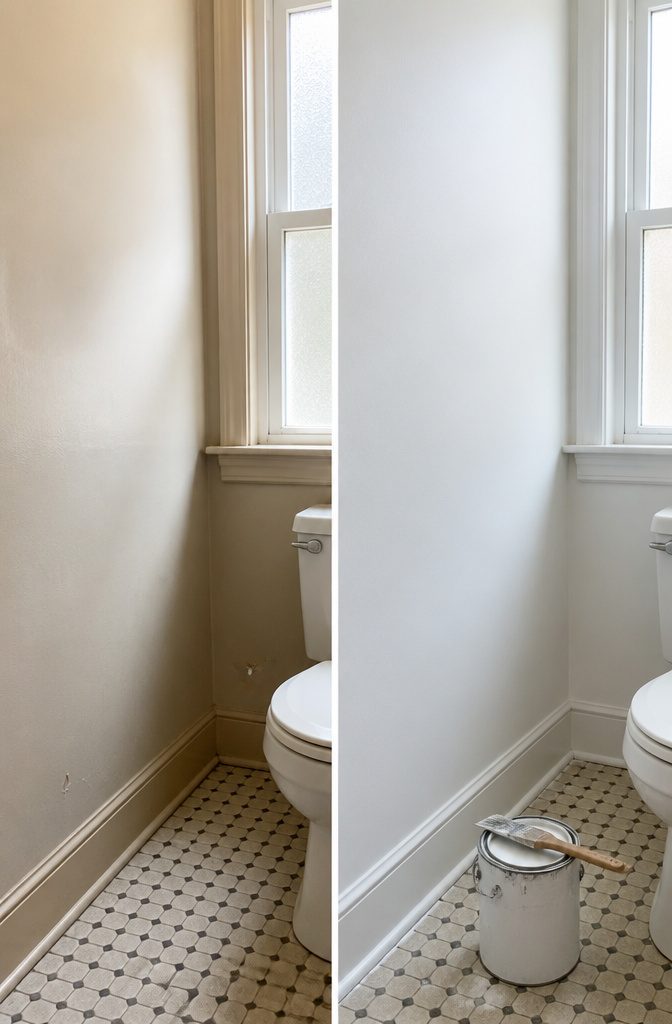
A quart of paint and one Saturday morning can reframe an entire toilet room.
That is the fastest return I have seen in any small-space project, and the math almost embarrasses me: half a day, maybe forty dollars in supplies, and the room reads completely different.
Lighter colors give the illusion of more space, which matters when the square footage is barely enough to turn around in.
Behr’s Bakery Box, a clean white, does the heavy lifting here; it bounces whatever light the room gets and keeps the walls from pressing in.
For something sharper, Behr’s Limousine Leather, a true black, works on trim or beadboard to add definition without clutter.
The practical reality is messier than the inspiration photos suggest. Trim tape leaks.
It always leaks, especially along the baseboard where the wall meets uneven tile. I have learned to press the edge with a putty knife, then still expect a few minutes of touch-up with a small brush.
A roller covers the field fast; a sprayer on beadboard gives consistent color in the grooves, though a roller would have managed almost as well and spared the masking.
Either way, the quart is enough. One coat if you are lucky, two if the previous color was bold, and by evening the brushes are in the sink and the room is finished.

【Color and Size Specifications】:1.5IN/38mm(Width), 10.5FT/3.2m(Length), 0.04IN/1mm(Thickness) Color: White caulk tape waterproof sealant caulk strip has a crease in the middle. CDFYREC caulking strip with crease design can be folded to 90 degrees for tightly sealing gaps between walls.
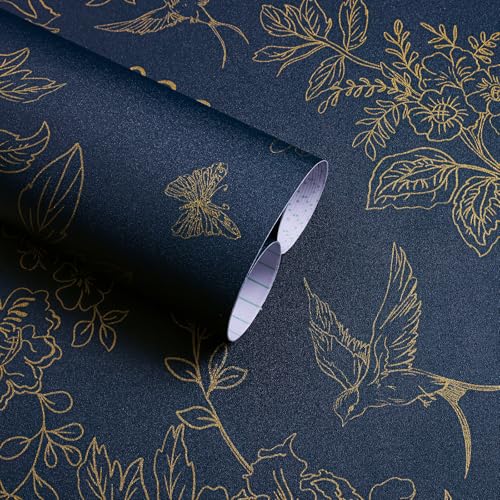
Vintage Floral Dark Blue and Gold Wallpaper: —【SIZE and MATERIAL】17.7 inch x 118.1 inch ≈14.5sq.ft.Made of vinyl, this wallpaper has strong adhesion and can be easily applied to any smooth and dry surface.

Make wallpaper installation a breeze with our wallpaper tool kit! This comprehensive kit includes must-have tools you need for a smooth and easy wallpapering experience.
2. Peel-and-Stick Wallpaper
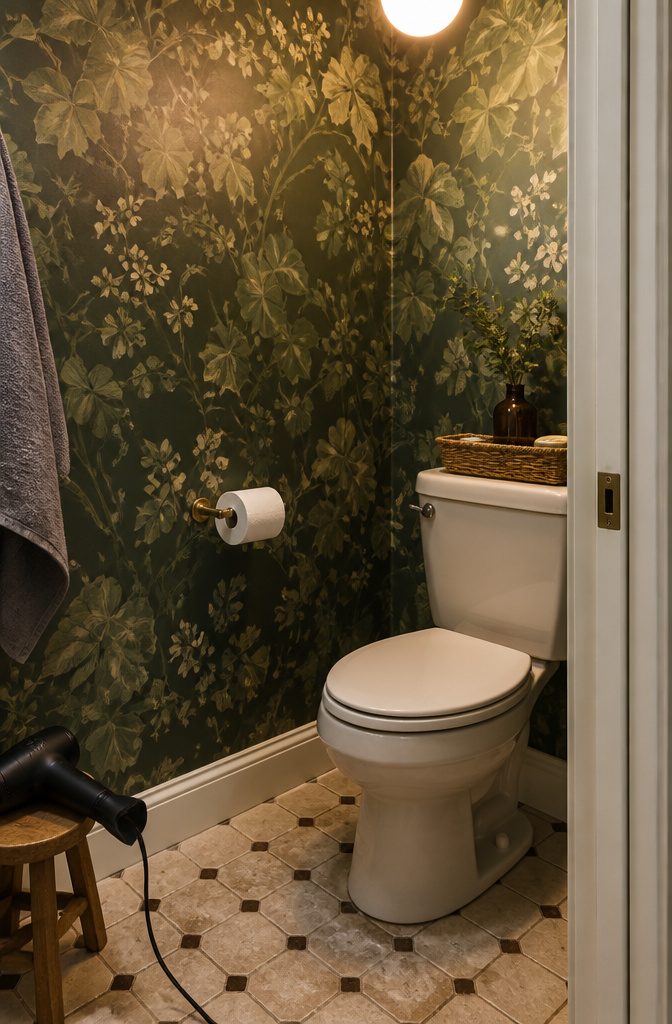
Peel-and-stick wallpaper is suggested for easy application, but the ease is relative.
The first strip teaches you quickly that alignment is a skill, not a given, and matching a pattern across a corner in a toilet room that is never quite square will eat a Saturday morning.
I have bought rolls from Target and from Spoonflower, paid between thirty and eighty dollars depending on whether I wanted a textured grasscloth look or a printed pattern, and every time the edges lifted within a year where humidity pooled near the baseboard.
The fix is running a hair dryer along the seam after application and keeping a spare roll for patching. For a rental, the payoff still works: the walls change completely in one afternoon, and the landlord never has to know.

Bates paint roller kit includes 19 essential pieces for home painting, prep, and cleanup projects.

PAINT TRIMMING TOOL: The Wagner SMART Edge Roller home painting tool makes painting a room easier and more enjoyable by eliminating hours of taping and cut-ins

COMPLETE 12-PC PROFESSIONAL SET:Includes 4" tray ×1, snap-fit handle ×1, reusable liners ×2, liner cover ×1, dual-brown microfiber sleeves ×4, white microfiber sleeves ×2, and 1.5" angled brush ×1. Perfect for walls, ceilings, trim, cabinets, and furniture
3. Wall Molding
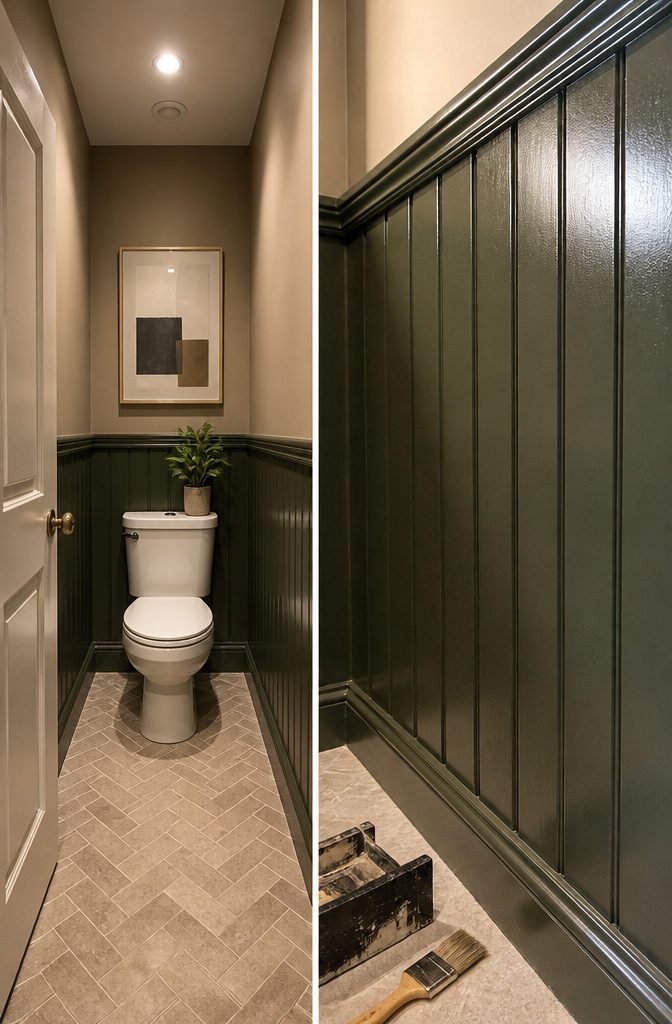
Wall molding adds architecture where square footage is thin.
In my own toilet room, wainscoting broke up a flat wall that otherwise read like an afterthought. The vertical lines draw the eye up, and the shadow lines between boards give you something to look at besides the fixture.
I settled on a 32-inch height after holding scrap wood against the wall at a few different marks.
Anything taller crowded the small room; anything shorter looked like a stripe. The math on this changes from house to house, so tape and patience matter more than a formula.
I cut everything with a $12 miter box from the hardware store, not a power saw.
The box took longer, but the cuts were clean enough for paint, and the setup fit on a bathroom floor with no clearance for a workbench.
The pieces went up with construction adhesive and a few finish nails, then two coats of semi-gloss to match the trim.

What You Will Receive:Wall molding kit includes 8 pieces 9.8x37.8 inch PS wall panels + 2 pieces 1.8x37.8 inch decorative edge strip. Assemble into a 39 x 79 inch shaped wall panel,total coverage area is 21.5 sq. ft

Stylish Wall Upgrade: This wainscotting wall panel kit adds texture and charm to any space. The 37.8” tall beadboard panels create a beautiful decorative accent for living rooms, bedrooms, kitchens, studies, and more

PVC WALL PANELS, 6-PIECE KIT: Elevate your walls with Plastpro’s 3-ft wainscoting panel kit. The complete solution for bathrooms, kitchens, bedrooms & living rooms. Includes 6 reversible PVC panels (3 ft high × 7¼ in wide), each pre-finished, pre-grooved, and ready to interlock. No nails or adhesive required.
4. Gallery Wall and Printable Art
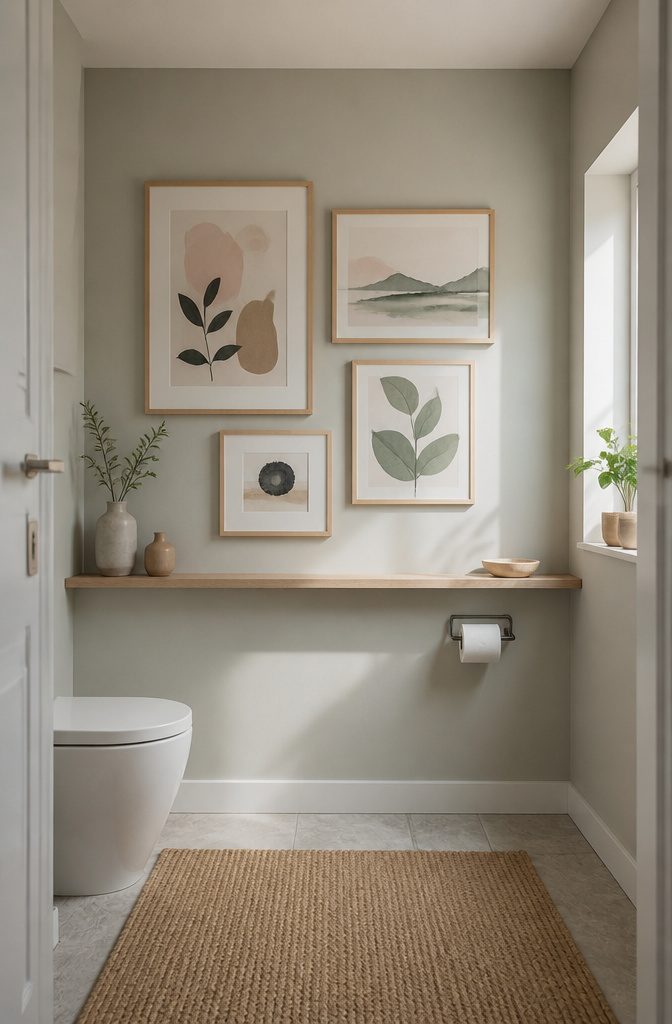
Printable art keeps a toilet room from feeling like an afterthought without the cost of originals.
I pull most of mine from Etsy shops selling digital downloads, and the Metropolitan Museum of Art has free high-resolution images that work beautifully for this.
The frames came from Target, simple wood ones that I spray-painted in place to match the room.
The first print went up at eye level for a standing person, which seemed right until I sat down and realized you only see this wall from the toilet.
The piece might as well have been on the ceiling. I moved it eight inches lower, to where your eyes actually land while seated, and suddenly the whole arrangement made sense.
Five-by-seven and 8-by-10 prints are the sweet spot here; anything larger fights the narrow walls.
I skip glass in favor of acrylic or even washi tape for swaps, since humidity is a factor. The frames don’t need to match exactly, but keeping them in one finish reads as intentional rather than leftover.

DURABLE AND FLEXIBLE - 1/2inch(width) x 10feet(length) flexible quarter round molding trim, made of high quality PVC material.

【Size】Each roll Width: 38mm/1.5 inch, Length: 3.2m/126 inch.

【Size】Each roll Width: 38mm/1.5 inch, Length: 3.2m/126 inch.
5. Over-the-Toilet Shelving
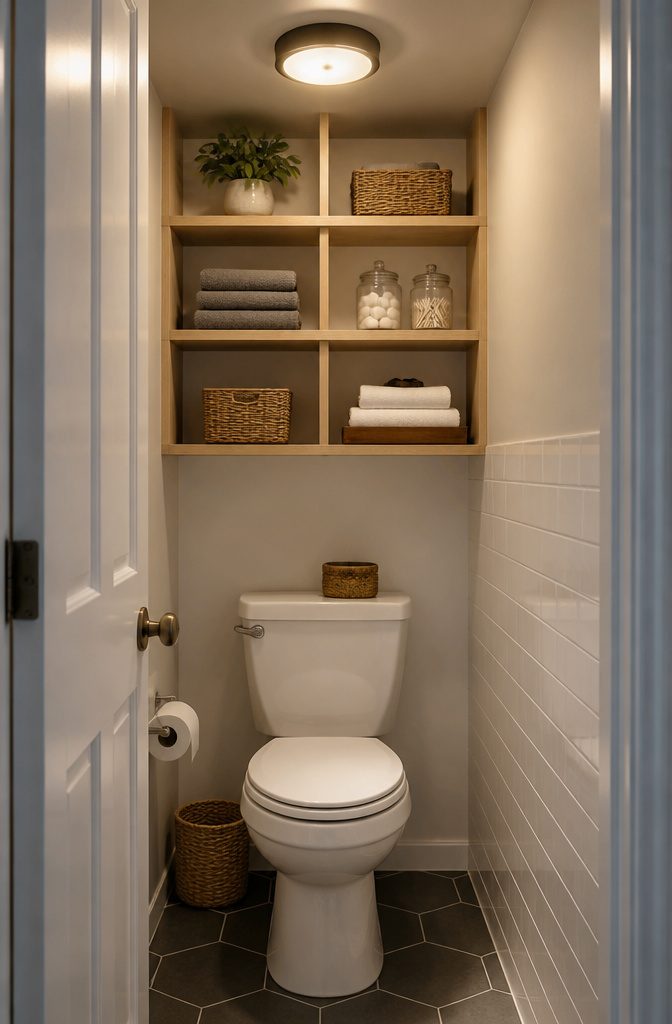
Over-the-toilet shelving turns dead wall space into storage you actually use, but the gap above the tank is not as standard as the product photos suggest.
Measure from the top of your tank lid to your lowest shelf height before you buy, or you will find out the hard way that some units sit so low the lid cannot lift.
I have assembled the narrow wire racks and the flat-pack ladders sold online, and the one that looked best in the listing blocked the tank completely.
When the toilet started running, I had to unstack towels, lift the whole shelving unit off its feet, and lean it against the shower door just to reach the flapper.
A running toilet at 10 PM teaches you fast which designs respect clearance and which treat the tank like it does not exist.
The units that worked left a six-inch gap, enough for lid removal and for my hand to fit behind for a quick wipe.

Easy DIY Installation: Peel off the backing and stick the tiles onto a clean, flat wall; no messy adhesives, no grout, no special tools and no experience required

Thicker Design: Backsplash tile peel and stick are designed with 2.5mm thicker, durability and solidity, provide higher quality peel and stick tiles

𝐏𝐫𝐨𝐝𝐮𝐜𝐭 𝐃𝐞𝐭𝐚𝐢𝐥𝐬: 15.7 inches wide by 118 inches long, coverage approx. 13 square feet each roll concrete wallpaper. Made of sturdy vinyl, durable, tear resistant, beige color, old cracked concrete look wallpaper
6. Small Cabinets and Floating Shelves
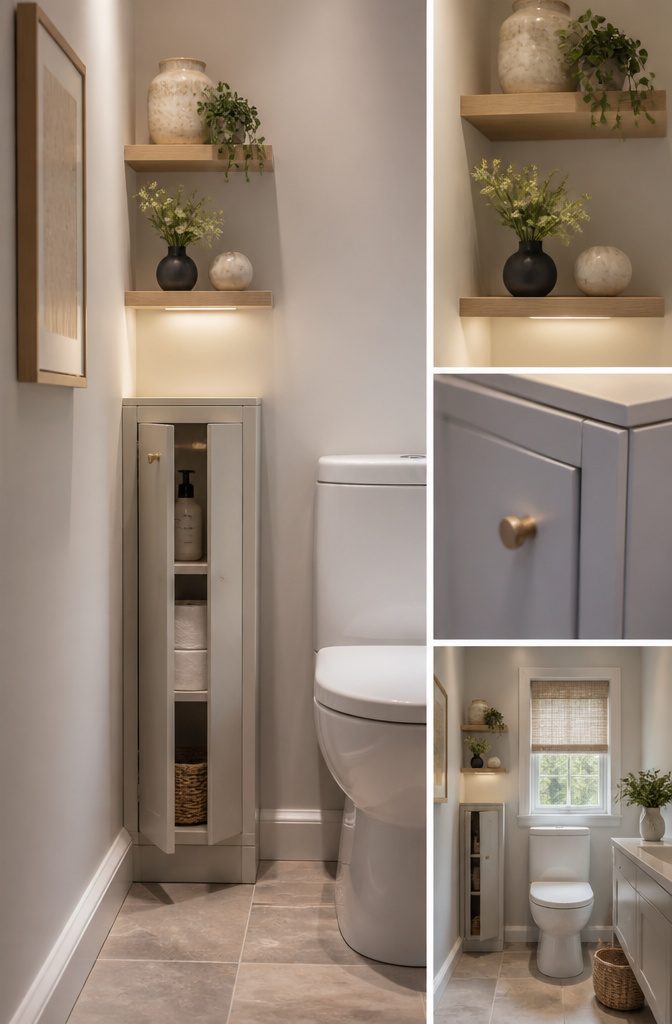
Wall-mounted storage is where small toilet rooms gain their only real square footage.
A cabinet wedged into the 14-inch gap beside my toilet holds three rolls and a box of wipes without brushing an elbow, and the shelf above it keeps a phone off the floor.
Drywall anchors or toggle bolts keep floating shelves secure when a stud finder insists it found wood but the bit hits nothing but dust.
My old plaster walls spun two anchors before I switched to toggles, which bite through the lath and actually grip.
Shelves facing down can cradle a spare roll; shelves facing up work for a small frame or a jar of cotton balls.

【SIZE&MATERIAL】 16.9In X 118.1In ≈ 13.8sq.ft. Floral wallpaper,upgrading and thickening. The thickened polymer material protective film makes this wallpaper less prone to tearing. Adopt the latest removable glue, strong adhesion and can be easily applied to any smooth and dry surface. No residue after removal.

【SIZE&MATERIAL】17.3In X118.In=14.16sq.ft.Floral wallpaper,upgrading and thickening. Adopt vinyl and the latest removable glue,wallpaper sticks to any smooth, flat ,clean surface,No residue after removal.

ROLL OF WALLPAPER: Each roll of wallpaper measures 17.5'' x 393'', covers 48.5 square feet. Black floral pattern wallpaper that is durable, removable, waterproof, longevity. Please choose enough rolls at a time to ensure they are from the same batch to avoid color differences.
7. Baskets and Toilet Paper Storage
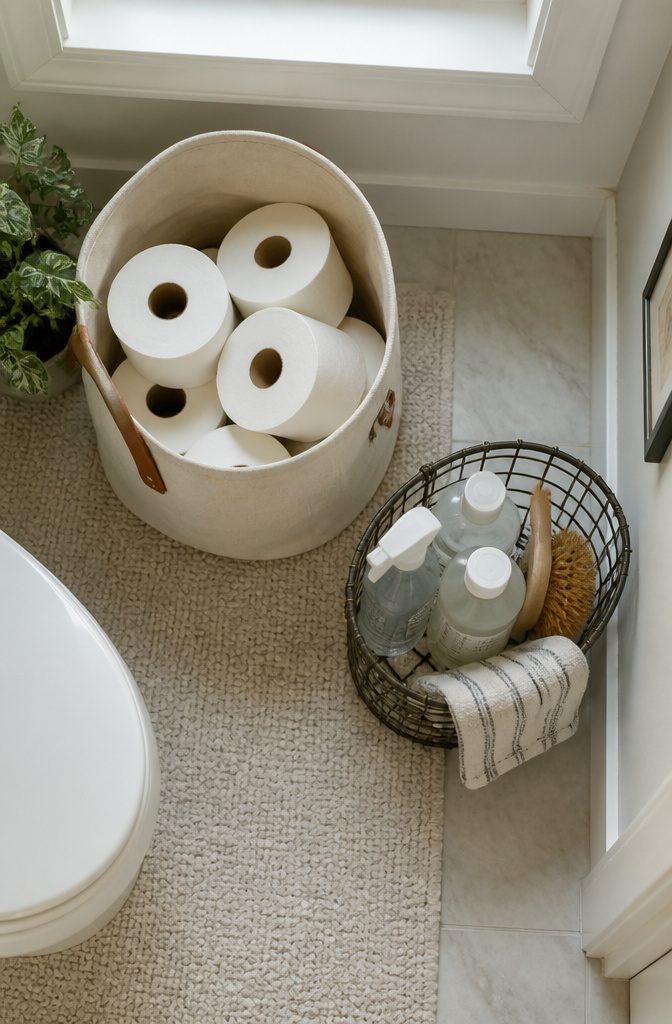
Decorative baskets solve the toilet paper storage problem without demanding a renovation budget.
I have bought the same canvas basket with a label holder three times now, which says something about how well it hits the balance between hiding rolls and letting the room breathe.
The fabric sides soften the look, and the label holder keeps the household from opening three different baskets to find the one with paper in it.
Not every basket works. A lidded seagrass piece I tried trapped moisture against the rolls and grew mildew along the rim within a month; the bathroom humidity had nowhere to go.
An open wire basket went the other direction, showing every torn wrapper and the dusty floor beneath.
The canvas basket with a label holder stays open enough to dry, closed enough to look tidy, and costs about what you would spend on a plastic organizer that looks like one.

Stores paint inside

WHAT'S IN THIS 10 PIECE PAINT KIT FOR WALLS: includes one plastic paint tray; one 9 inch roller frame; one 4 inch mini roller frame; two 9 inch microfiber roller covers (1/2 inch nap); two 4 inch microfiber roller covers (1/2 inch nap); one 1 inch flat brush; one 1.5 inch angle sash brush; one 2 inch angle sash brush

🔥💖 Greatly Reduces the Time Spent Applying Masking Tape, Paints 10-20 Times Faster Than a Sash Brush !!! Package Include : ✬ 1 X Clean-Cut Paint Edgers. ✬ 2 X Rollers. ✬ 2 X Brushes.
8. Peel-and-Stick Floor Tiles
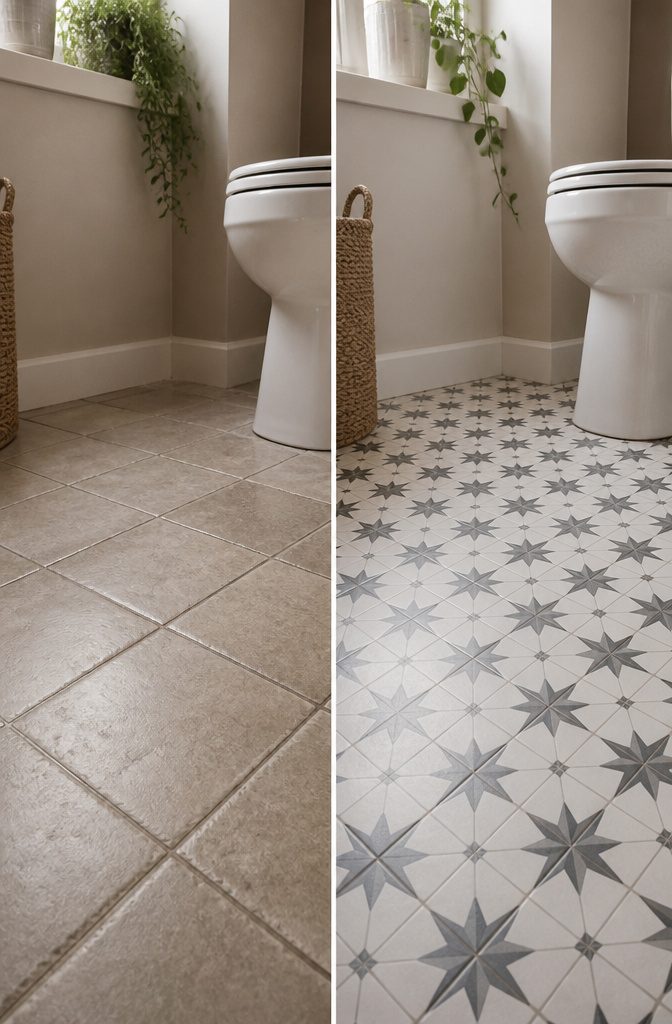
Peel-and-stick floor tiles can look surprisingly real in a toilet room if you pay attention to the grout lines.
The 12×12 squares I laid in my rental took one full Saturday, and I spent the last hour drawing fake grout between each tile with a fine-point permanent marker.
That single step sold the look. Visitors assumed it was actual ceramic until they crouched down.
Two years of weekly mopping lifted the corners at the doorway and along the front edge of the toilet base.
Water seeped underneath, softened the adhesive, and the tiles never lay flat again. If I did it over, I would run a thin bead of silicone caulk along every edge and threshold before anyone stepped on it.
The tiles themselves held up fine; the failure was at the perimeter where I assumed the backing would seal itself.
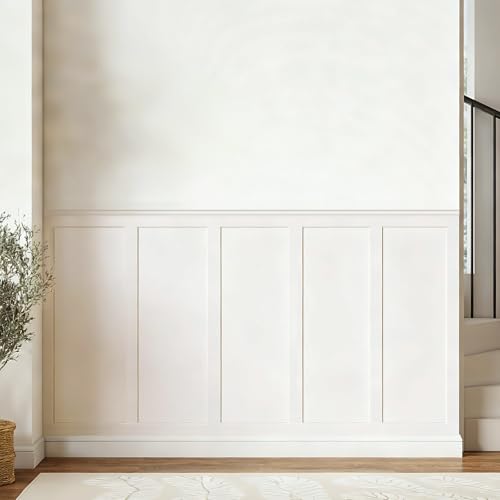
【Coverage】Includes 10 pre-cut wall molding slats and 2 shelf edge strips to create a clean board & batten look. (No peel-and-stick adhesive or nails included)

What You Will Receive: you will receive 3 sets of pre cut wall decorations, each set has 10 pcs, total 30 pcs, which can be freely matched according to your needs, they attaches easily and gives doors or walls elegant finished look

Wall Molding Kit: you will receive 3 sets of pre-cut peel and stick molding for walls, which can be easily matched and connected to give a sophisticated look to a door or wall, meeting your various decoration needs
9. Light Fixtures
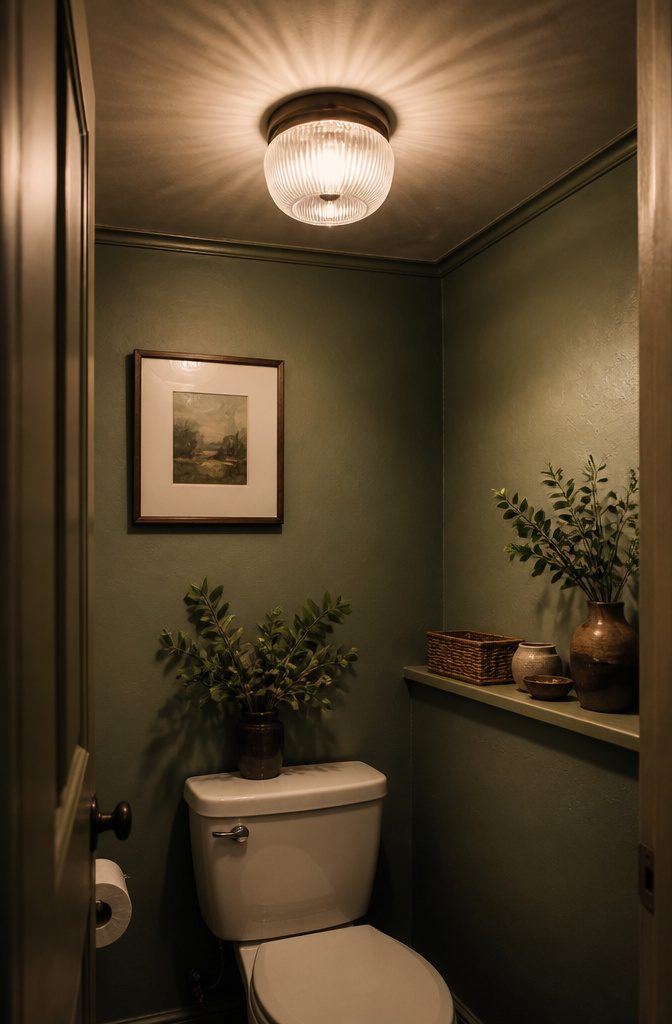
Flush-mount ceiling fixtures in a toilet room are an under-$50 swap that changes how the whole space reads.
The builder-grade "boob light" I left up for a full year cast flat, yellowish light that made the narrow room feel like a storage closet.
Replacing it with a $38 ribbed glass flush mount took twenty minutes and rewired the ceiling from cave to clean.
The wiring itself is straightforward if you respect the order: flip the breaker, then test with a non-contact voltage tester before touching anything.
Mine beeped on my hand at first contact, a reminder that phantom voltage runs through old boxes even when the circuit reads dead. I moved the sensor to the wire itself, confirmed silence, and proceeded.
Lumens are what actually matter for a small room, not watts. A 6-by-8-foot toilet room wants 800–1100 lumens from a single overhead; anything less and you will squint at labels, anything more and the walls feel like an interrogation.
Color temperature is the other half. Daylight bulbs at 5000K turn a small white room sterile.
Soft white at 2700K goes amber and muddy. 3000K sits right in the middle, warm enough to feel residential but clean enough that the space reads as intentional design rather than leftover space.

100% Silicone Caulk Protection: This silicone caulk white provides ultimate waterproof protection, ensuring a reliable seal against water damage. Ideal for areas with consistent exposure, keeping your surfaces safeguarded and pristine under any weather condition.

【Material】bathroom sealant bath sealant,white bathroom caulk strip made of PVC tape material, the caulk tape strip is waterproof and has long-lasting seal and and floor tile adhesive.
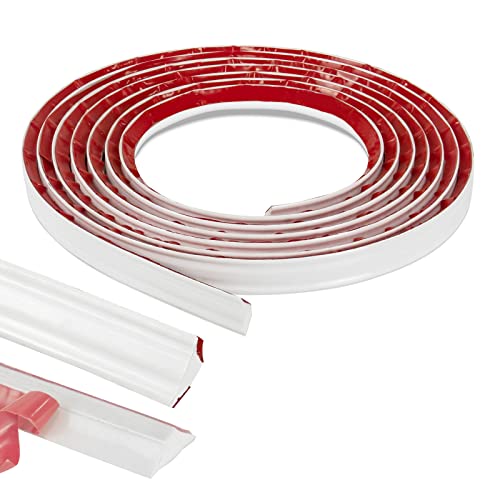
DURABLE AND FLEXIBLE - 3/4inch(width) x 16feet(length) flexible trim, made of high quality PVC material.
10. Hardware Swaps
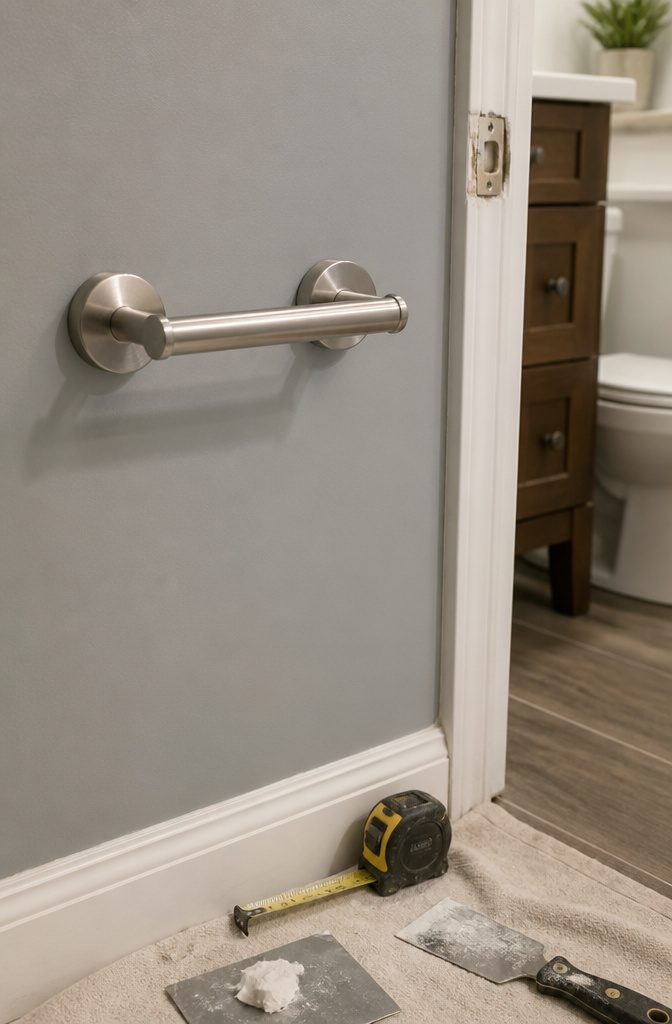
Toilet paper holders are the kind of detail you forget until the old chrome one is staring at you in an otherwise fresh room.
The newer options in matte black or brushed brass get the attention, but brushed nickel hides water spots and reads cleaner in a tight space where you are inches from every surface.
The set I ordered came with a paper template for mounting, the kind you tape to the wall and drill through.
I ignored it, measured by eye, and drilled three holes before the bracket sat level. The first two sit behind the plate now, patched with spackle that no one sees but I know are there.
Door hardware carried its own surprise.
The replacement knob I wanted needed a 2⅜-inch backset; the existing latch was drilled for 2¾. Swapping the knob meant either buying an adjustable model or filling the old faceplate mortise and re-drilling.
I chose the adjustable, which cost about eight dollars more and saved an hour of chiseling. For a Saturday project, that trade made sense.
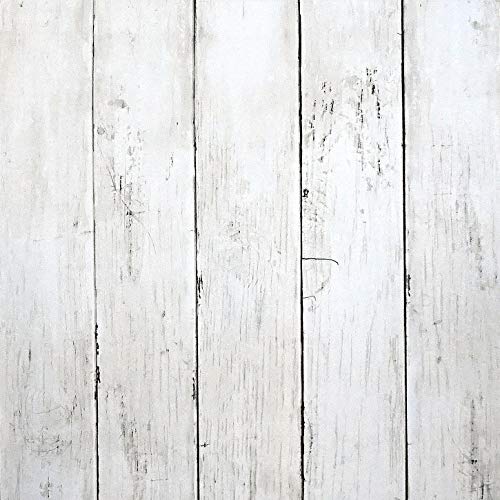
Authentic Distressed Look Design:The realistic appearance and gray-white tone of white wooden wallpaper,showcases a wood texture with natural imperfections,that captures the timeless beauty weathered wooden planks

Bathroom Humidity Protection - Steamy showers create intense environmental moisture causing standard paper borders to from painted surfaces quickly. The waterproof exterior shaping this bathroom wallpaper resists wet conditions entirely. You maintain beautiful interior spaces deploying a wall decal peel and stick safely

Pattern design:Petals are beige/light beige colors, plus grey green flower branches. Deep and dramatic colors give the whole flower a melancholy tone, and soft and exquisite patterns and colors can add a touch of elegance and charm to any space
Where to Start
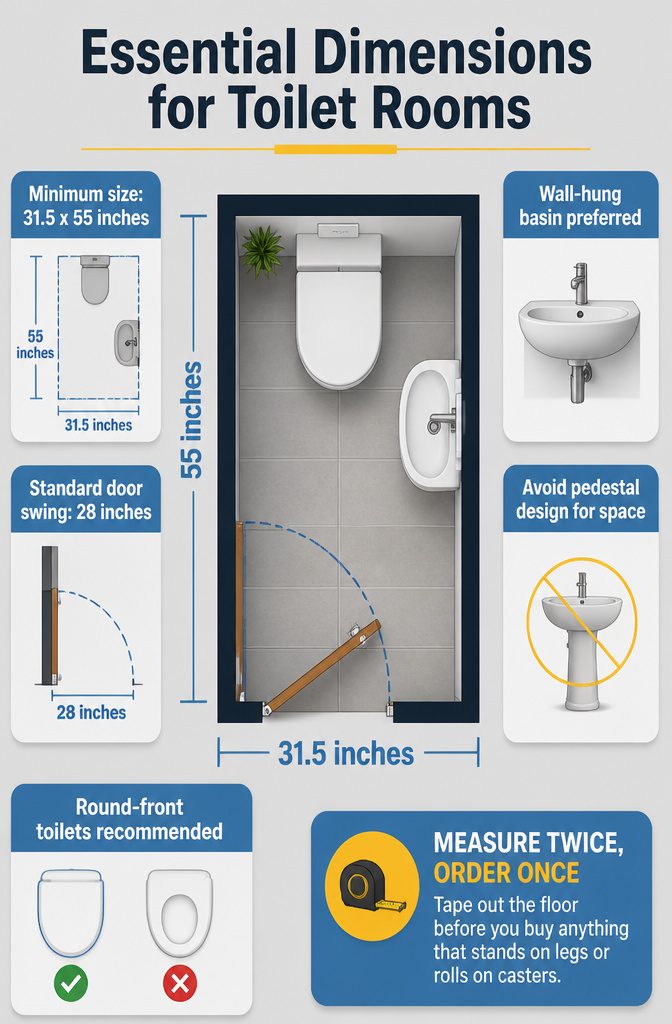
A toilet room needs 31.5 by 55 inches at absolute minimum if you want both a toilet and a basin in there.
That is 80 by 140 centimeters, and it is not generous. It is the line where the door still opens, where your knees do not hit the wall, and where the basin does not block the seat from lowering all the way.
I learned this the hard way when I measured my own water closet at 36 by 60 inches and thought I had room for a slim cabinet beside the basin.
The cabinet was 12 inches deep. The door swings 28 inches.
The math was obvious once I did it on paper, but on site I had only eyeballed it and already ordered the piece. Canceling that order cost a restocking fee, and it was the cheapest mistake I made that month.
The 31.5 by 55 inch footprint assumes a standard 28 inch door swing and a wall-hung or corner basin. A pedestal steals another few inches of toe space that the wall-hung gives back.
Round-front toilets save a couple inches over elongated without feeling like a compromise you will notice daily. Measure twice, order once, and tape out the floor before you buy anything that stands on legs or rolls on casters.
Color in a Small Room
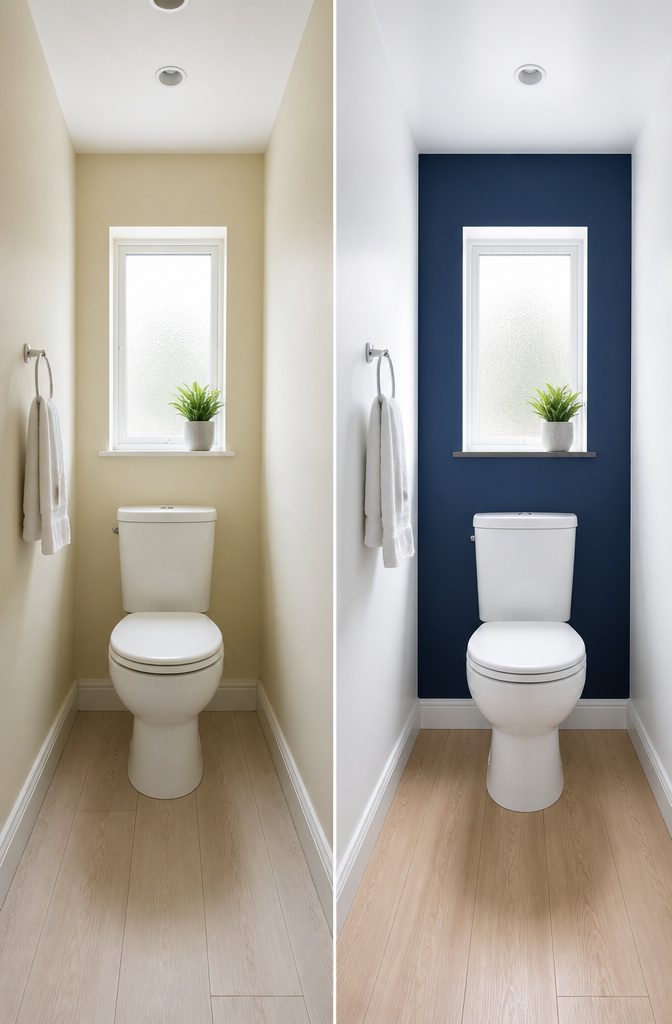
Lighter colors give the illusion of more space in a small toilet room, but the gray I chose read purple once the walls dried, and I repainted within the week.
The mistake was picking a mid-tone with too much red undertone without testing it at the hour I’d actually use the room.
After that, I tried a navy accent wall in a half bath with no window, thinking the mood would feel intentional rather than cramped.
It felt like a closet. No natural light means dark color absorbs what little reflection exists, and the fixture alone couldn’t recover it.
I returned to white, not because it is safe, but because it bounces the most light back into a room that has almost none to spare.
If you want mood without the cave effect, keep the darker color to a room that gets at least some daylight, or commit to a much stronger bulb than the builder grade one you probably have now.
Themed Decor
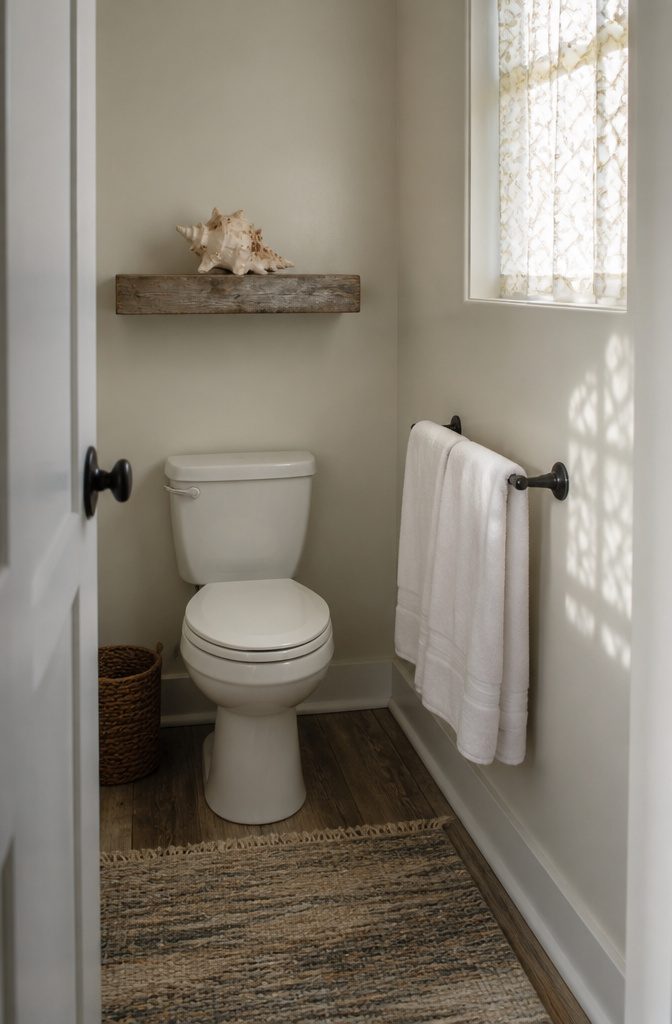
In 2019 I tried a full beach theme in my half bath: sand-colored paint, a rope-framed mirror, a basket of starfish on the tank lid.
The starfish sat there collecting dust and shedding tiny white flakes onto the floor. The rope mirror, which looked great in the store, unraveled at one corner within two months of bathroom humidity.
One themed object beats a themed room every time. A single piece does the work without the maintenance burden.
A small print of waves, a ceramic shell on a shelf, one found object from an actual trip. The rest stays neutral so the room ages normally.
My current half bath has a plain white hand towel and one piece of driftwood on a narrow ledge. Five years later it still looks intentional, not like a gift shop that closed.
Frequently Asked Questions
What are some small toilet room design ideas?
Wall paint, peel-and-stick wallpaper, wainscoting, printable art, over-the-toilet shelving, floating shelves, decorative baskets, peel-and-stick floor tiles, updated light fixtures, and hardware swaps all work in tight spaces.
The article covers each with real measurements and the mistakes that happen when you skip them.
How can I make a small bathroom look bigger?
Lighter wall colors bounce light back into the room and keep walls from pressing in.
A clean white like Behr’s Bakery Box works; dark colors absorb too much reflection unless the room gets natural daylight. 3000K bulbs at 800–1100 lumens also keep the space from reading as a cave or an interrogation room.
What are the best storage solutions for a small bathroom?
Over-the-toilet shelving with a six-inch gap above the tank, wall-mounted cabinets in the gap beside the toilet, floating shelves with toggle bolts for old plaster, and canvas baskets with label holders for toilet paper.
Each saves the only real square footage available: the walls.