
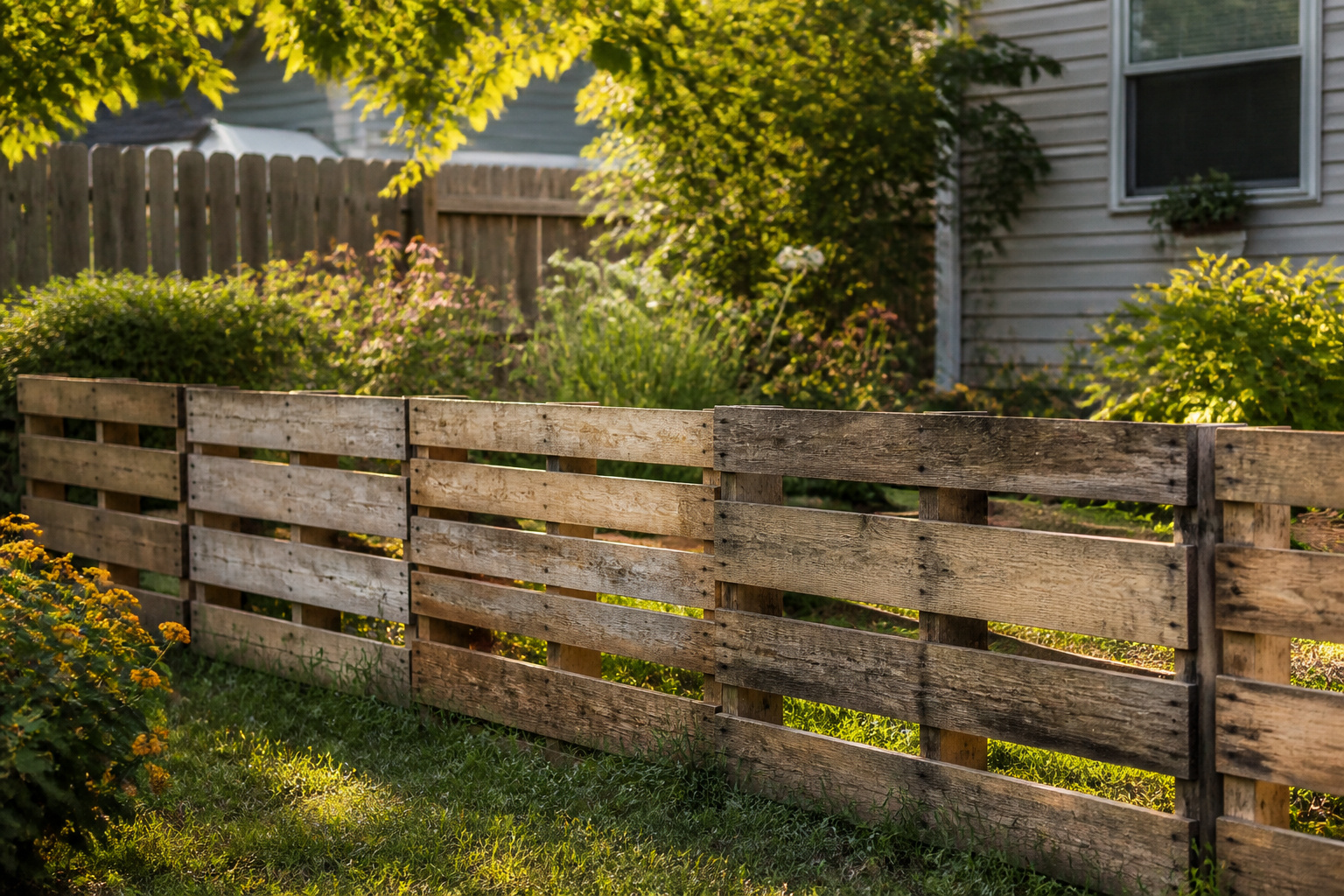
Cheap fence ideas are low-cost boundary solutions that trade something for their price, usually privacy, durability, or your weekends.
Chain link at $25 to $45 per linear foot is the cheapest permanent option, but it leaves your yard fully visible unless you pay more for slats.
Pallet fences cost nearly nothing in materials yet demand three to four weekends of heavy labor and still rot within five years.
1. Chain Link Fence
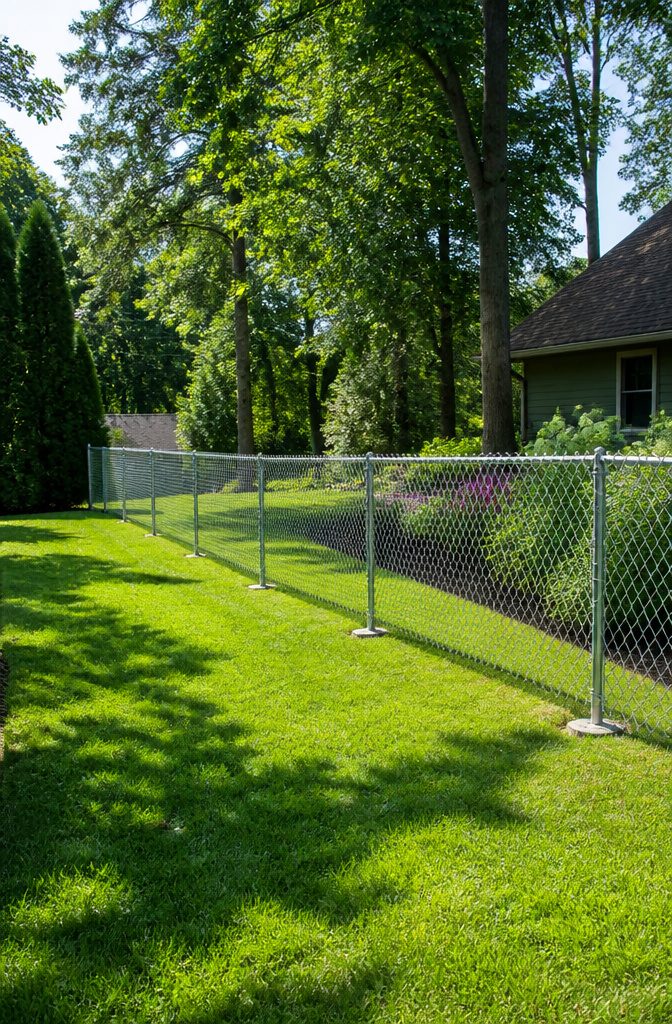
Chain link is usually the cheapest permanent fence to install, running $25 to $45 per linear foot where I live, with basic galvanized wire at the low end and vinyl-coated or privacy-slatted versions climbing higher.
That price includes posts, hardware, and labor if you hire it out, though the posts and tension work are manageable over a weekend if you rent a two-man auger and have a line level handy.
The tradeoff is immediate. Chain link keeps dogs in and defines property lines without rotting or painting, but it offers almost no privacy unless you weave in slats later, which pushes you toward the upper end of that price range.
For renters or first-home owners who need a boundary fast and cheap, that openness can matter less than the fact that the fence will still be standing when you move on.
I would not put chain link in a front yard where curb appeal pays back at resale, but for a side or back lot, the savings are real and the maintenance is nearly zero.

Upgrade iCover Privacy Screen For Fence: Our privacy screen is made of heavy-duty knitted net, measuring 4 ft high by 50 ft long. It is suitable for fences with a height of 4 ft or slightly higher. Please accurately measure your fence before purchase

Quality: These black fence tapes are made of weather resistant PVC material and are designed for long-term use.

Enhanced Security: Enjoy increased privacy and protection with chain link fencing Tape (Material Depth 0.52 mm); easily integrate privacy fence tape for a more secluded outdoor space
2. Cedar Split Rail Fence
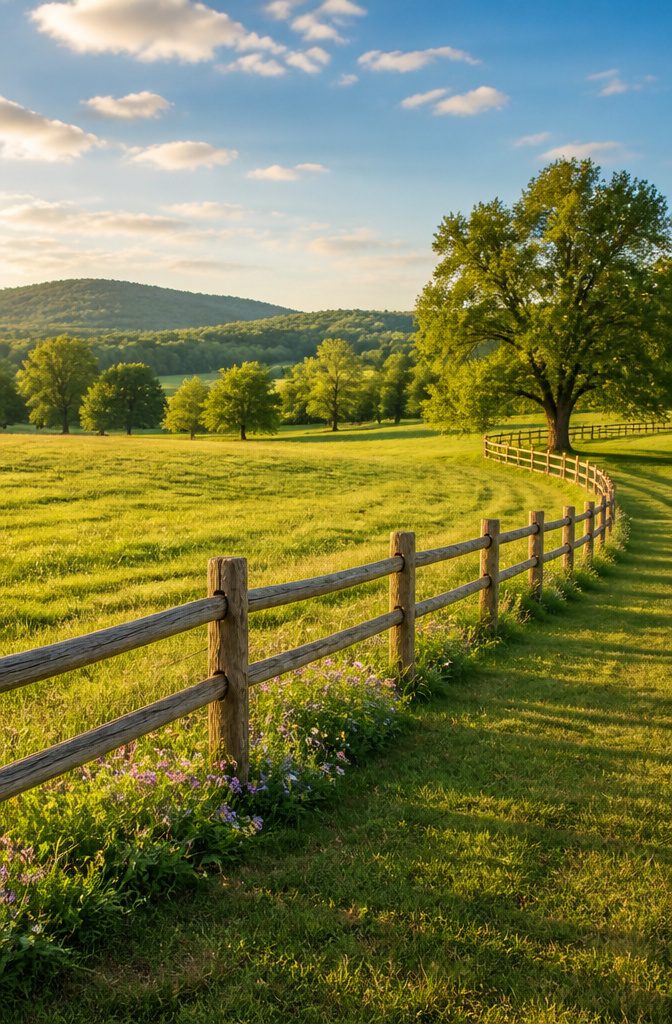
Cedar split rail runs $15–$35 per linear foot installed, which puts it among the cheapest wood fences you can buy.
The savings come from how little material the style actually uses: two or three horizontal rails held by rough-hewn posts with no pickets, no panels, no hardware beyond the basics.
That same openness gives it a rustic look that reads as intentional on large lots or country-style yards where a solid privacy wall would feel out of place and cost three times as much.
I like it for front boundaries or long perimeter lines where the goal is marking what is yours, not keeping anything in. Dogs slip through.
Deer barely notice it. It is decorative boundary marking, not real containment, and the sooner you accept that, the better the fence works for you.
If you need to stop a determined retriever or satisfy a pool code, this is the wrong place to save money.

EASY ORDERING: Everything you need for your fence project is in the box except for the final post. Only ONE additional post, BL19112, is required for the end of your project. A gate is available by searching BL19111.

Backyard Privacy Enclosure: Our vinyl fence panel set includes 2 panels measuring 50 x 50 in, ideal for concealing outdoor items like trash bins, pool equipment, and air conditioners, keeping your backyard neat and attractive while meeting HOA guidelines

Reinforced and Thickened Material: Qikdesign vinyl privacy screen is made of high-quality and thickened PVC material, posts on both sides are thickened and reinforced (0.2 in wall thickness), making it more durable than materials used in similar products on the market, and able to remain stable in strong winds. We can provide a 10-year warranty on our vinyl fence.
3. Vinyl Fence
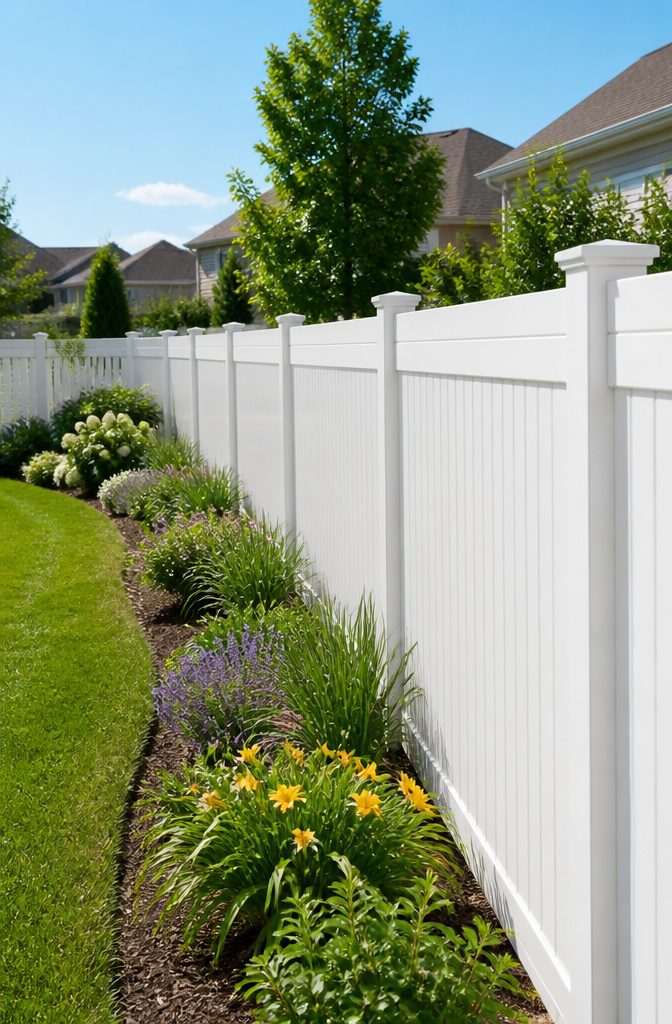
Vinyl fencing lands at $24–$60 per linear foot installed, which puts it in the same neighborhood as cedar privacy rather than undercutting chain link.
That price buys a surface that never needs paint or stain, a detail that matters when weekends are already spoken for.
The clean, uniform look is what draws first-home owners who want the yard finished without signing up for a maintenance schedule. Panels go up fast, stay white or tan or gray year after year, and hose off without much fuss.
The catch shows up later.
A cracked panel from a thrown rock or a lawnmower stone does not patch like wood; you replace the whole section, and matching five-year-old color in sunlight can mean replacing two panels to hide the seam.
Fading happens too, unevenly where bushes shade one stretch and noon sun cooks another.
For some buyers the trade is worth it. For others, the upfront savings evaporate the first time a repair bill arrives.

Premium Quality: Eapele railing bracket is made of high-quality nylon has high hardness, is not easy to break or bend, is corrosion-resistant, and can withstand wind and rain for years of indoor & outdoor use

Premium Quality: Eapele railing bracket is made of high-quality nylon has high hardness, is not easy to break or bend, is corrosion-resistant, and can withstand wind and rain for years of indoor & outdoor use.

Premium Quality: Eapele railing bracket is made of high-quality nylon has high hardness, is not easy to break or bend, is corrosion-resistant, and can withstand wind and rain for years of indoor & outdoor use
4. Aluminum Fence
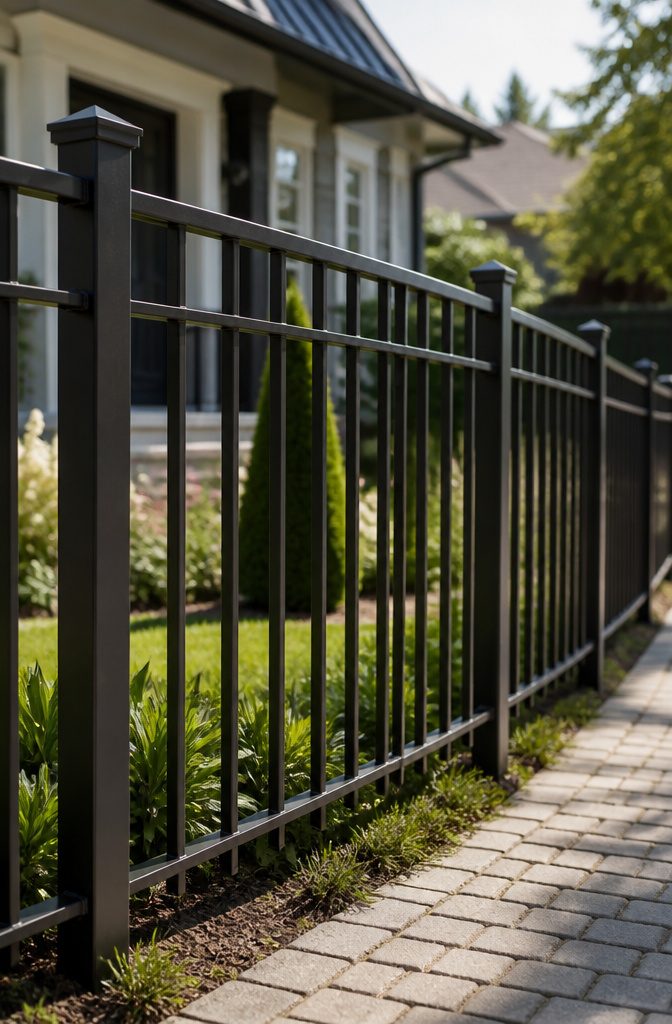
Aluminum fence panels run $20 to $40 per linear foot installed, which lands them in the middle of the cheap fence ideas list, not at the bottom.
The metal is lightweight, hollow, and powder-coated to mimic wrought iron without the rust maintenance that kills iron budgets over time. That rust-free promise is the main reason aluminum gets picked.
The look reads ornamental, not private. The vertical pickets and narrow spacing block some sight lines but leave gaps, so aluminum works for front yards where you want curb appeal and boundary definition rather than backyard seclusion.
Neighbors can still see through it; dogs can still see out.
Installation comes in pre-fabricated panels, usually six or eight feet wide, which limits how much you can customize the line to slopes or curves. The posts go in first, then panels screw in between them.
A helper matters here. The panels are light enough to carry alone, but aligning the screw holes while holding a six-foot span straight is awkward solo work.
One dropped panel bends the picket tops, and matching a replacement panel’s finish to weathered ones two years later is nearly impossible. Buy an extra panel during the initial order if your yard has tight turns or awkward angles.
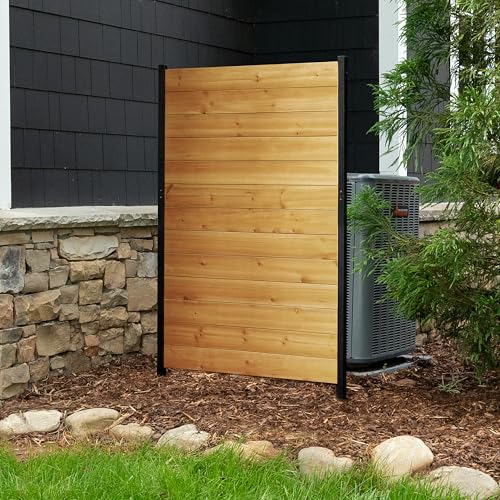
STYLISH NATURAL WOOD: This FSC certified wood screen is made with real wood meaning no two boards have the same grain color, finish, or wood knots differing it from vinyl outdoor privacy fence screen panels.

1 SCREEN PURCHASE: You will receive preassembled materials to construct 1 cedar wood outdoor privacy screen in a charcoal finish with your purchase
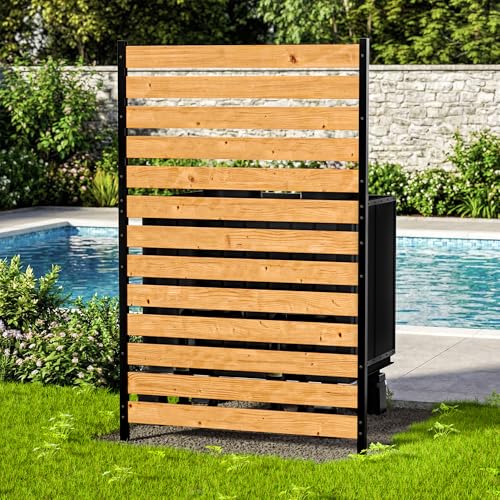
Real Wood & Aluminum Posts Our privacy fence is made with real wood, so no two boards share the same grain, color, finish, or knots—unlike vinyl outdoor privacy fence screen panels. Premium aluminum posts add strength and a refined look.
5. Pallet Fence
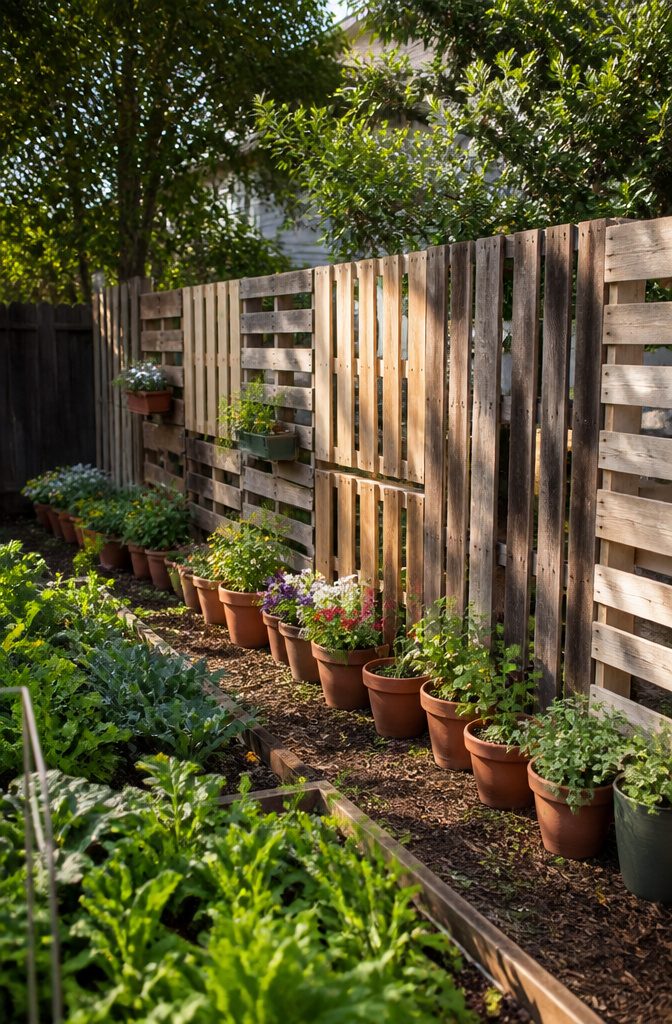
Pallet fencing is the option that costs almost nothing in dollars and asks for everything in sweat.
The pallets themselves come from loading docks, grocery stores, and warehouse back lots, and most places will let you haul them away free if you ask.
What you save in material you spend in sorting: not every pallet is worth bringing home, and the ones stamped "HT" for heat-treated hold up longer than the chemically treated variety.
Standing them takes digging, leveling, and either sinking posts between pallets or bolting them to a rail system running along the back.
Either way, the weight is the real enemy. A single standard pallet runs forty to fifty pounds, and a run of any length means hundreds of pounds of wood to move, align, and secure before the afternoon heat sets in.
Figure three to four weekends, not one, for anything beyond a small garden border.
Fastening means exterior screws and a willingness to pre-drill, because pallet wood splits easy and nail guns bounce off the hard spots.
For longevity, three to five years is the honest range before the bottom boards start rotting where they touch soil, unless you raise them on a gravel bed or capillary break.
Paint or stain buys another season or two, but this is never a permanent fence. It is a fence for someone whose budget is zero and whose back is strong.

Sturdy Construction: Built to endure harsh weather conditions and minimize sharp edges or burrs. Made from 11.5-gauge heavy-duty galvanized wire for maximum rust resistance and long-lasting durability.

High Strength and Temperature Resistance: Tensile strength of 198 lbs with temperature range from -170 to +1000, suitable for high-temperature applications such as CV boot clamps, tie rod boot clamps, and heat wrap for exhaust pipes. UV resistant for outdoor PVC pipes and metal pipes, pipe straps
Sturdy Construction: Built to endure harsh weather conditions and minimize sharp edges or burrs. Made from 11.5-gauge heavy-duty galvanized wire for maximum rust resistance and long-lasting durability.
6. Living Fences
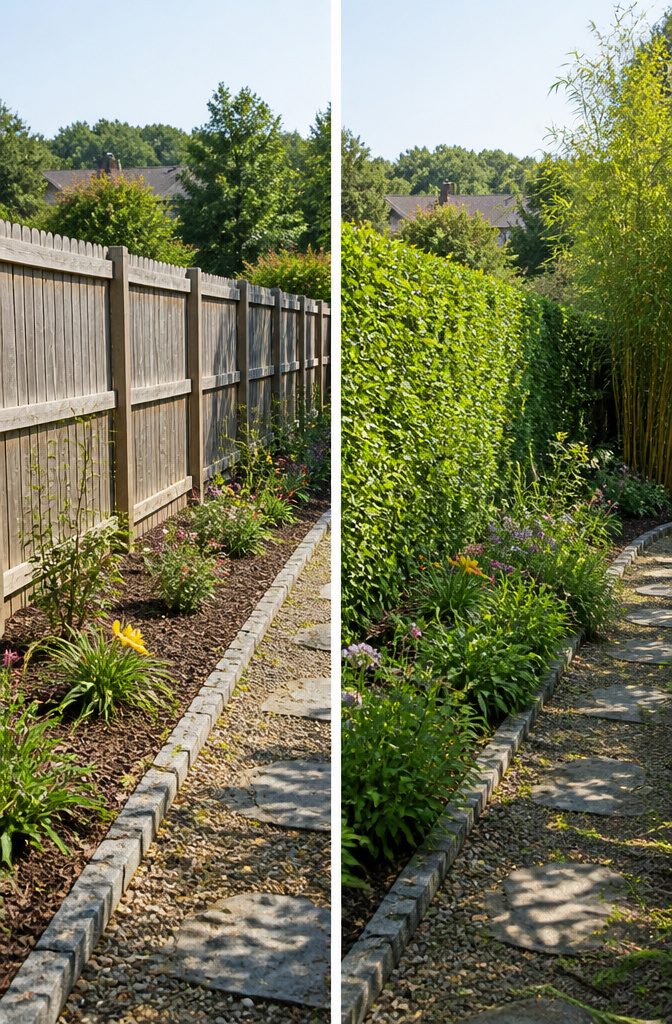
A hedge fence fills in slowly, and that patience costs more than the plants themselves.
Most varieties need three to five years before they read as a solid wall, and during that stretch you are still pruning, shaping, and watering through dry spells.
Bamboo works faster above ground, but the running types will invade your neighbor’s yard or your own foundation unless you bury a root barrier deep enough to matter.
Clumping bamboo stays put, yet it tops out shorter and costs more per linear foot at the nursery.
Water access shapes whether either option stays cheap. A long hedge in a dry summer drinks like a lawn, and bamboo in a container needs near-daily attention in July heat.
These are landscaping projects, not weekend fence builds, and they suit owners who plan to stay put long enough to see the payoff. If you need a boundary defined before your next birthday party, a living fence will disappoint you.

Enhanced Security: Enjoy increased privacy and protection with chain link fencing Tape (Material Depth 0.52 mm); easily integrate privacy fence tape for a more secluded outdoor space

Privacy Solution: Most economical way for privacy over chain link fence, porous decorative concealment, existing cyclone wire fence, wood retaining wall, welded wire fence, chain link fence, privacy barrier around swimming pool, block nose neighbor see through, add privacy to acre back yard backdrop, front yard, patio, garden and porch; hide street, road, construction site, pet kennel pen, block surrounding noise and street view, stops dogs from barking at neighbors.

Enhanced Outdoor Comfort: Enjoy your outdoor space with a patio Blade Slats With Bottom Locking Channel privacy fence that provides a sense of seclusion; the mesh fence allows airflow while blocking unwanted views
7. Wire Fencing
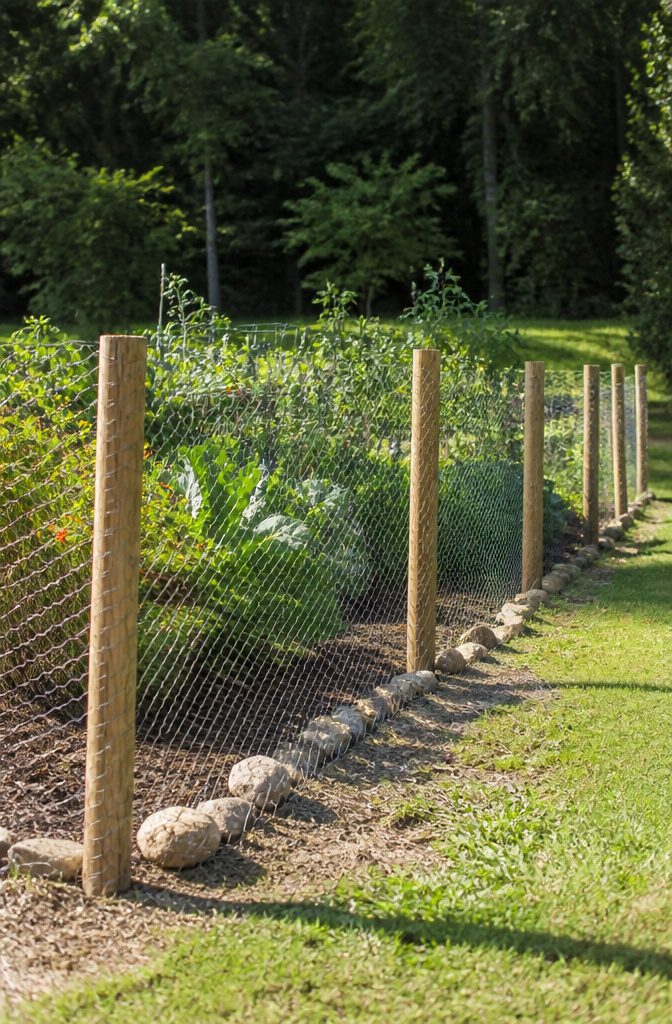
Chicken wire and barbed wire sit at the bottom of every price list for fencing material, and for good reason.
A roll of chicken wire stretches far enough to edge several raised beds for the cost of a restaurant dinner, while barbed wire runs even less per foot and carries real stopping power against livestock.
The catch is knowing where each belongs.
Barbed wire has no place in a yard where children or pets roam.
The same barbs that turn a steer also tear skin, and a dog running the fence line will learn that lesson fast. City zoning often bans it outright for residential use, which saves you from the mistake of installing it.
Chicken wire solves gentler problems.
Stapled to wooden posts with fence staples every six inches, it keeps rabbits from lettuce and chickens from flower beds. The galvanized coating buys a few seasons before rust sets in; uncoated wire corrodes faster.
Neither option offers privacy or curb appeal, but both do exactly what cheap fencing should: solve one problem for almost nothing, then hold up long enough to justify the hour spent installing it.

Backyard Privacy Enclosure: Our vinyl fence panel set includes 3 panels measuring 50 x 50 in, ideal for concealing outdoor items like trash bins, pool equipment, and air conditioners, keeping your backyard neat and attractive while meeting HOA guidelines

Customizable Outdoor Privacy: These large outdoor privacy fence set includes two panels, each measuring 44"W x 44"H; Easily configure them into an "L" shape or a straight line to ideally shield your garden or patio
8. Electric Fencing
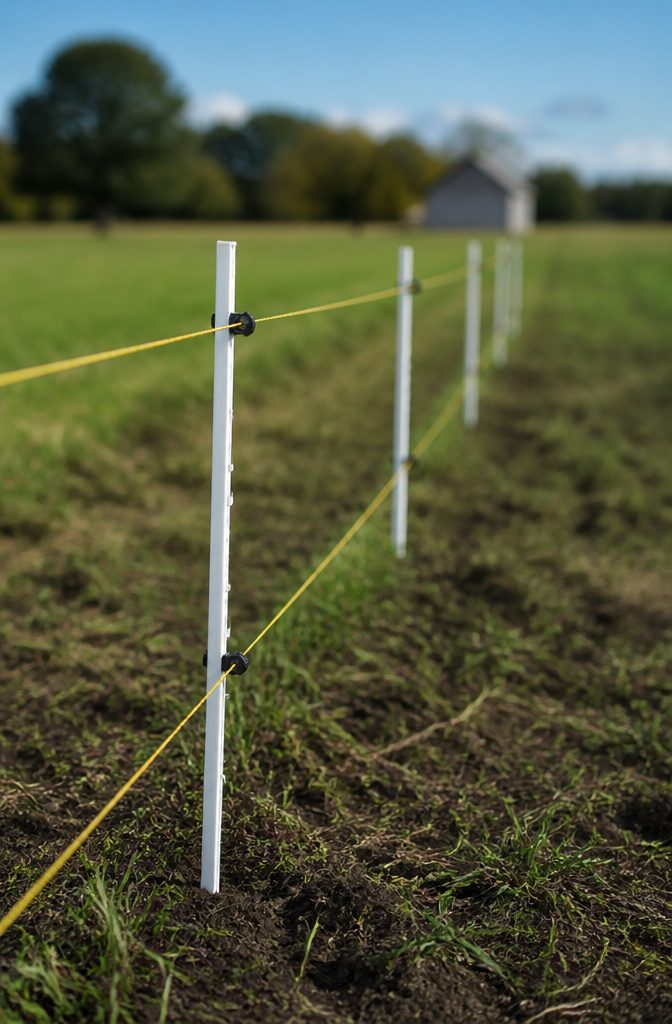
Electric fencing carries an upfront material cost lower than almost any physical barrier, sometimes just pennies per foot for polywire or tape, but that number hides the real investment: a working knowledge of grounding systems, joule output, and animal behavior that takes time to build.
The shock itself is a brief, high-voltage pulse meant to startle livestock into retreat, not to injure, which is why it works on horses and cattle who learn quickly but fails entirely with predators or determined pets who push through once and never look back.
Residential use raises problems the farm context avoids. Most municipalities restrict electric fencing to agricultural zoning, and a fence that delivers even a mild shock to a toddler or a neighbor’s dog opens liability a standard wooden fence never would.
Underground utilities complicate grounding rod placement in suburban soil, and the visual result, posts with plastic insulators and sagging wire, reads as temporary infrastructure rather than a finished yard.
For a few hundred dollars and a weekend, the hardware is cheap enough.
The gap is in the setup: a charger sized wrong for your acreage, a ground rod in dry soil, or wire too close to overhanging branches turns the whole system into an inconsistent nuisance that livestock ignore and visitors fear.
The sources that mention electric fencing group it with chicken wire and barbed wire as options better suited to gardens, livestock, or decorative use than to a standard residential yard, and that classification holds.
This belongs on pasture, not property lines where the mail carrier walks.
9. Trellis Panels
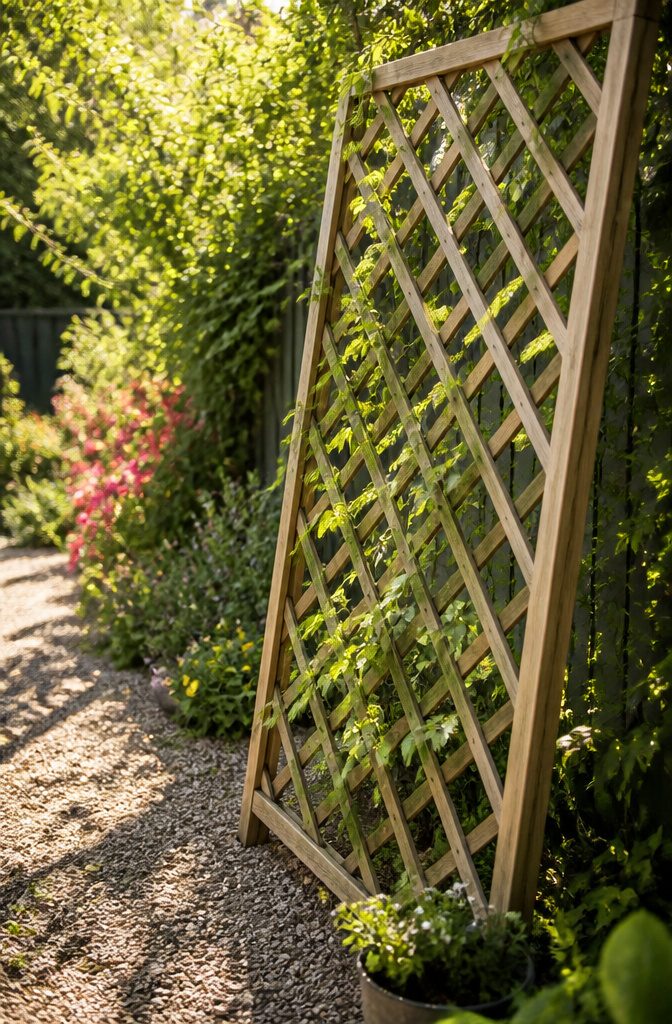
Trellis panels sit in a strange middle space: too open for privacy, too light for keeping anything out, but exactly right when the goal is marking where your yard ends without looking like you built a wall.
Wood lattice runs cheaper and takes stain or paint however you want it. Vinyl skips the maintenance but costs more up front and limits you to the colors the factory picked.
Either way, heights rarely top six feet, and anything over four feet starts to need real bracing or it will rack sideways the first time someone leans on it.
The real payoff is what climbs it. Morning glory, clematis, or basic ivy will fill the gaps in a single season if you are patient with training the first few weeks.
Without a plant, a trellis is just a frame. With one, it becomes a green screen that costs next to nothing to thicken year over year.
Anchoring matters more than people expect. A trellis in soil needs posts sunk two feet minimum or wind will walk it across the garden.
Against concrete or a deck surface, metal brackets and weight plates do the job without drilling into a landlord’s structure, which matters for renters who want the look without the permanent install.
I have seen too many trellises leaning like a door off its hinges because someone thought a few inches of dirt would hold a six-foot sail.
What Cheap Actually Costs
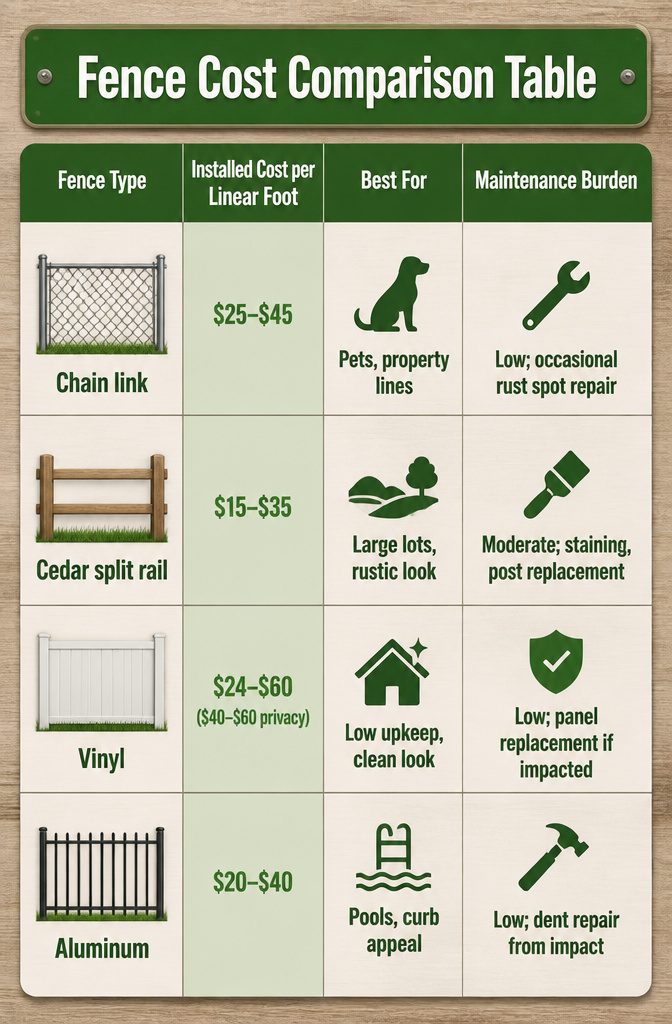
Sticker price on a fence line rarely predicts what you will actually spend. Chain link runs $25–$45 per linear foot installed, split rail $15–$35, aluminum $20–$40, and vinyl $24–$60 with privacy styles landing at the top of that band.
The cheap ones cost more by year five once you factor in posts that rot at the concrete line, vinyl brittle from UV, or aluminum panels a truck backing out of the driveway will crumple.
A split rail cedar post replaced once plus stain every other year can push its true cost past a vinyl line that only needs a hose-off.
To compare across the nine styles, add estimated repair and maintenance to the installed price, then divide by the years you plan to stay.
| Fence Type | Installed Cost per Linear Foot | Best For | Maintenance Burden |
|---|---|---|---|
| Chain link | $25–$45 | Pets, property lines | Low; occasional rust spot repair |
| Cedar split rail | $15–$35 | Large lots, rustic look | Moderate; staining, post replacement |
| Vinyl | $24–$60 ($40–$60 privacy) | Low upkeep, clean look | Low; panel replacement if impacted |
| Aluminum | $20–$40 | Pools, curb appeal | Low; dent repair from impact |
If the fence is temporary or the yard is flat and friendly to DIY, the lower upfront number wins.
If the slope is irregular or the soil holds moisture, the extra $10–$20 per foot for vinyl or aluminum buys fewer Saturdays with a post-hole digger.
DIY or Hire It Out
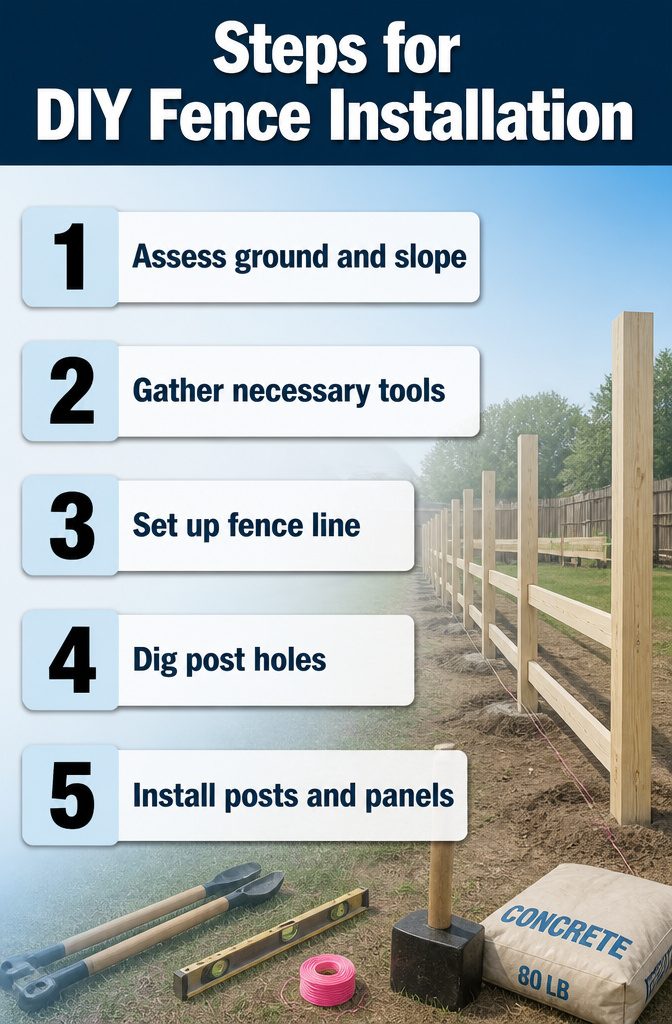
The 277 linear feet I put in last spring taught me that DIY stops saving money once the yard has slopes, multiple corners, or gates. Flat ground and a straight run are the only places self-installation reliably wins.
Tool costs add up fast. For a post-and-rail cedar split rail, you need post-hole diggers, a level, string line, and a tamper.
Add a gas-powered auger rental for dense soil, plus concrete for setting, and you are already spending what a crew’s labor markup would have been for a short run.
Chain link needs a come-along, stretcher bars, and tension bands most homeowners will never use again.
Setting posts straight is where the learning curve lives. You are managing plumb in two directions, grade, and spacing all at once, while concrete is curing and your arms are fatigued.
Small errors compound: a post half an inch out at ground level means a panel that leans noticeably six feet up.
A pro’s speed matters most when the project involves tear-out of an old fence, utility marking, or permit inspections. Rework after a failed inspection — footing depth, setback from the property line, finished-side orientation — costs more than the original labor quote.
For a simple flat stretch under fifty feet, DIY still makes sense. Past that, the weekend timeline and the tool math usually favor hiring it out.
Durability and Upkeep
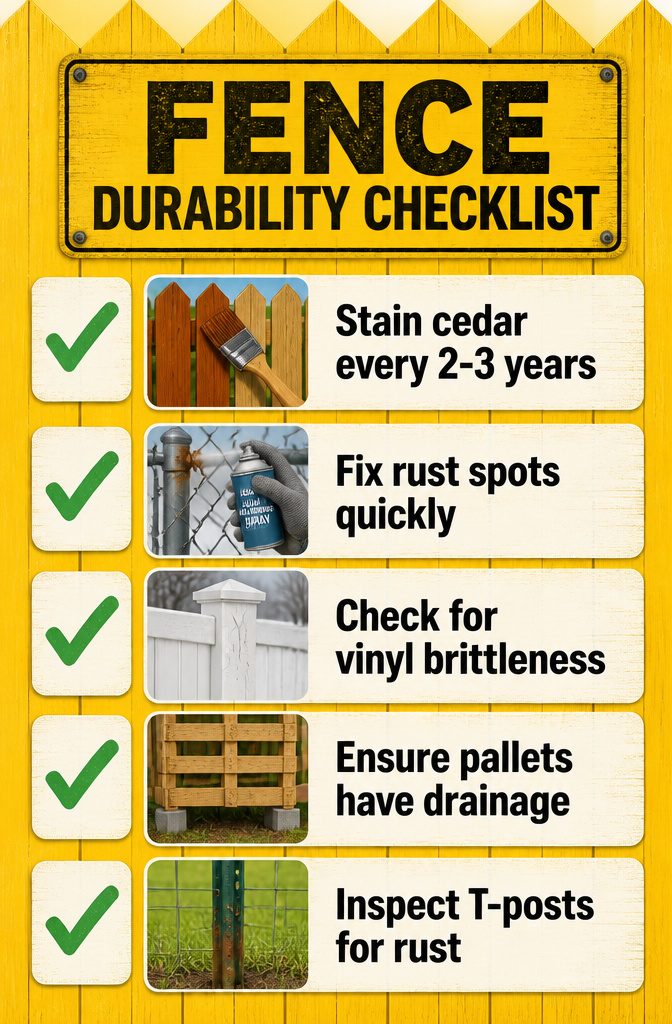
Cheap materials only stay cheap if they last, and weather is what turns a weekend project into next spring’s do-over.
Stain cedar every two to three years or the sun bleaches it gray and rain starts splitting the rails.
I skip the clear coats; the pigment is what blocks UV, and a five-gallon bucket of solid-color stain costs about the same as one premature replacement post.
Chain link and aluminum both rust, but differently. Galvanized chain link holds up until the coating gets nicked; then it corrodes fast at the scratch.
Aluminum oxidizes slower, and the white powder it forms actually protects the metal underneath. A rattle-can of cold-galvanizing spray fixes chain link spots before they spread.
Vinyl gets brittle in hard freezes and warps in sustained heat.
Dark colors are worse for both. In zones with real winter, expect cracking at the post caps within five years.
Pallets and trellis are the ones that taught me the hard way. Standard pallet wood is rarely pressure-treated; set it in grass that stays damp and the bottom row rots in one season.
Trellis panels, especially the latticed kind, trap leaves against the fence line and hold moisture like a sponge. Both need feet of air underneath or they become termite bait.
Wire mesh alone has no rot issue, but the posts do.
T-posts rust at the soil line; wooden line posts snap where the wire tension concentrates. I check those stress points each spring.
How a Fence Reads from the Street
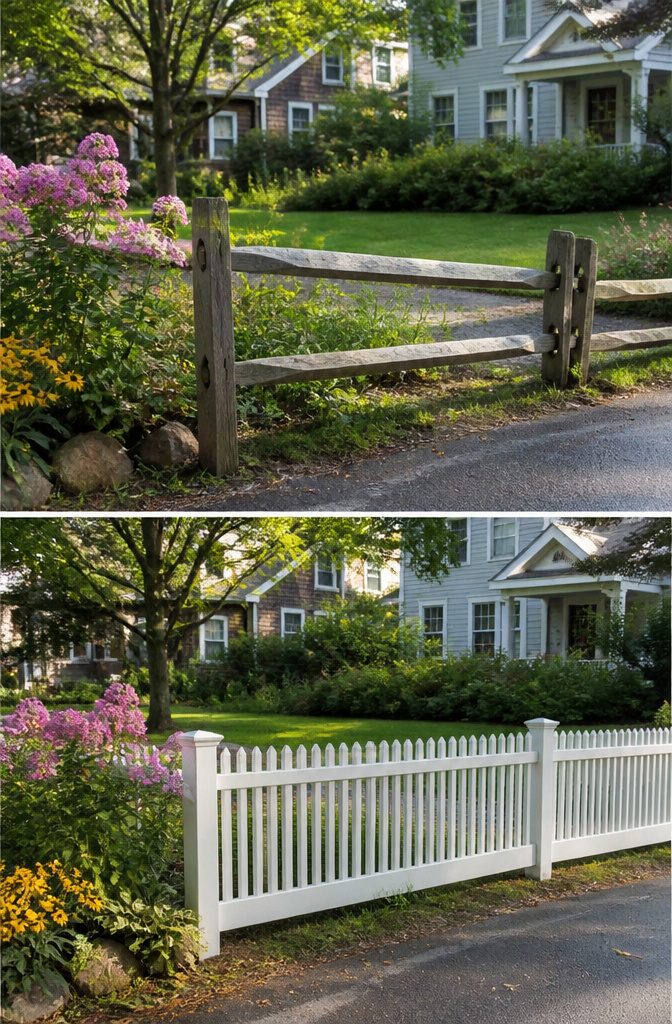
A fence is the first thing buyers see when they pull up, and it sets the tone before they ever step out of the car.
Chain link in a front yard reads utility, not welcome, which is why it belongs around back where function matters more than first impressions.
Split rail or rough-hewn wood in the right region, though, signals intentional style rather than budget constraint.
The trick is matching material to context. A weathered cedar rail fence in rural Pennsylvania looks established; the same fence in suburban Phoenix looks like you stopped halfway through the project.
For first-home owners thinking about resale, the fence that hurts value is the one that looks temporary.
Pallet wood with inconsistent gaps, unpainted pressure-treated posts already graying at six months, or wire stretched between leaning metal stakes all suggest deferred maintenance to a buyer’s eye.
Buyers do not deduct the replacement cost from their offer; they skip the house entirely.
Painted wood or clean vinyl in a neutral tone costs little more upfront but photographs better for listings and holds the line during appraisal.
If the budget only stretches to bare-bones materials, concentrate them where they are least visible from the street and keep the front boundary tidy. A cheap fence that looks deliberate protects value; one that looks accidental erodes it.
Frequently Asked Questions
What is the cheapest fence to install?
Chain link is usually the cheapest permanent fence to install, running $25 to $45 per linear foot.
Basic galvanized wire sits at the low end, while vinyl-coated versions or privacy slats push the price higher. It keeps dogs in and marks property lines with almost no maintenance, though it offers little privacy unless you add slats later.
How much does a vinyl fence cost?
Vinyl fencing runs $24 to $60 per linear foot installed, with basic picket at the lower end and privacy styles around $40 to $60.
That puts it in the same range as cedar privacy fencing rather than below chain link. You trade the lower upfront cost of wire or wood for a surface that never needs paint or stain.
What are the best options for privacy fencing?
Cedar privacy fencing is one of the more affordable ways to get real backyard privacy, and vinyl privacy panels at $40 to $60 per linear foot offer a low-maintenance alternative.
Chain link with woven slats can work too, though that pushes you toward the upper end of chain link pricing. Split rail, aluminum, and trellis without climbing plants all leave gaps, so they fail at actual screening.