

Murphy bed ideas range from $200 DIY kits to $3,000 built-in wall units, and the deciding factor is usually whether you can drill into the studs or you’re stuck with a lease.
Wall-mounted versions free 35–40 square feet of floor each morning; chest-style units roll away entirely when your landlord says no holes.
Either way, the mechanism has to be rated for the frame plus your actual mattress, not the thin demo pad they show in the showroom.
1. Murphy Bed with a Desk
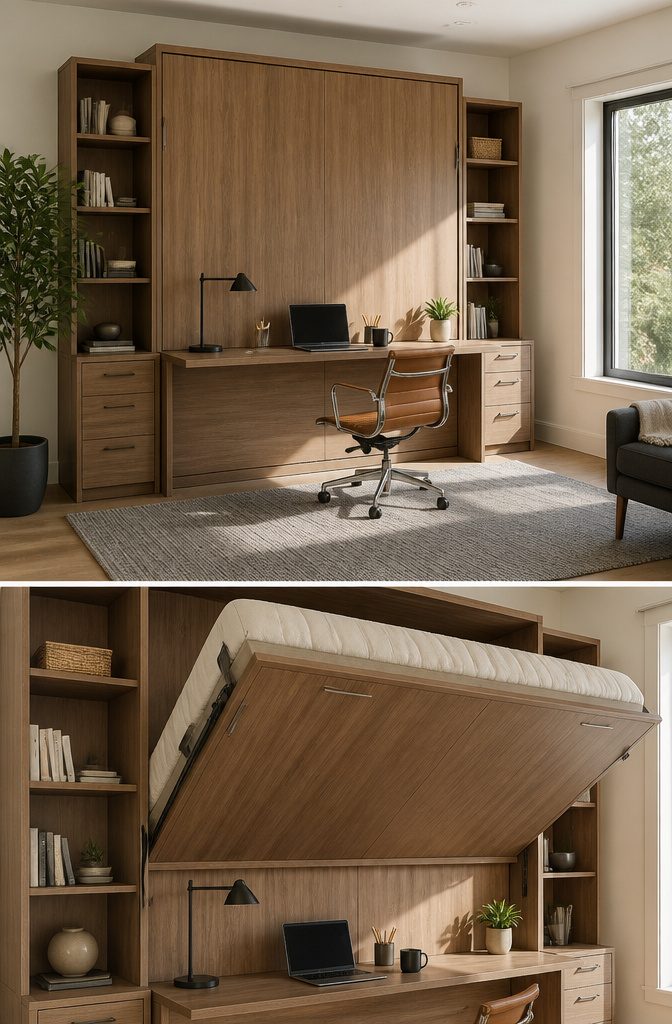
A desk-integrated Murphy bed turns the same wall into a workspace by day and a guest room by night.
Modern mechanisms swing the desktop down with the bed frame while keeping the surface perfectly level, so your laptop, lamp, and coffee cup stay put.
One-handed operation is standard now, which matters when you’re lowering a queen frame after dinner with one arm full of bedding.
The real payoff is matching the finish to what you already own.
Raised-panel doors that echo existing bookcases, or a cabinet run that reads as built-in storage rather than a bed box, keep the room from feeling like a furniture showroom.
Complete units run $2,000–$3,000 installed.
DIY kits with hardware and plans sit under $200, though you’ll supply the plywood and the weekend. Either way, leave clearances for the chair and any side tables you need to shuffle when guests actually arrive.
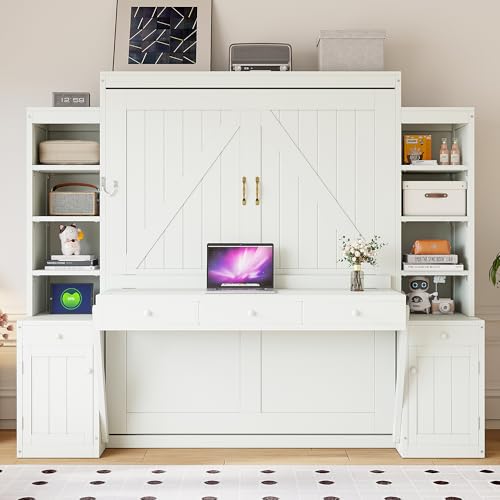
【Smart Space-Saving Murphy Bed】This queen size murphy bed features a seamless, user-friendly folding mechanism that effortlessly converts from a stylish murphy bed cabinet into a comfortable bed in seconds. Perfect for guest rooms, offices, or studios, it instantly reclaims valuable floor space while offering a secure and sturdy sleeping solution

【All-in-One Space-Saving Solution】- Upgrade your small space with this versatile Murphy bed that combines a comfortable bed, built-in sofa, sleek desk, and storage cabinet in one sleek unit! Perfect for studios, guest rooms, or home offices, this foldable wall bed maximizes floor space when not in use. The soft-cushioned sofa provides extra seating, while the hidden bed ensures a restful night’s sleep—no compromise on comfort or style!

Queen Size Murphy Bed With Desk Design: YOPTO Queen Murphy Bed combines a comfortable sleeping area with a built-in desk, making it a practical solution for bedrooms, guest rooms, home offices, and studio apartments. This wall bed easily transforms your space by combining a queen size bed and workspace in one functional design.
2. Murphy Bed with a Sofa
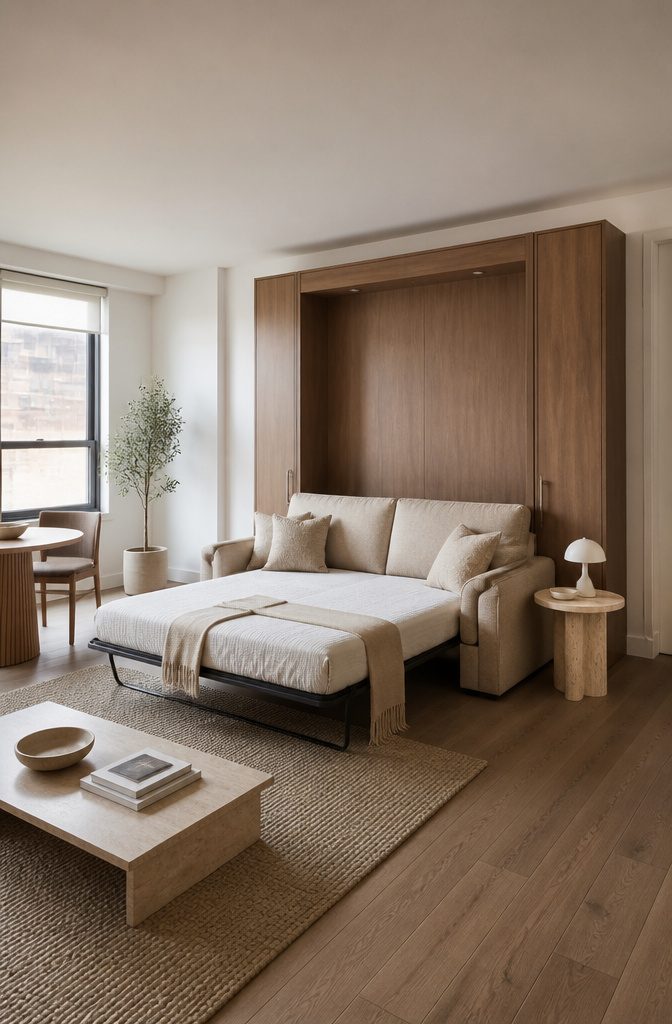
A sofa-Murphy bed combination lets a studio apartment keep its living room layout without the nightly shuffle of furniture against walls.
The sofa sits in place against the unit; you lift the cushions, pull the front panel, and the mattress and frame unfurl downward. By morning, the bed stows back up and the room returns to seating.
Standard mattresses 10–12 inches thick work with most of these units, and coil construction is the better choice here.
Foam mattresses, including the compressed bargain styles sold online, lack the structural integrity for being stored on their sides when the bed is closed. A coil mattress keeps its shape and support through repeated cycles.
The bed size itself is flexible: full, queen, lower to the ground or higher.
One approach I have seen places the mattress low so the stowed unit doubles as a bench on the room-facing side, giving you a seating nook rather than blank wall.
For tight studios, that extra usable surface matters more than the bed height.

[Full Size Murphy Bed] Crafted from durable industrial-grade laminated MDF and plywood, it includes a dual piston metal folding mechanism for smooth and easy lifting and lowering.
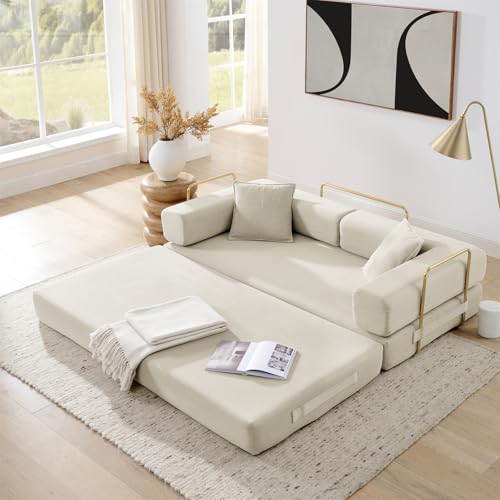
King-Size Versatility: Upgrade your living space with this king size sofa bed. Its convertible 3-seat design allows easy adjustment of the armrests, seamlessly transforming from a stylish lounge couch to a spacious sleeper, perfect for living rooms, bedrooms, or studios.

【All-in-One Space Maximizer】- This Murphy bed seamlessly integrates a queen-sized folding bed with a contemporary L-shaped sofa and integrated storage compartments. Engineered for compact living, the unit transforms your living area by day and bedroom by night without sacrificing comfort. The intelligent layout eliminates space constraints in studios, apartments, or multipurpose rooms, featuring overhead and side storage units to organize bedding, pillows, and living essentials. Perfect solution for urban dwellers seeking functionality without compromise.
3. Murphy Bed with Bookcases
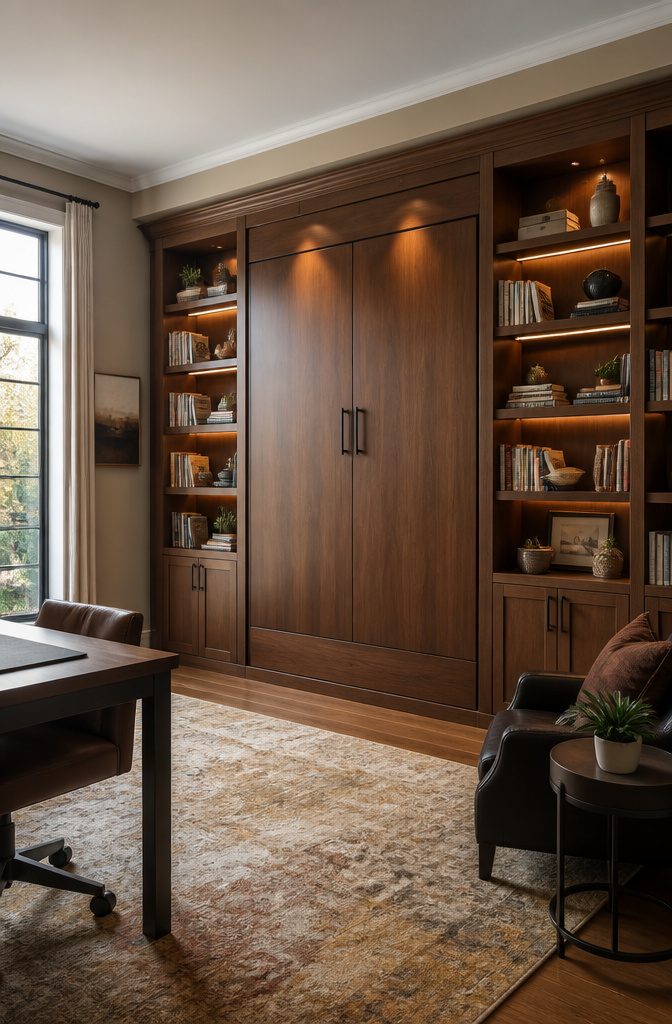
A Murphy bed flanked by bookcases solves the visual problem of a blank bed frame staring at you all day.
The bed folds up between two shelving towers, and the bottom of the frame reads as cabinet doors. Closed, the whole wall looks like a built-in armoire or library unit, not a piece of furniture you are hiding.
This layout earns its floor space back twice. The bookcases hold books, files, or whatever clutter accumulates in a room that serves as an office or library by day.
Some units add glass doors and built-in lighting, which turns the shelving into display space and keeps the room feeling finished after the bed goes up.
These wall units can hold up to 2,000 lbs, frame and all, so the storage load is not a structural concern.
For a renter or first-time owner working with a few hundred dollars and a weekend, the bookcase approach makes most sense in a room that already needs storage.
You are building out the wall you would have filled with IKEA Billys anyway; the bed just sits in the gap between them.

1. Folding Hidden Murphy Bed Queen: This Queen Murphy bed folds neatly into a sleek cabinet when not in use, instantly transforming bedrooms, home offices, or guest rooms into functional spaces. For apartments, small homes, or multi-purpose rooms, it eliminates the hassle of permanent bed placement and frees up valuable floor space for daily activities like working, exercising, or entertaining.

18.3" SIDE CABINET WITH 4 SHELVES & 3 DRAWERS: Combine a comfortable Queen sleeping space with practical storage in one cabinet-style design. The 18.3-inch side cabinet features 4 upper shelves for books, decor, and everyday essentials, plus 3 spacious lower drawers for clothing, linens, and bedside items—helping keep your room organized without adding a separate storage unit.
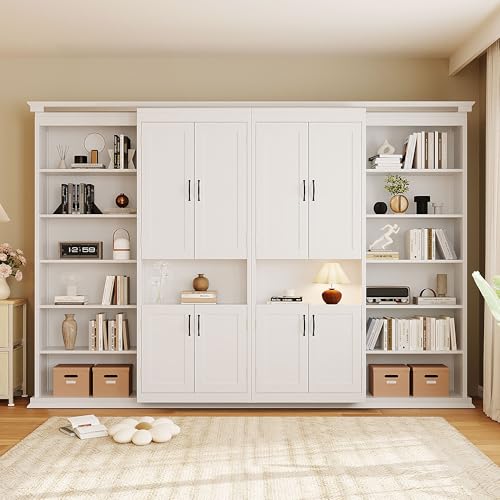
Dual Sliding Storage Cabinets for Flexible Organization:Two front storage units glide smoothly left or right on premium rails, giving you effortless access and customizable storage. Perfect for books, décor, toys, or daily essentials—without blocking the bed operation.
4. Murphy Bed in a Chest
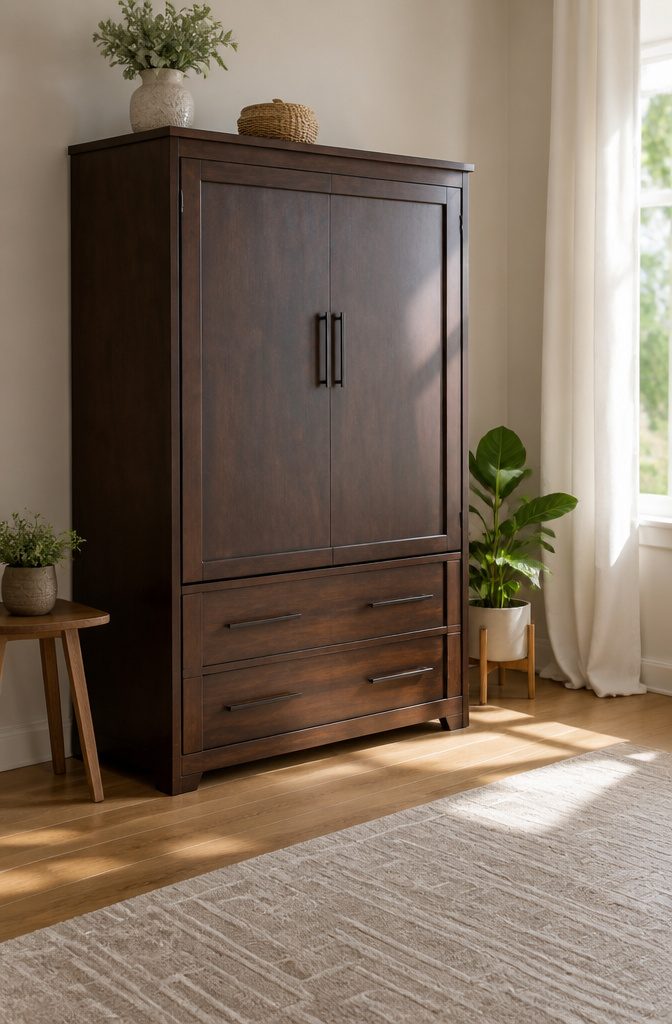
A freestanding chest-style Murphy bed folds out from a cabinet on the floor rather than mounting to the wall, which makes it the only Murphy bed option most leases allow.
No brackets, no studs, no patching holes when you leave. Some models come with wheels, so the whole unit rolls aside for cleaning or a different room layout.
The tradeoff is real. Built-in wall units can frame an entire room with storage and look like architecture that was always there.
A chest bed gives up that integration for portability. You gain the ability to move it with a dolly when your lease ends; you lose the seamless built-in look and the larger sleep surface that wall-mounted frames accommodate.
Storage still exists in the chest format, just differently.
The cabinet face may include drawers or compartments that stay usable whether the bed is open or closed, but they compete for space with the mattress cavity rather than wrapping around it.
For renters who move every couple years, that compromise usually wins.

Complete Queen Horizontal Murphy Bed Frame Kit: Includes a tubular steel mattress platform, cambered wood slats, two-stage gas springs, and mounting hardware for building a horizontal queen wall bed with an integrated support frame.

【Reinforced Support for Stronger Weight Bearing】 Additional under-bed support bars combined with four extra support legs reinforce the platform from underneath, improving weight distribution and delivering stronger, more reliable support for daily use while reducing long-term stress on the bed surface

🏗️【Sturdy Construction】 The queen size murphy bed engineered with a heavy-duty metal frame and 26 resilient multi-layer solid wood slats, providing robust structural integrity and an impressive 1200 LBS total weight capacity that ensures a wobble-free, deformation-free sleep experience
5. Murphy Bed Bunk Beds
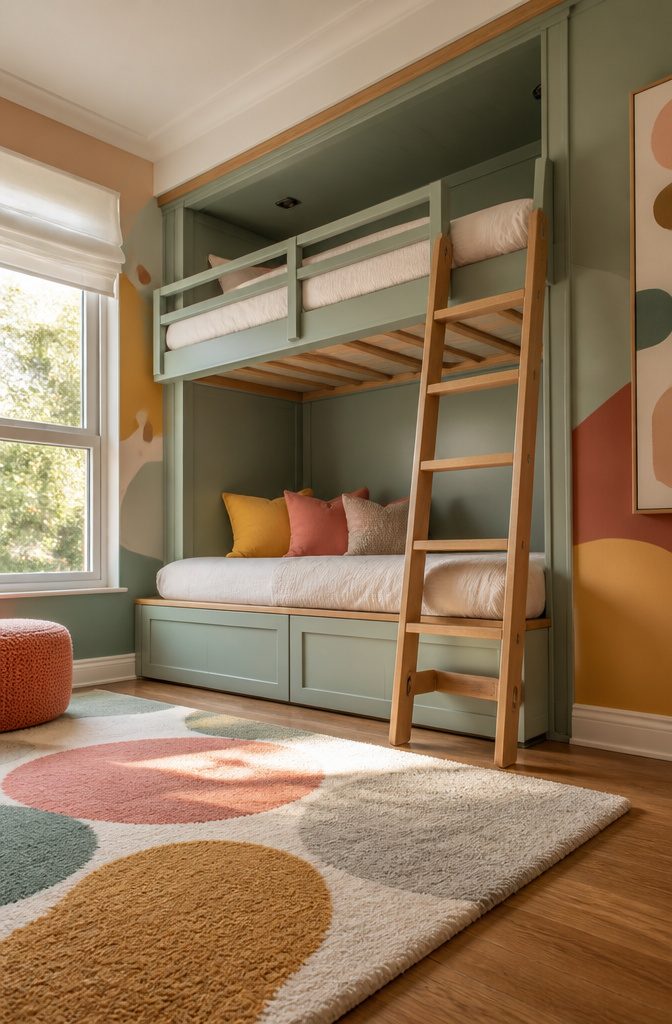
Bunk-style Murphy beds stack two sleeping platforms vertically against the wall, folding up together to clear floor space for daytime use.
The lower bunk sits at standard height while the upper requires a ladder, which makes anchoring into wall studs and ceiling joists non-negotiable if the frame is going to survive a kid who climbs like a kid.
Nikki and Caleb Grandy’s build in Arizona used a 2×4 frame sheathed in medium-density fiberboard, then trimmed with molding so the closed unit reads as paneled wall rather than folded furniture.
The ready-made market here is thin. One option, the Urban Stack Murphy Bunk Bed, ships as a ready-to-assemble kit in twin or twin extra-long, with an integrated ladder and white industrial-grade melamine standard.
Most families will need to go custom or plan on shop-built frames, which means sourcing hardware rated for the doubled load and confirming the wall can take the torque of two mattresses tilting at once.
Safety on the upper bunk matters more when the whole assembly moves. Locking mechanisms that engage once the bed is lowered, plus guardrails that stay put during the fold, separate usable designs from novelty builds.
For vacation cabins where the beds see guests who are unfamiliar with the mechanics, the simpler the latch system, the fewer 2 AM phone calls.

𝐂𝐎𝐌𝐏𝐋𝐄𝐓𝐄 𝐌𝐔𝐑𝐏𝐇𝐘 𝐁𝐄𝐃 𝐇𝐀𝐑𝐃𝐖𝐀𝐑𝐄 𝐒𝐘𝐒𝐓𝐄𝐌 — WHAT’S IN THE KIT — Includes gas piston lift system (smooth open/close rated for daily use), patented 2-in-1 auto-locking stainless steel pivot plates, heavy-duty square tube folding legs, quick-release mattress retention strap, all mounting hardware and fasteners, plus 3 fully illustrated guidebooks (Cut List Guide, Construction Guide, Assembly Handbook). No separate hardware store runs needed for the mechanical components.
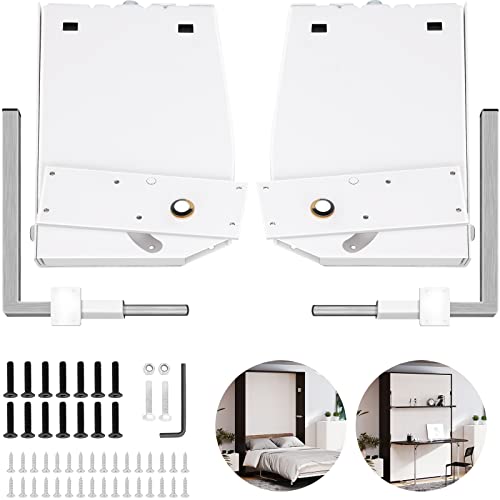
【SUPERIOR REBOUND FORCE】- One person can freely fold out or up the bed. Inside 9 premium springs, high rebound strength to ensure the whole process.

Horizontal Mount Queen Size Full Size Twin size Deluxe Murphy Bed Hardware Kit(for the small size bed,just reduce the springs in the housing if they are too strong)
6. Vertical vs. Horizontal Murphy Beds
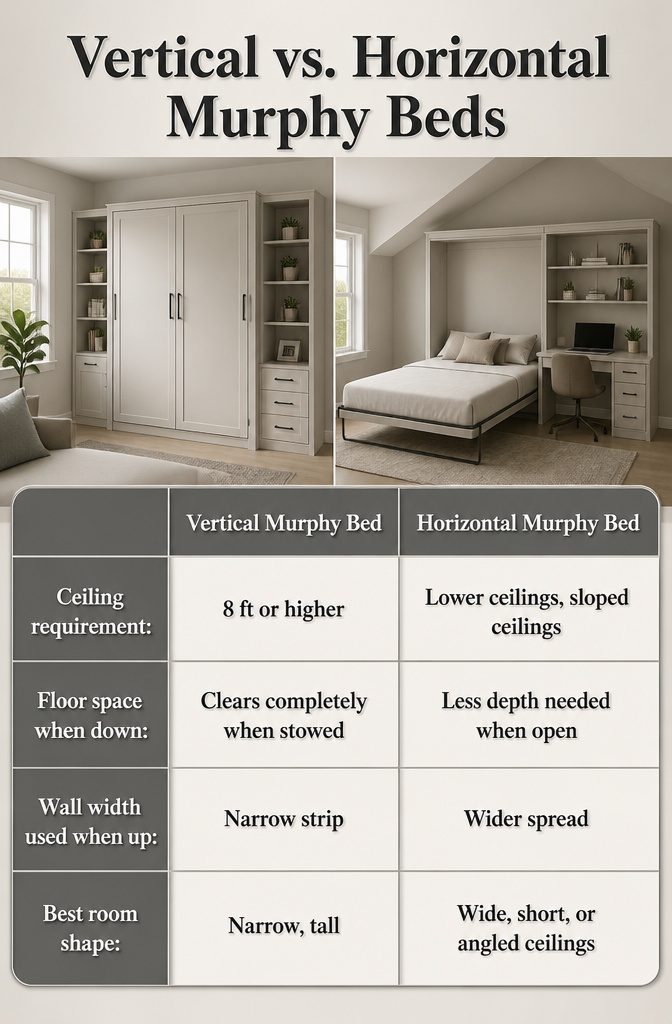
Ceiling height decides the orientation before anything else. A vertical Murphy bed folds upward against the wall, so 8 feet of clearance is the practical minimum for a standard queen.
That upward swing frees the floor completely once the bed is stowed, which makes vertical units the default for normal-height rooms where width is tight.
Horizontal beds fold sideways instead.
They eat more wall width but need far less vertical clearance, which makes them the workable choice for attic conversions, basement rooms, or any space with a sloped ceiling where a vertical unit would collide with the angle.
In a narrow room, the sideways motion also means less floor depth is blocked when the bed is down; you can walk past the foot while it is open.
The tradeoff is wall real estate.
Vertical beds occupy a narrow vertical strip. Horizontal units spread wider, which limits what else can hang on that wall.
A horizontal Murphy bed with desk integration keeps the desktop level as it lowers, so the workspace does not need clearing; that combination is built for offices with limited height.
| Attribute | Vertical Murphy Bed | Horizontal Murphy Bed |
|---|---|---|
| Ceiling requirement | 8 ft or higher | Lower ceilings, sloped ceilings |
| Floor space when down | Clears completely when stowed | Less depth needed when open |
| Wall width used when up | Narrow strip | Wider spread |
| Best room shape | Narrow, tall | Wide, short, or angled ceilings |
Measure twice for clearance in every direction. The bed must open fully without hitting doors, windows, or other furniture, and that arc differs sharply between the two orientations.

2-in-1 Murphy Bed and Desk Combo: Features a spacious 61.8 x 17.7 in desktop for work or study, then converts into a pull-down bed in a few simple steps, allowing a home office, guest room, or studio to serve both needs without separate furniture

[Solid Wood Murphy Bed] Made of high-quality solid pine wood and MDF with reliable construction, this murphy bed frame can last for long time use

[Murphy Bed with Desk] The Queen Size Murphy Bed boasts a unique design that effortlessly transitions from bed mode to desk mode, making it an ideal addition for small spaces like studios, study rooms, or home offices. You can have a dedicated office space by day and a comfortable guest bedroom by night.
7. Murphy Bed for Studio Apartments
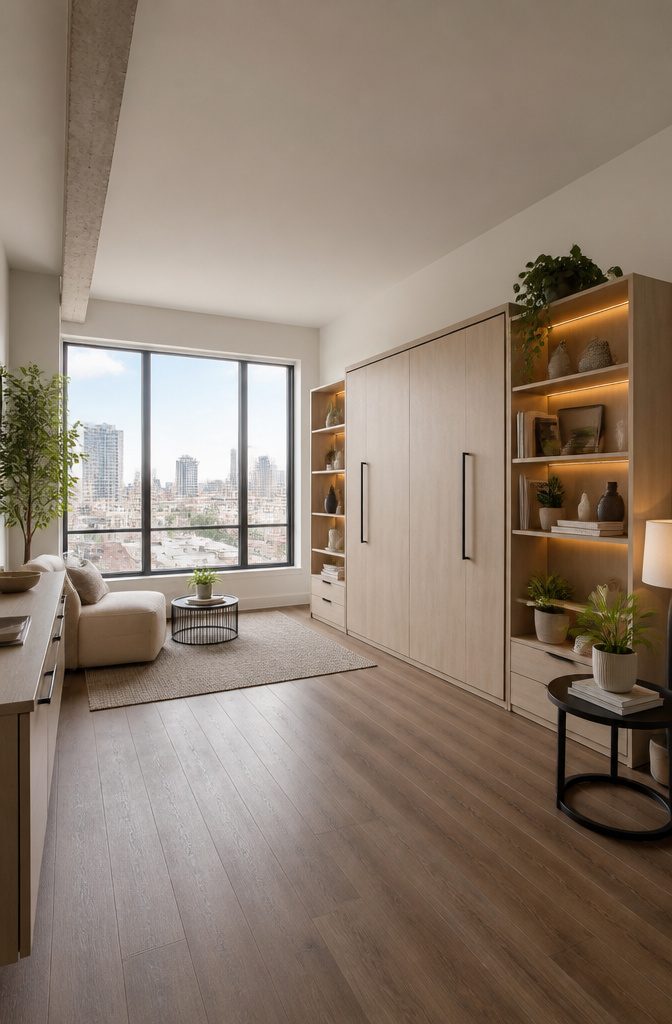
A Murphy bed is one of the few pieces that actually earns its footprint twice.
Folded up, it frees the floor area you need for living; down at night, it gives you a real mattress instead of a sofa or a futon. In a studio, that swap matters more than anywhere else.
The placement decides whether it feels clever or cramped. Putting the bed opposite a window means morning light hits you naturally when it lowers, which beats stumbling toward a dark wall.
Against the longest wall usually clears the most floor space when it is open, since the shorter walls are where traffic already compresses.
Built-ins around the bed frame can carve out a sleeping zone without a full wall, which keeps the openness that makes studio living tolerable.
Vertical shelving draws the eye up and gives storage that does not compete for the same floor area.
What sold me on the idea, reading through a dozen of these layouts, is the cost comparison. A studio with a Murphy bed functions like a one-bedroom at a fraction of the rent or purchase price difference.
The bed is not hiding that you live in one room; it is making that one room work on two different schedules.

【Space-Saving 2-in-1 Design】This Murphy Bed combines a comfortable sleeping area with a built-in sofa, allowing one piece of furniture to serve multiple purposes. Designed for apartments, studios, guest rooms, and multifunctional spaces, it helps maximize floor space without sacrificing everyday comfort.

【Sturdy Construction】Made of high-quality solid pine wood and MDF with reliable construction, this murphy bed frame can last for long time use and ensure strong stability and durability.

【King-Size Convertible Sleeper Sofa Bed】: Tired of bulky furniture trapping your space? Our Floor Sofa Bed unleashes your creativity, breaking traditional sofa limits! Create a 3-Seat Sofa/Oversized Sleeper Bed/Lounge Recliner/Game Chair/Custom Sectional, perfect for living rooms, dorms, and game rooms — whether hosting guests or enjoying movie nights with family!
8. Murphy Bed for Home Offices
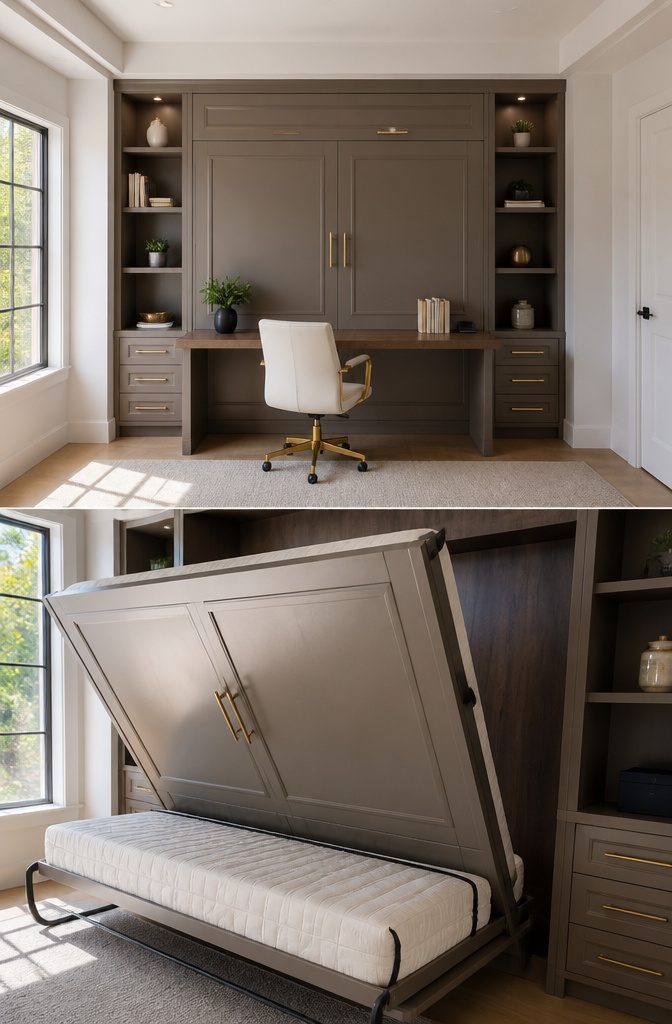
A hybrid office-guest room needs to look professional during work hours, and that is exactly what pushed Murphy desk beds into one of the fastest-growing uses after 2020.
The bed folds up behind cabinet doors or a raised panel front that reads as built-in furniture, so your video calls see millwork, not a mattress.
The desk integration matters most. Some models keep the desktop level as the bed lowers, which means you do not have to clear your laptop and papers every time guests arrive.
That hinge system is the detail that separates a functional office from a storage room with a desk in it. Cable management gets tricky because the desk panel moves; anything hard-wired to the wall has to flex or detach cleanly.
I would run power up from the floor rather than across the moving panel, and keep a small wireless hub on the desktop itself.
Ceiling height limits the vertical designs, which is why horizontal Murphy desk beds work better in some offices. The bed folds out sideways, the desk stays put, and the proportions fit rooms where a tall cabinet would feel cramped.
Task lighting belongs on the fixed side of the unit, not the moving panel, so sconces or a light bridge above the desk survive the transition intact.

1. Queen-Size Folding Hidden Murphy Bed: This Queen Murphy bed folds neatly into a sleek cabinet when not in use, instantly transforming bedrooms, home offices, or guest rooms into functional spaces. For apartments, small homes, or multi-purpose rooms, it eliminates the hassle of permanent bed placement and frees up valuable floor space for daily activities like working, exercising, or entertaining.

Transforms small spaces instantly—fold up when not in use to reclaim floor space in apartments, studios, guest rooms, and home offices without sacrificing comfort or style.

❤Space Saving Wall Bed: This Queen Size Murphy bed can be folded away into a cabinet to open up floor space in any room. A foldable wall bed is the ideal space-saving furniture for a multi-use guest room, home office, or home gym. The hide away bed is easy to use, simply pull on the handles and flip the support leg down onto the floor.
9. Murphy Bed for Guest Rooms
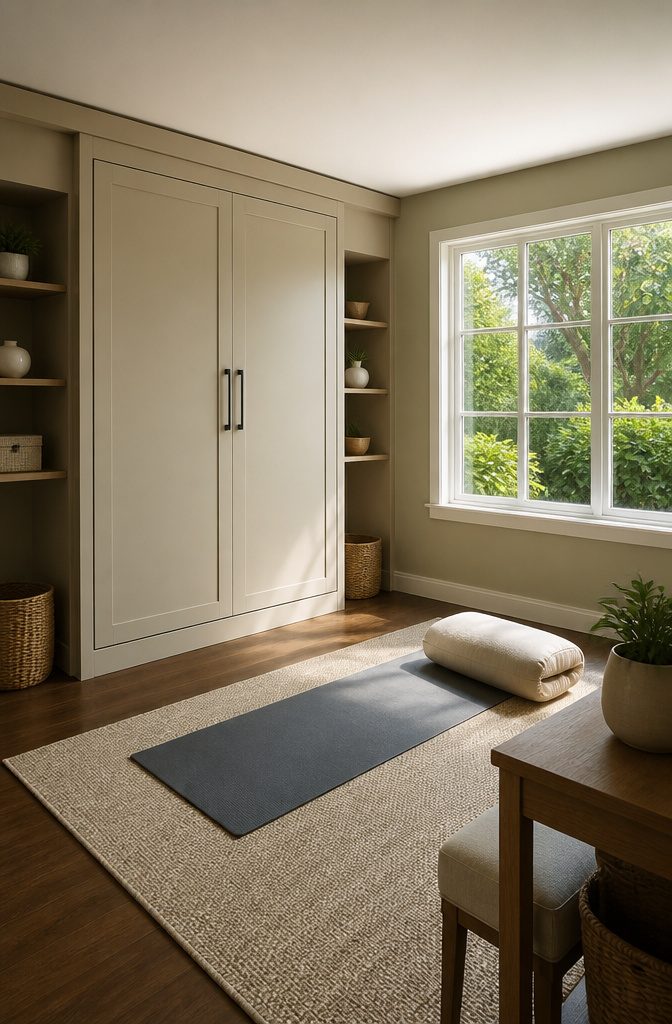
The guest room that sits empty eleven months a year is wasted square footage, and most of us figure that out after the second mortgage payment.
Mine became a yoga corner with a Murphy bed folded against the wall. When my mother visits, the mat rolls up and the bed comes down; the rest of the time, the room earns its keep.
Standard mattresses up to about 11 inches thick work with most Murphy bed hardware, and that matters more than people think.
Coil mattresses keep their structure when stored vertically; foam mattresses, especially the compressed-memory-foam bargains sold online, tend to sag and lose support on their sides.
Guests who visit twice a year can tolerate a lot, but anyone coming monthly needs real sleep quality, not the metal-bar compromise of a sofa bed.
The mechanism itself dictates the thickness limit, so the measurement to check is the clearance between the closed bed face and the wall, not just what looks good in the showroom.

Space-Saving: Perfect for compact living, this murphy wall bed is folding from wardrobe to bed in seconds. Fold it up to free floor space and keep your room open and clutter-free. Ideal for small apartments, bedrooms, guest rooms, and home offices

Farmhouse Style Murphy Bed: Our farmhouse full size Murphy bed features a unique wood grain finish metal trim and convenient handles. Wall Murphy bed full size combines farmhouse style and modernity, adding a beautiful, elegant touch to your room, and can fit a bedroom, home office, guest room, and study room.

SPACE SAVING WALL BED DESIGN: This queen size Murphy bed folds vertically into a slim wall cabinet, reclaiming valuable floor space for your home office, workout area, or living room. Transform any room from a functional workspace by day into a comfortable bedroom by night.
10. Murphy Bed with Integrated Storage
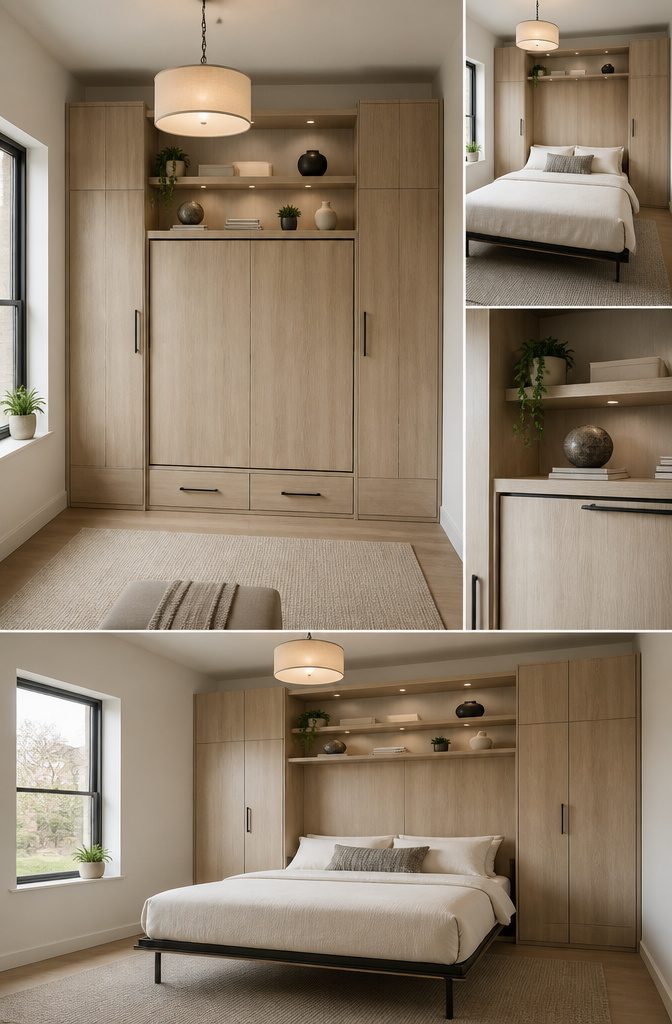
The real win with a Murphy bed built around storage is that it replaces the dresser you no longer have room for.
Wardrobe towers flanking the bed frame hold clothing and linens without eating extra wall space, while drawers tucked beneath the mattress keep essentials reachable but out of sight.
Floating shelves above the unit add display area for books or a few plants, which matters in tight quarters where every surface already has a job.
Finishes run from painted MDF to hardwood veneers, so the unit can read as basic built-in or something closer to furniture you would have chosen anyway.
Lighting integration is increasingly common: task lighting near a fold-down desk area, sconces positioned for bedtime reading, or a light bridge spanning the upper cabinet.
These additions add cost and wiring complexity, but they also mean you are not stringing extension cords across a room that barely fits the bed unfolded.
My own preference leans toward keeping the storage symmetrical if the wall allows it.
Two matching towers balance the visual weight when the bed is closed, and they give a guest room the feel of an intentional bedroom rather than a storage unit that happens to sleep someone.

TIME TESTED: Our kits have stood the test of time for over 35 years. If you’re going to build a high-quality murphy bed, you want it to last a lifetime. American-made steel, labor, and support are behind each kit.

TIME TESTED: Our kits have stood the test of time for over 35 years. If you’re going to build a high-quality murphy bed, you want it to last a lifetime. American-made steel, labor, and support are behind each kit.

【SUPERIOR REBOUND FORCE】- One person can freely fold out or up the bed. Inside 5 premium springs, high rebound strength to ensure the whole process.
What Makes a Murphy Bed Comfortable
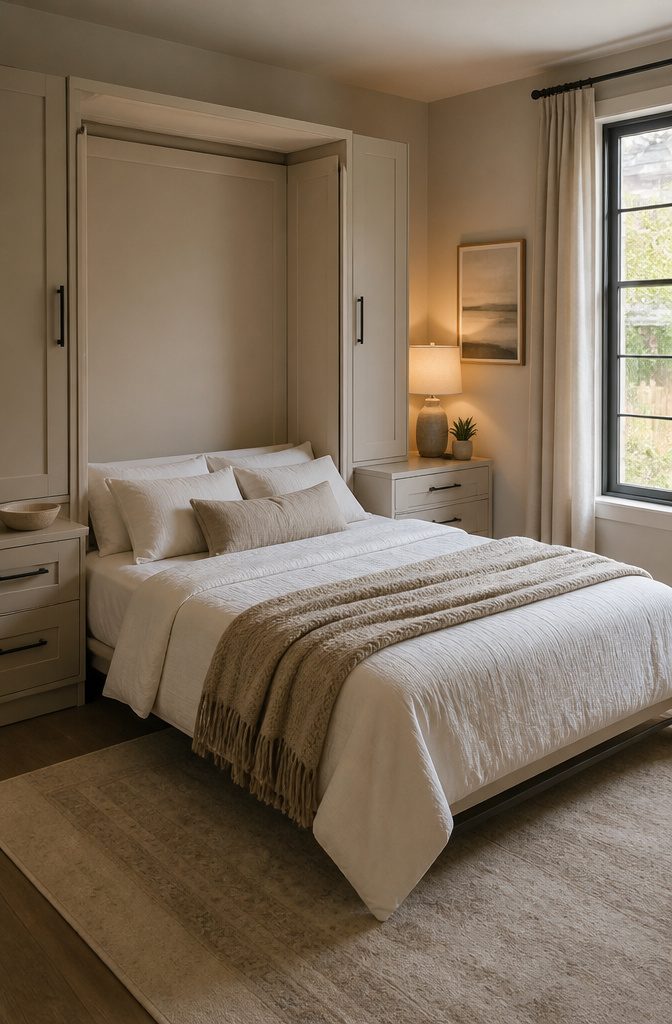
A modern Murphy bed frame accepts mattresses up to 12 inches thick, with 10 inches being the standard most manufacturers design around.
That thickness includes your bedding, which is where the comfort question gets practical: a standard comforter and a couple of pillows fold in cleanly, but an extra-thick down comforter or a collection of decorative pillows will need separate storage or the cabinet won’t close flush.
Most Murphy beds can accommodate a mattress up to 12 inches thick, while the standard Murphy bed mattress is 10 inches… a mattress of this size will easily fold into the bed’s frame, along with most bedding and pillows.
— Dwell
For the mattress itself, coil springs hold their structure when stored upright inside a closed cabinet.
Foam mattresses, including the compressed-shipped bargains that dominate online marketplaces, tend to sag and shift over months of vertical storage. Their layered construction simply isn’t built for that orientation.
The mechanism quality determines whether daily use stays smooth or becomes a struggle. Solid hardwood frames paired with premium hardware prevent the sagging and shifting that cheapen the experience over time.
What convinced me, reading through the details, was that many homeowners now use Murphy beds as their primary bed — not just a guest compromise — which only works when the lift system is rated for repeated daily operation.
Space-Saving Math
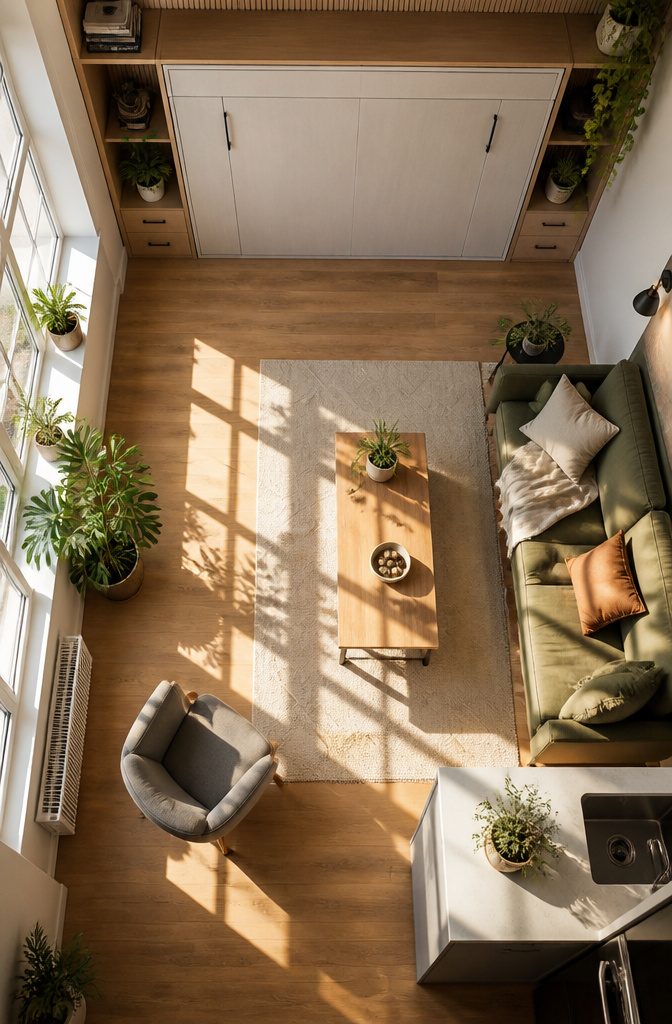
A queen Murphy bed tucked upright frees roughly 35–40 square feet of floor, the same footprint you’d need for a desk and chair or a yoga mat laid corner to corner.
In a 400-square-foot studio, that’s nearly a tenth of your total area coming back to you each morning.
The real shift is functional, not just spatial. Wall beds let one room serve as bedroom at night and office, craft space, or workout area by day.
Sources note that even rooms under 120 square feet gain enough breathing room for a dresser, small desk, or extra seating once the bed folds away.
For renters in 500-square-foot units who can’t knock down walls, this is the closest thing to adding a room without a lease violation.
Vertical mounting on the shortest wall opens the longest stretch of usable floor, which matters when every inch counts.
DIY or Buy
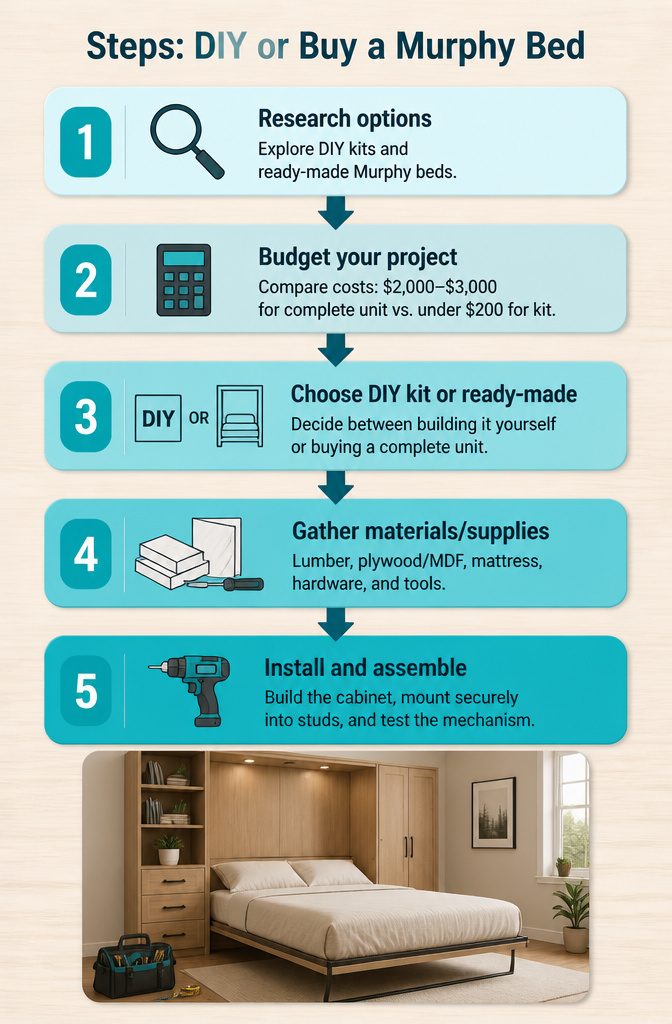
A complete Murphy bed unit from Wayfair, AllModern, or Hayneedle typically lands between $2,000 and $3,000, sometimes more once you add lighting, storage, or surrounding cabinetry.
That figure includes the frame, the mechanism, the finished exterior, and often delivery. What it does not include is your mattress, which most retailers sell separately or leave to you.
The alternative is a DIY kit running under $200.
The kit ships you the pivot hardware, the lift mechanism, and the building plans. The lumber, the plywood or MDF for the cabinet, the mattress, and every tool needed stay on your shopping list.
Lori Wall Beds is one name that sells this way, and the savings are real because you are doing the cutting, joining, and finishing yourself.
That gap, roughly $1,800, buys you precision engineering and factory warranty on one side, and on the other side it buys you the chance to mismatch something critical.
Solid hardwood tolerates the stress of a bed pivoting against a wall far better than MDF or plywood, and the anchoring into studs has to be exact.
A bed that drops wrong because the frame twisted or the wall mount missed a stud is not a weekend oops; it is a safety problem.
The kits work for someone with a table saw, a stud finder, and the patience to level a heavy frame perfectly. Without those, the complete unit is the less expensive mistake.
Mechanism Quality
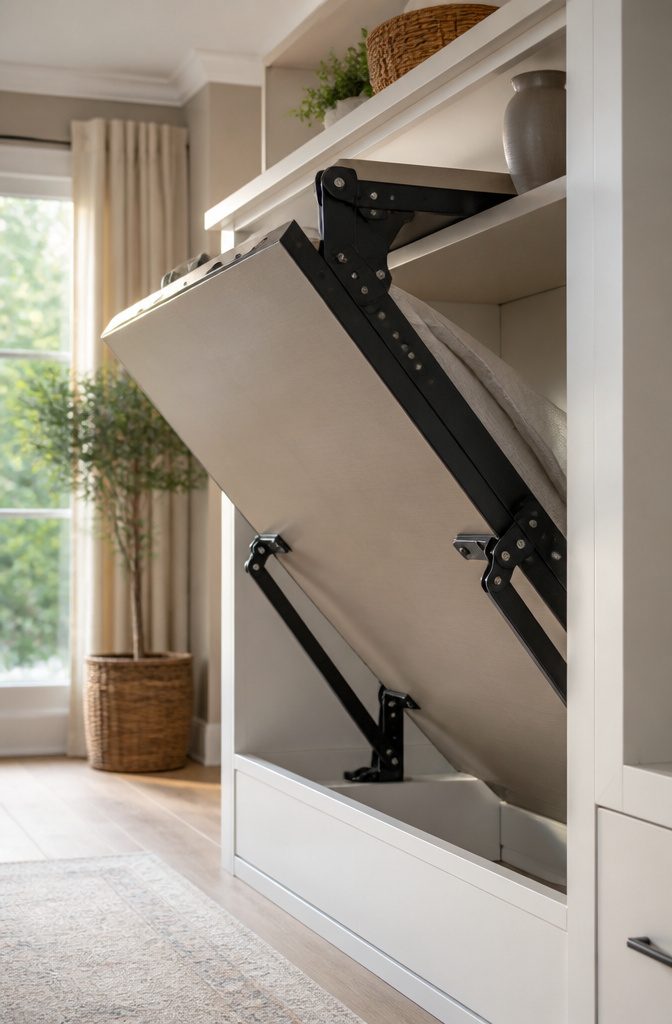
A friend’s install last year taught me what separates a wall bed you actually use from one that stays shut out of spite.
The hinge on his kit was stiff enough that folding the frame required two hands and a foot planted against the cabinet. After a month, the bed stayed down permanently, which defeats the whole point.
The mechanism needs to be rated for the combined weight of the frame plus your mattress, not just the frame the manufacturer ships.
Cheap units cut corners with undersprung hardware that feels fine in the showroom with a thin demo pad, then groan under a real mattress.
Sagging or shifting over months is the tell in reviews; look for complaints about the bed creeping open or needing muscle to lock upright.
One-handed operation is the test. A well-balanced spring or piston system lets you pull the bed down and guide it back with a single hand while the other steadies the mattress.
Anything less means the hardware is fighting you, and that fight gets old fast. Solid hardwood frames paired with quality hardware hold up to daily use without the looseness that turns a guest bed into a storage nuisance.
Frequently Asked Questions
Are Murphy beds good for small spaces?
Yes. A queen Murphy bed tucked upright frees roughly 35–40 square feet of floor, which you can use for a desk, yoga mat, or seating.
Even rooms under 120 square feet gain enough breathing room for a dresser or small desk once the bed folds away.
What is the best room to install a Murphy bed in?
Any room that needs to do double duty: home offices, guest rooms, living rooms, studios, or even larger bedrooms.
The best location is where floor area is limited but versatility matters most, since a well-designed Murphy bed makes the room feel larger without sacrificing comfort.
How do I choose the right Murphy bed design?
Start with your room’s purpose and ceiling height. Vertical beds need 8 feet of clearance and work best in narrow, tall rooms; horizontal beds fit sloped or low ceilings but eat more wall width.
Match finishes to existing furniture so the closed unit reads as built-in storage rather than a hidden bed.
Can a Murphy bed work in a home office?
Yes. A Murphy bed is one of the best upgrades for a hybrid home office, keeping the room professional during video calls and converting to a guest room at night.
Desk-bed integrations that keep the desktop level as the bed lowers mean you do not have to clear your laptop and papers every time guests arrive.